Ware Megan, O'Connor Patrick, Bub Kristen, Backus Deborah, McCully Kevin
Department of Epidemiology and Cancer Control, St. Jude Children's Research Hospital, Memphis, TN, USA.
Department of Kinesiology, College of Education, University of Georgia, Athens, GA, USA.
Health Psychol Behav Med. 2022 Aug 18;10(1):786-805. doi: 10.1080/21642850.2022.2112197. eCollection 2022.
This study is a secondary analysis of data from a mixed methods exploration of fatigue in people with multiple sclerosis (MS), a chronic autoimmune disease affecting the central nervous system. During initial analysis, worry emerged during discussions of the fatigue experience. The purpose of this study is to explore worry in relationship to exercise and physical activity behavior.
Mixed methods were used to address the research question. 55 people with MS provided demographic and survey data (habitual physical activity, body perception, functioning). 35 participated in semi-structured interviews on the topics of fatigue, body sensations, emotions, and their effects on physical activity. Qualitative data were analyzed utilizing constructivist grounded theory. Quantitative data were analyzed utilizing multiple regression.
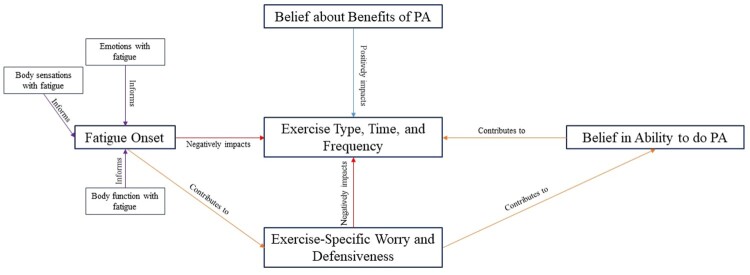
Qualitative theory described participants' thoughts and experiences regarding the consequences of fatigue during activity, and how they appear to influence subsequent actions. Worry played a critical role in thought processes regarding physical activity. Aspects of body perception were weak quantitative predictors of physical activity behavior after control of physical functionality.
The most significant finding of this study was the description and dialogue about worry as a factor that shapes perceptions of the benefits and value of exercise and physical activity. Physical activity practitioners could benefit from seeking to understand physical-activity-related worry when examining physical activity behavior and designing programming.
本研究是对多发性硬化症(MS)患者疲劳状况进行混合方法探索所得数据的二次分析。多发性硬化症是一种影响中枢神经系统的慢性自身免疫性疾病。在初步分析过程中,疲劳体验讨论中出现了担忧情绪。本研究旨在探讨担忧与运动及身体活动行为之间的关系。
采用混合方法来解决研究问题。55名多发性硬化症患者提供了人口统计学和调查数据(习惯性身体活动、身体感知、功能状况)。35人参与了关于疲劳、身体感觉、情绪及其对身体活动影响等主题的半结构化访谈。定性数据采用建构主义扎根理论进行分析。定量数据采用多元回归进行分析。
定性理论描述了参与者关于活动期间疲劳后果的想法和经历,以及这些想法和经历似乎如何影响后续行动。担忧在关于身体活动的思维过程中起着关键作用。在控制身体功能后,身体感知方面是身体活动行为的较弱定量预测指标。
本研究最显著的发现是对担忧作为塑造运动和身体活动益处及价值认知的一个因素进行了描述和探讨。身体活动从业者在研究身体活动行为和设计项目时,若能设法理解与身体活动相关的担忧,可能会从中受益。