Vitte Lisa, Hauguel Cyriaque, Benoit Vincent, Genet Marie-Camille, Letot Jessica, Bruel Henri, Delaunay Florian, Le Roux Pascal, Gerardin Priscille, Devouche Emmanuel, Apter Gisèle
Hospital Group Du Havre, Le Havre, France.
Laboratoire de Psychopathologie et Processus de Santé, Université Paris Descartes, Paris, France.
Front Psychiatry. 2022 Aug 9;13:889557. doi: 10.3389/fpsyt.2022.889557. eCollection 2022.
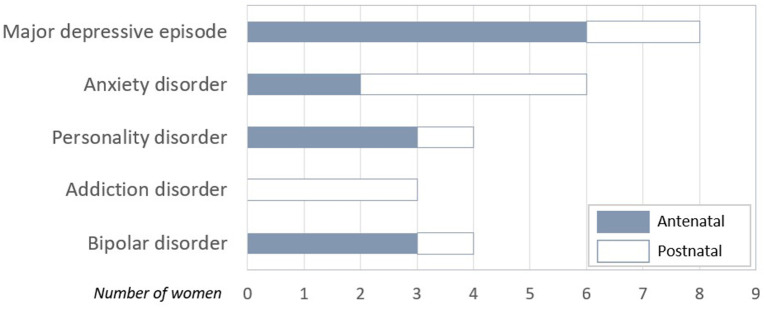
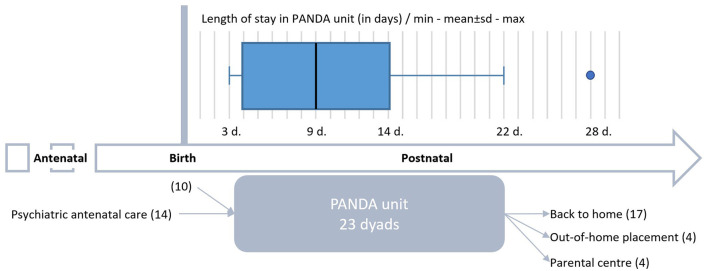
The PANDA unit is a full-time mother-baby hospitalization unit based on an original model of care for vulnerable dyads. It is located within a neonatal unit allowing tripartite care (perinatal psychiatry, neonatology and post-natal care). It thus differs from traditional mother-baby units in its close links with the other perinatal care actors, allowing comprehensive health and mental health care in the immediate post-partum period. Patients admitted to the Panda Unit may have been referred during the antenatal period or taken into care in an emergency if the mother's clinical condition requires it, in the aftermath of childbirth. During their stay, the dyads are evaluated daily by a perinatal psychiatrist. This includes assessment of maternal clinical state, the newborn's development and the quality of mother-infant interactions. During the first 6 months of use, 24 dyads have benefited from PANDA care. Three women among 5 were admitted during the antenatal period and almost one-third were aged under 21. The first primary diagnosis during the antepartum was major depressive disorder, two-fold that of personality disorder or bipolar disorder alone. At the end of PANDA stay, close to 3 women among 4 were back to their home with their child, and an out-of-home placement was mandated for 4 infants. PANDA unit is a step toward continuous and comprehensive integrative care. The mother and baby do not leave the maternity ward, and management of mother, baby, and their interactions can start immediately after birth. Considering the importance of the first months of life in the establishment of fundamental links and bonding, PANDA offers an innovative opportunity for what we hope will be both therapeutic and preventive for at-risk dyads. The detection, and ultimately prevention and management of risk of abuse and neglect is another major challenge that this unit hopes to address from the very beginning.
熊猫单元是一个全日制母婴住院单元,基于针对脆弱母婴对的原始护理模式。它位于新生儿单元内,提供三方护理(围产期精神病学、新生儿学和产后护理)。因此,它与传统的母婴单元不同,它与其他围产期护理人员联系紧密,能在产后即刻提供全面的健康和心理健康护理。入住熊猫单元的患者可能在孕期就已被转诊,或者如果母亲的临床状况需要,在分娩后会作为紧急情况接受护理。在住院期间,母婴对每天由围产期精神病医生进行评估。这包括对母亲临床状态、新生儿发育以及母婴互动质量的评估。在使用的前6个月,有24对母婴受益于熊猫护理。5名女性中有3名在孕期入院,近三分之一年龄在21岁以下。产前的首要诊断是重度抑郁症,是人格障碍或双相情感障碍单独发病率的两倍。在熊猫单元住院结束时,4名女性中有近3名带着孩子回家,4名婴儿被安排了院外安置。熊猫单元是迈向持续和全面综合护理的一步。母婴不离产房,对母亲、婴儿及其互动的管理在出生后即可立即开始。考虑到生命最初几个月在建立基本联系和情感纽带方面的重要性,熊猫单元为我们希望对高危母婴对具有治疗和预防作用的护理提供了一个创新机会。对虐待和忽视风险的检测,以及最终的预防和管理,是该单元希望从一开始就应对的另一项重大挑战。