Institute of Psychology, University of Bern, Bern, Switzerland.
J Sleep Res. 2023 Feb;32(1):e13719. doi: 10.1111/jsr.13719. Epub 2022 Aug 26.
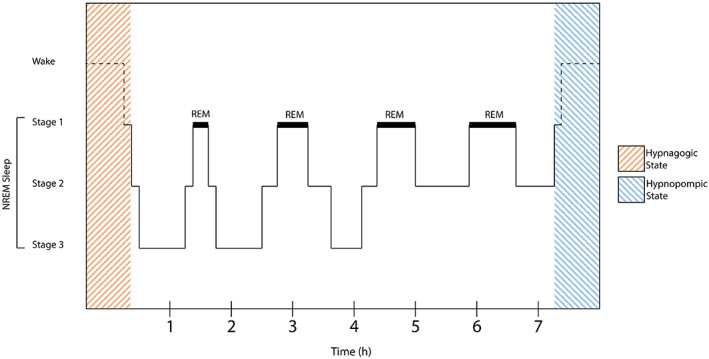
The hypnagogic state refers to a transitional stage between wakefulness and sleep, in which sensory perceptions can be experienced. In this review, we compile and discuss the recent scientific literature on hypnagogia research regarding the future directions proposed by Schacter (1976; Psychological Bulletin, 83, 452). After a short introduction discussing the terminology used in hypnagogia research and the differentiation of hypnagogic states with other related phenomena, we review the reported prevalence of hypnagogic states. Then, we evaluate the six future directions suggested by Schacter and we propose three further future directions. First, a better understanding of the emotional quality of hypnagogic states is needed. Second, a better understanding of why hypnagogic states occur so frequently in the visual and kinaesthetic modalities is needed. Lastly, a better understanding of the purpose of hypnagogic states is needed. In conclusion, research has made great progress in recent years, and we are one step closer to demystifying the hypnagogic state.
催眠状态是指清醒和睡眠之间的过渡阶段,在此期间可以体验到感官知觉。在这篇综述中,我们汇编并讨论了关于 Schacter(1976;《心理公报》,83,452)提出的未来方向的催眠研究的最新科学文献。在简短介绍了催眠研究中使用的术语以及催眠状态与其他相关现象的区别之后,我们回顾了报告的催眠状态的流行程度。然后,我们评估了 Schacter 提出的六个未来方向,并提出了三个进一步的未来方向。首先,需要更好地了解催眠状态的情绪质量。其次,需要更好地了解为什么催眠状态在视觉和动觉模态中如此频繁地发生。最后,需要更好地了解催眠状态的目的。总之,近年来研究取得了很大进展,我们离揭开催眠状态的神秘面纱又近了一步。