Department of Psychology, University of Groningen, Grote Kruisstraat 2/1, 9712TS, Groningen, The Netherlands.
Behav Res Methods. 2023 Sep;55(6):3055-3077. doi: 10.3758/s13428-022-01957-7. Epub 2022 Aug 26.
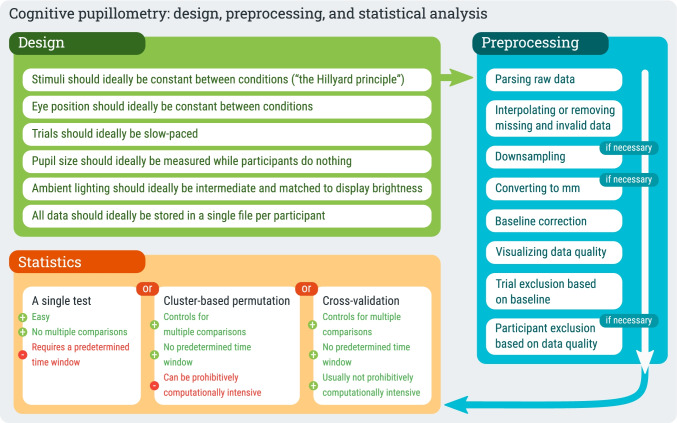
Cognitive pupillometry is the measurement of pupil size to investigate cognitive processes such as attention, mental effort, working memory, and many others. Currently, there is no commonly agreed-upon methodology for conducting cognitive-pupillometry experiments, and approaches vary widely between research groups and even between different experiments from the same group. This lack of consensus makes it difficult to know which factors to consider when conducting a cognitive-pupillometry experiment. Here we provide a comprehensive, hands-on guide to methods in cognitive pupillometry, with a focus on trial-based experiments in which the measure of interest is the task-evoked pupil response to a stimulus. We cover all methodological aspects of cognitive pupillometry: experimental design, preprocessing of pupil-size data, and statistical techniques to deal with multiple comparisons when testing pupil-size data. In addition, we provide code and toolboxes (in Python) for preprocessing and statistical analysis, and we illustrate all aspects of the proposed workflow through an example experiment and example scripts.
认知瞳孔测量学是通过测量瞳孔大小来研究认知过程,如注意力、心理努力、工作记忆等。目前,还没有一种普遍认可的认知瞳孔测量学实验方法,研究小组之间甚至同一小组不同实验之间的方法差异很大。这种缺乏共识使得在进行认知瞳孔测量实验时,很难知道应该考虑哪些因素。在这里,我们提供了一个全面的、实用的认知瞳孔测量方法指南,重点是基于试验的实验,其中感兴趣的度量是对刺激的任务诱发瞳孔反应。我们涵盖了认知瞳孔测量学的所有方法学方面:实验设计、瞳孔大小数据的预处理以及在测试瞳孔大小数据时处理多重比较的统计技术。此外,我们还提供了预处理和统计分析的代码和工具箱(在 Python 中),并通过一个示例实验和示例脚本说明了所提出工作流程的各个方面。