Institut de Recherche en Infectiologie de Montpellier (IRIM), Université de Montpellier, CNRS UMR9004, Montpellier, France.
Department of Physics and Astronomy, Center for Cell and Genome Sciences, University of Utah, Salt Lake City, UT, USA.
Sci Rep. 2022 Aug 27;12(1):14651. doi: 10.1038/s41598-022-18681-z.
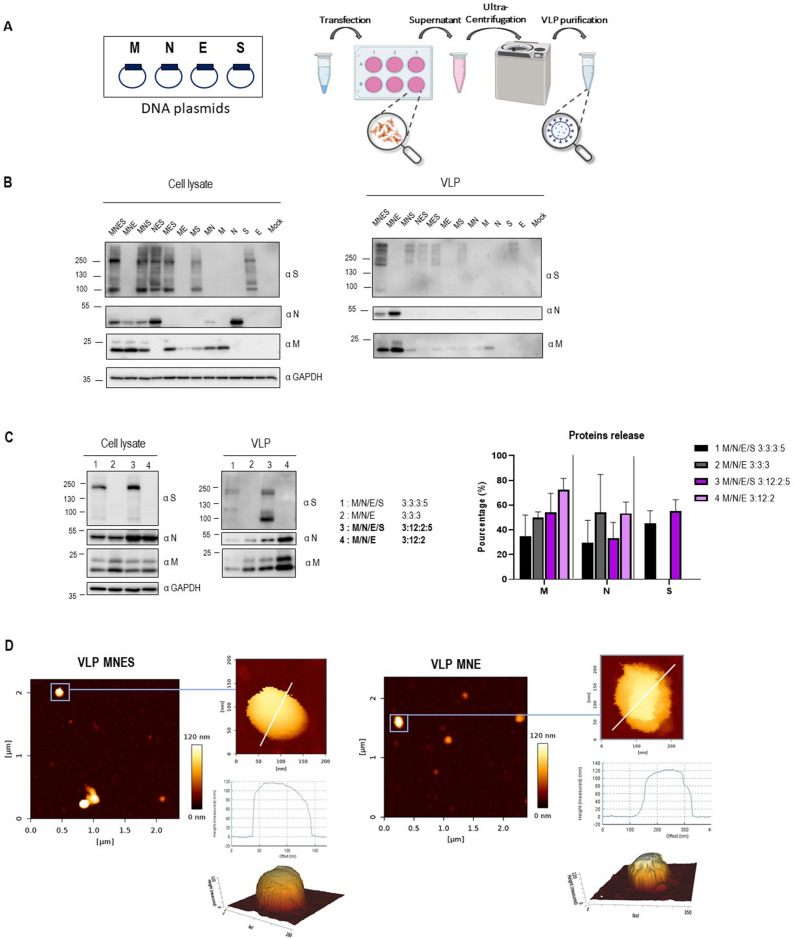
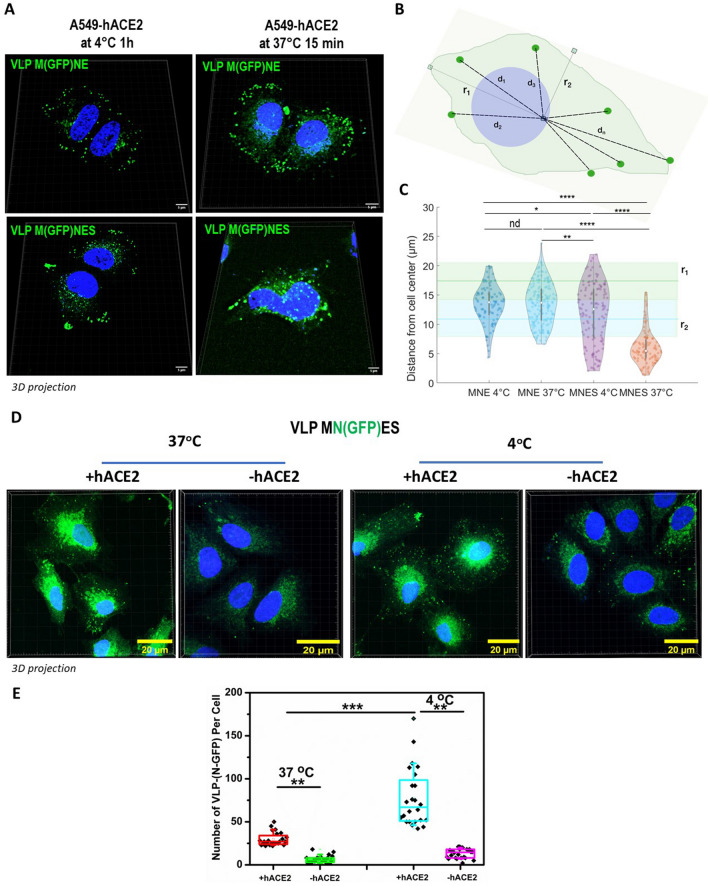
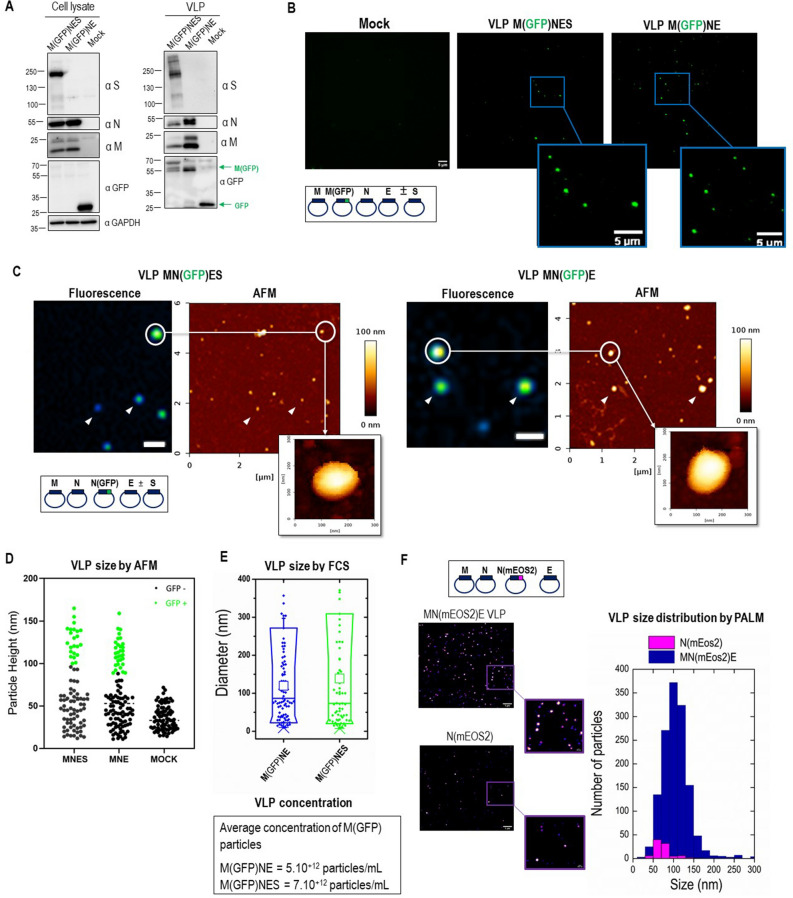
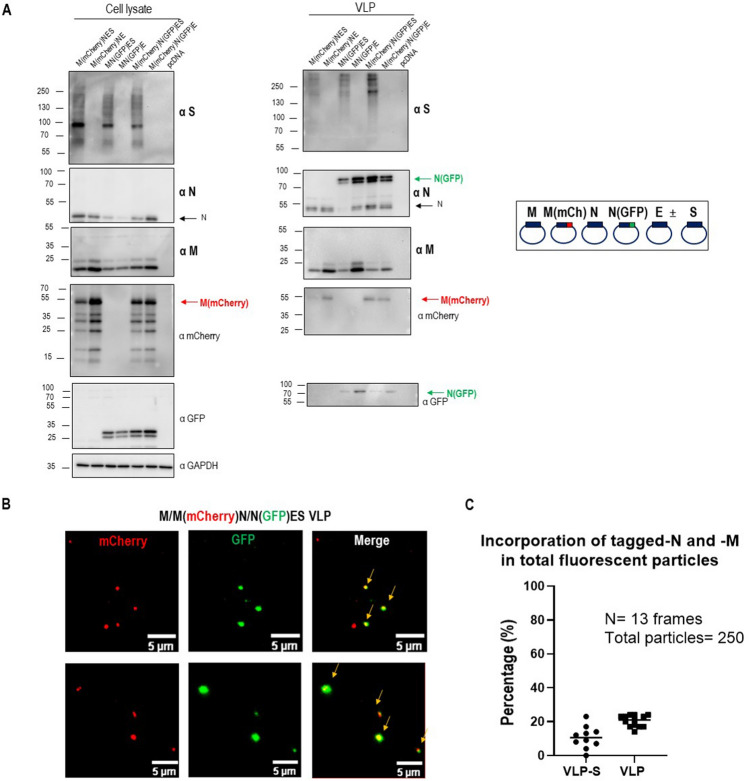
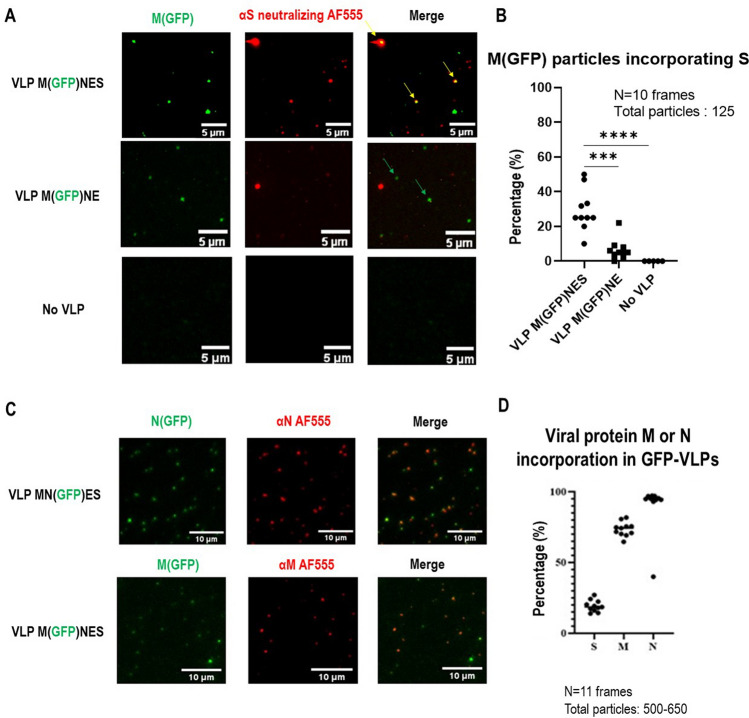
SARS-CoV-2 is an RNA enveloped virus responsible for the COVID-19 pandemic that conducted in 6 million deaths worldwide so far. SARS-CoV-2 particles are mainly composed of the 4 main structural proteins M, N, E and S to form 100 nm diameter viral particles. Based on productive assays, we propose an optimal transfected plasmid ratio mimicking the viral RNA ratio in infected cells. This allows SARS-CoV-2 Virus-Like Particle (VLPs) formation composed of the viral structural proteins M, N, E and mature S. Furthermore, fluorescent or photoconvertible VLPs were generated by adding a fluorescent protein tag on N or M mixing with unlabeled viral proteins and characterized by western blots, atomic force microscopy coupled to fluorescence and immuno-spotting. Thanks to live fluorescence and super-resolution microscopies, we quantified VLPs size and concentration. SARS-CoV-2 VLPs present a diameter of 110 and 140 nm respectively for MNE-VLPs and MNES-VLPs with a concentration of 10e12 VLP/ml. In this condition, we were able to establish the incorporation of the Spike in the fluorescent VLPs. Finally, the Spike functionality was assessed by monitoring fluorescent MNES-VLPs docking and internalization in human pulmonary cells expressing or not the receptor hACE2. Results show a preferential maturation of S on N(GFP) labeled VLPs and an hACE2-dependent VLP internalization and a potential fusion in host cells. This work provides new insights on the use of non-fluorescent and fluorescent VLPs to study and visualize the SARS-CoV-2 viral life cycle in a safe environment (BSL-2 instead of BSL-3). Moreover, optimized SARS-CoV-2 VLP production can be further adapted to vaccine design strategies.
SARS-CoV-2 是一种 RNA 包膜病毒,负责导致目前全球已导致 600 万人死亡的 COVID-19 大流行。SARS-CoV-2 颗粒主要由 4 种主要结构蛋白 M、N、E 和 S 组成,形成直径为 100nm 的病毒颗粒。基于生产性测定,我们提出了一种最佳转染质粒比例,模拟感染细胞中的病毒 RNA 比例。这使得能够形成由病毒结构蛋白 M、N、E 和成熟 S 组成的 SARS-CoV-2 病毒样颗粒 (VLPs)。此外,通过在 N 或 M 上添加荧光蛋白标签并与未标记的病毒蛋白混合,生成荧光或光转化的 VLPs,并通过 Western blot、原子力显微镜结合荧光和免疫斑点法进行表征。借助活荧光和超分辨率显微镜,我们定量了 VLPs 的大小和浓度。SARS-CoV-2 VLPs 的 MNE-VLPs 和 MNES-VLPs 的直径分别为 110nm 和 140nm,浓度为 10e12 VLP/ml。在这种情况下,我们能够确定 Spike 掺入荧光 VLPs 中。最后,通过监测表达或不表达受体 hACE2 的人肺细胞中荧光 MNES-VLPs 的对接和内化,评估了 Spike 的功能。结果表明,S 在标记有 GFP 的 N 上优先成熟,并且 VLPs 内化和宿主细胞中的潜在融合依赖于 hACE2。这项工作为使用非荧光和荧光 VLPs 提供了新的见解,以便在安全环境(BSL-2 而不是 BSL-3)中研究和可视化 SARS-CoV-2 病毒生命周期。此外,优化的 SARS-CoV-2 VLP 生产可以进一步适应疫苗设计策略。