Institute of Allergology, Charité - Universitätsmedizin Berlin, Corporate Member of Freie Universität Berlin and Humboldt-Universität zu Berlin, Berlin, Germany.
Fraunhofer Institute for Translational Medicine and Pharmacology (ITMP), Allergology and Immunology, Berlin, Germany.
Front Immunol. 2022 Aug 10;13:930979. doi: 10.3389/fimmu.2022.930979. eCollection 2022.
In mycosis fungoides (MF), the most common cutaneous T-cell lymphoma, itch is a frequent clinical symptom. Whether mast cells (MCs), eosinophils (Eos) or their mediators play a role in MF-associated itch or disease severity is controversially discussed. Here, we explored the role of MC and Eo numbers in the skin as well as blood levels of their mediators in disease severity and itch.
In 10 patients with MF and 10 matched control subjects we assessed disease severity, itch, and quality of life impairment using dedicated tools such as the mSWAT, ItchyQoL and DLQI. We analyzed skin biopsies and measured serum levels of tryptase, a mast cell mediator, as well as of the eosinophil products eosinophil cationic protein (ECP) and major basic protein (MBP).
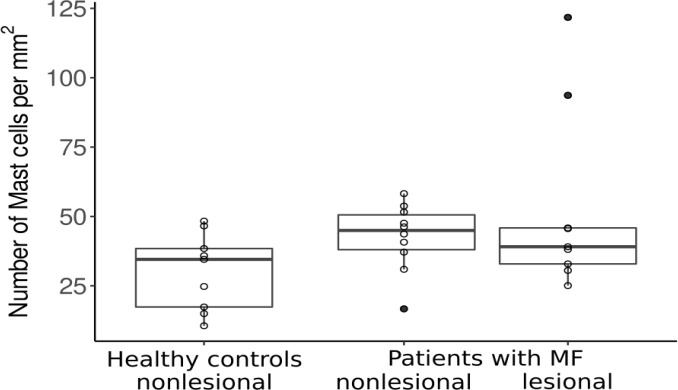
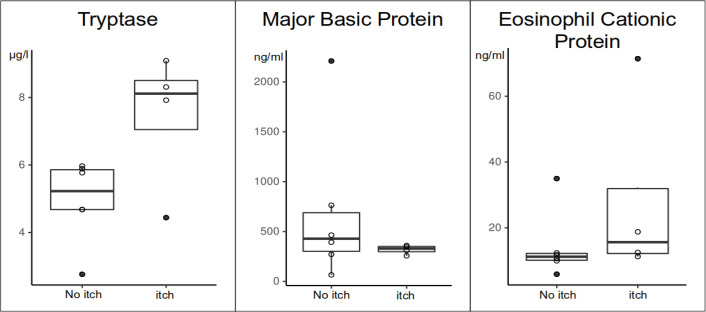
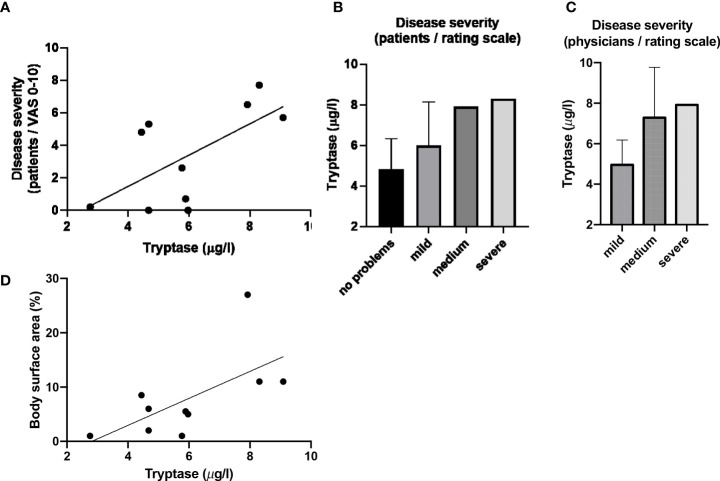
The presence of chronic itch, in four of 10 patients, was associated with significantly higher disease severity (mSwat), larger body surface area affected, and stronger QoL impairment (Itchy-Qol, DLQI). Serum levels of tryptase, but not ECP and MBP, were linked with patient-reported disease severity, body surface area affected, and the presence of itch. Three of the four patients with chronic itch, but none of the six patients without, had tryptase levels above >6µg/l. Numbers of MCs in the papillary dermis were higher in MF skin lesions then in non-lesional skin of MF patients and skin of healthy controls.
The MC-mediator tryptase, in MF, is linked to disease activity and impact, most prominently to itch. Our findings call for larger studies that explore the role of MCs, tryptase and other MC mediators as drivers of itch and their role in MF pathogenesis.
蕈样肉芽肿(MF)是最常见的皮肤 T 细胞淋巴瘤,瘙痒是其常见的临床症状。肥大细胞(MC)、嗜酸性粒细胞(Eos)或其介质是否在 MF 相关瘙痒或疾病严重程度中起作用,目前存在争议。在此,我们探讨了 MC 和 Eo 数量在皮肤中的作用以及其介质在疾病严重程度和瘙痒中的血液水平。
我们评估了 10 例 MF 患者和 10 例匹配对照者的疾病严重程度、瘙痒和生活质量受损情况,使用专门的工具,如 mSWAT、ItchyQoL 和 DLQI。我们分析了皮肤活检,并测量了血清中肥大细胞介质类胰蛋白酶的水平,以及嗜酸性粒细胞产物嗜酸性粒细胞阳离子蛋白(ECP)和主要碱性蛋白(MBP)的水平。
10 例患者中有 4 例存在慢性瘙痒,其疾病严重程度(mSwat)更高,受影响的体表面积更大,生活质量受损更严重(Itchy-Qol、DLQI)。类胰蛋白酶的血清水平与患者报告的疾病严重程度、受影响的体表面积以及瘙痒的存在相关,但 ECP 和 MBP 的血清水平与这些因素无关。在 4 例慢性瘙痒的患者中,有 3 例类胰蛋白酶水平>6µg/l,但在 6 例无瘙痒的患者中无一例如此。MF 皮损中的 MC 数量高于 MF 患者非皮损皮肤和健康对照者的皮肤。
在 MF 中,MC 介质类胰蛋白酶与疾病活动和影响相关,最显著的是与瘙痒相关。我们的发现呼吁进行更大规模的研究,以探索 MC、类胰蛋白酶和其他 MC 介质作为瘙痒驱动因素及其在 MF 发病机制中的作用。