Institute of Allergology, Charité - Universitätsmedizin Berlin, Corporate Member of Freie Universität Berlin and Humboldt-Universität Zu Berlin, Berlin, Germany.
Allergology and Immunology, Fraunhofer Institute for Translational Medicine and Pharmacology ITMP, Berlin, Germany.
Clin Exp Med. 2024 Jul 28;24(1):171. doi: 10.1007/s10238-024-01407-y.
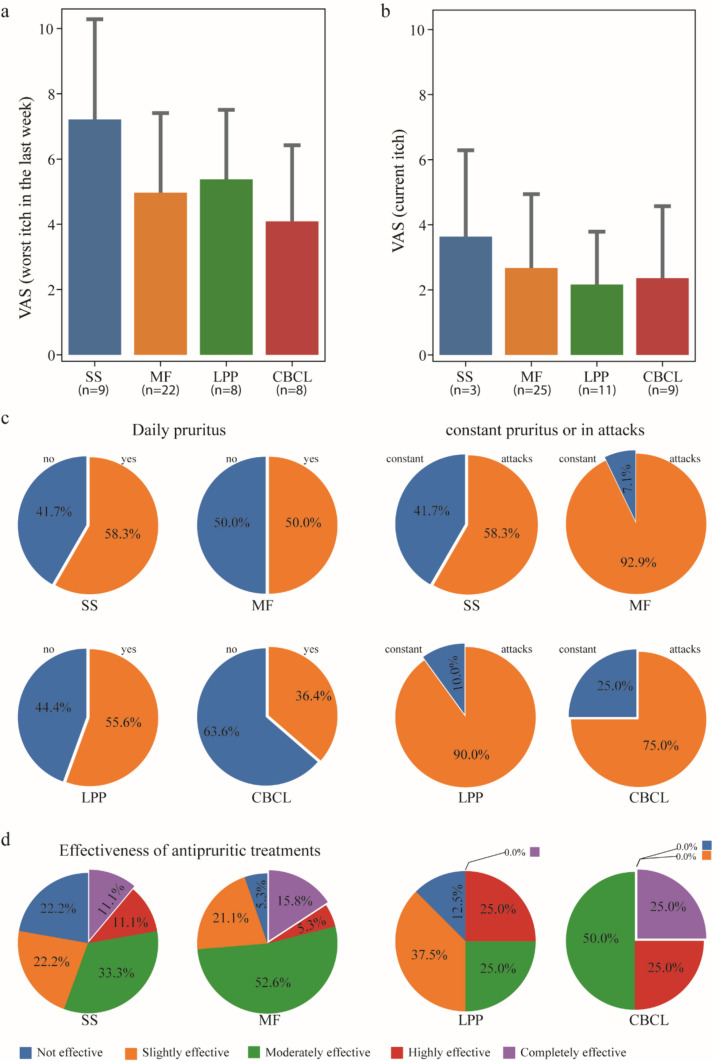
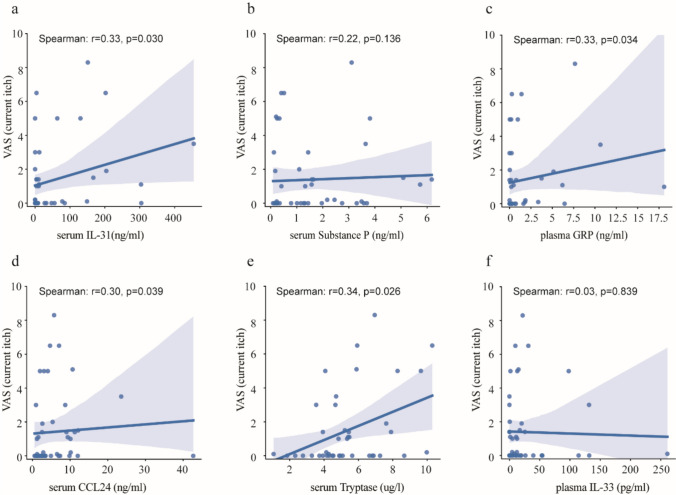
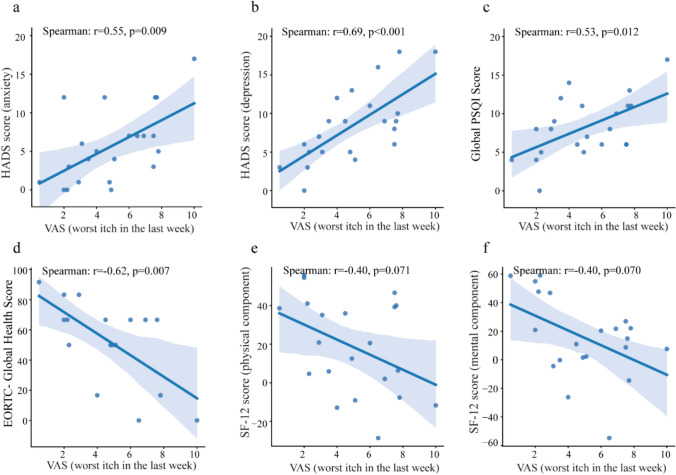
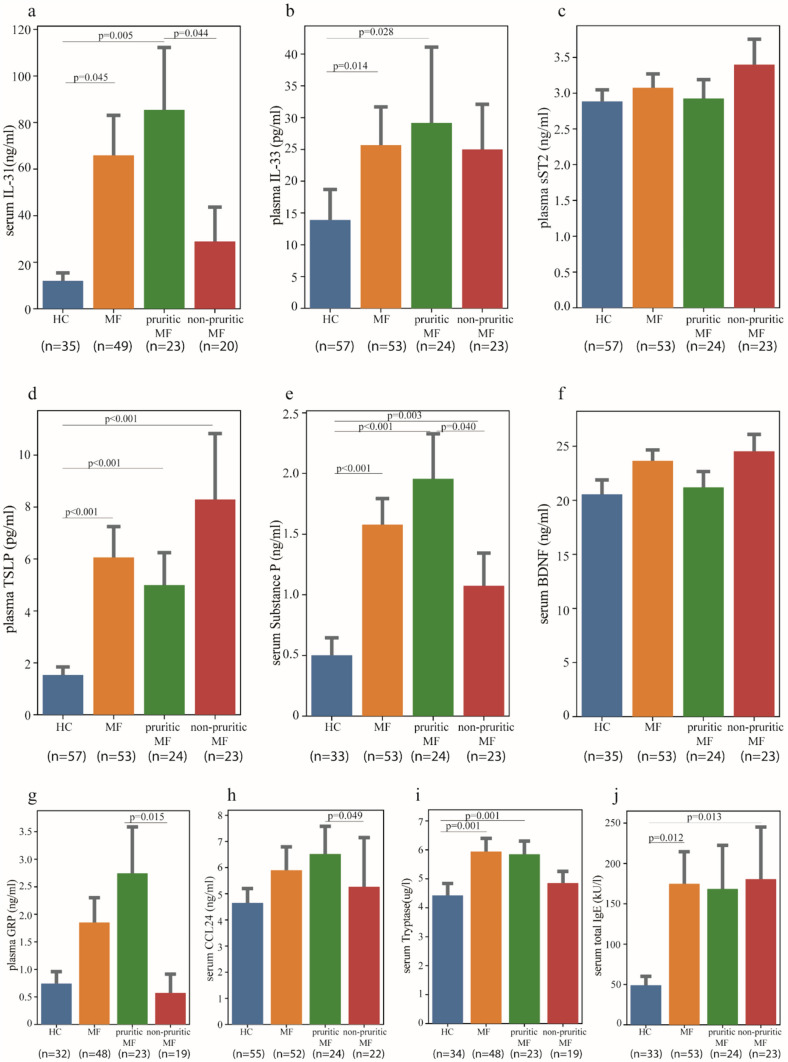
Patients with primary cutaneous T-cell lymphoma (CTCL) often experience severe and difficult-to-treat pruritus that negatively affects their quality of life (QoL). However, the mechanisms of pruritus in CTCL, including mycosis fungoides (MF), remain largely unknown, and detailed characteristics of CTCL-associated pruritus is not fully elucidated. To characterize pruritus in CTCL, cutaneous B-cell lymphoma (CBCL), and large plaque parapsoriasis (LPP), and to identify potential itch mediators involved in the pathogenesis of pruritus in CTCL patients. Clinical data and blood samples were collected from 129 healthy subjects and 142 patients. Itch intensity, QoL impairment, psychological distress, and sleep quality were assessed using validated questionnaires and instruments. Blood levels of BDNF, CCL24, GRP, IL-31, IL-33, sST2, substance P, TSLP, tryptase and total IgE were measured using ELISA or ImmunoCAP. Pruritus was prevalent in CTCL, LPP and CBCL patients, with higher prevalence and severity observed in CTCL. In CTCL, pruritus correlated with significant impairment in QoL, sleep, psychological distress. Compared to healthy controls, elevated levels of IL-31, IL-33, substance P, total IgE, tryptase, and TSLP were found in MF patients. A comparison of MF patients with and without pruritus revealed higher levels of IL-31, substance P, GRP, and CCL24 in the former. Itch intensity positively correlated with IL-31, GRP, CCL24, and tryptase levels. Pruritus significantly burdens CTCL patients, necessitating appropriate therapeutic management. Our findings suggest that various non-histaminergic mediators such as tryptase and IL-31 could be explored as novel therapeutic targets for managing pruritus in MF patients.
原发性皮肤 T 细胞淋巴瘤(CTCL)患者常经历严重且难以治疗的瘙痒,这对其生活质量(QoL)产生负面影响。然而,CTCL 瘙痒的机制,包括蕈样肉芽肿(MF),仍在很大程度上未知,并且 CTCL 相关瘙痒的详细特征尚未完全阐明。为了描绘 CTCL、皮肤 B 细胞淋巴瘤(CBCL)和大斑块副银屑病(LPP)中的瘙痒,并确定参与 CTCL 患者瘙痒发病机制的潜在瘙痒介质。收集了 129 名健康受试者和 142 名患者的临床数据和血液样本。使用经过验证的问卷和仪器评估瘙痒强度、QoL 受损、心理困扰和睡眠质量。使用 ELISA 或 ImmunoCAP 测量 BDNF、CCL24、GRP、IL-31、IL-33、sST2、P 物质、TSLP、类胰蛋白酶和总 IgE 的血液水平。CTCL、LPP 和 CBCL 患者均存在瘙痒,CTCL 患者的瘙痒发生率和严重程度更高。在 CTCL 中,瘙痒与 QoL、睡眠、心理困扰的显著受损相关。与健康对照组相比,MF 患者中发现 IL-31、IL-33、P 物质、总 IgE、类胰蛋白酶和 TSLP 水平升高。MF 患者有或无瘙痒的比较显示,前者中 IL-31、P 物质、GRP 和 CCL24 水平更高。瘙痒强度与 IL-31、GRP、CCL24 和类胰蛋白酶水平呈正相关。瘙痒显著影响 CTCL 患者的生活,需要进行适当的治疗管理。我们的研究结果表明,各种非组胺能介质,如类胰蛋白酶和 IL-31,可能被探索作为 MF 患者瘙痒管理的新型治疗靶点。