Doucet Marie-Hélène, Delamou Alexandre, Manet Hawa, Groleau Danielle
Division of Social and Transcultural Psychiatry, McGill University, Montreal, QC Canada.
Centre National de Formation et de Recherche en Santé Rurale de Mafèrinyah, Université Gamal Abdel Nasser de Conakry, Conakry, Republic of Guinea.
Sex Cult. 2022;26(5):1858-1884. doi: 10.1007/s12119-022-09975-5. Epub 2022 May 11.
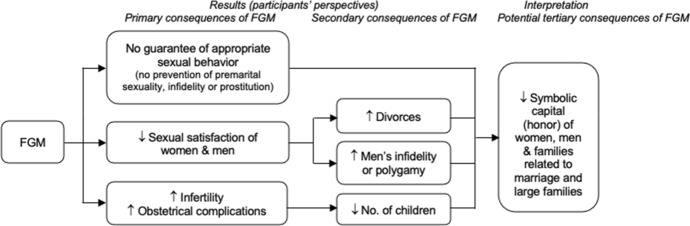
Female genital mutilation (FGM) is justified by sociocultural arguments, including that it guarantees girls'/women's appropriate sexual behavior, thus preserving family honor. We explored the perspectives of Guineans who do not practice FGM ("positive deviants"), as well as of Guineans who still practice FGM but who are supportive of abandoning the practice ("reluctant adherents"). We conducted a "focused ethnographic" study in Conakry, Guinea with a sample of 58 people. Individual semi-structured interviews were undertaken to explore the views and experiences of 18 women and 12 men of different generations who abandoned the practice of FGM. Group interviews with an additional 16 women and 12 men (half of whom were "positive deviants" and the other half "reluctant adherents") validated and enriched the data. Participants consider that FGM has deleterious consequences as it: (1) does not prevent girls or married women from being sexually active outside of marriage; (2) may impair couples' sexual satisfaction, and thus lead to divorce, men's infidelity or polygamy; and (3) may reduce women's ability to have multiple children, because of the increased risk of infertility or obstetric complications. In addition, participants reported that many Guineans fear that the promotion of FGM abandonment is a Western plot to eradicate their culture. We conclude that Guineans who practice and do not practice FGM share the same cultural values about the importance of culturally appropriate sexual behavior, being married, and having many children, which are central sources of honor (symbolic capital) to women and their families. They, however, have opposing views on how to achieve these objectives. Based on our participants' perspectives, the harmful consequences of FGM can potentially sabotage these sources of honor. Recommendations for messages aimed at promoting FGM abandonment are discussed.
女性生殖器切割(FGM)基于社会文化理由被合理化,包括它能保证女孩/妇女有适当的性行为,从而维护家庭荣誉。我们探究了不实行女性生殖器切割的几内亚人(“积极偏差者”)以及仍实行女性生殖器切割但支持摒弃这种做法的几内亚人(“不情愿的从业者”)的观点。我们在几内亚科纳克里进行了一项“聚焦人种志”研究,样本为58人。对18名放弃女性生殖器切割做法的不同年龄段女性和12名男性进行了个人半结构化访谈,以探究他们的观点和经历。对另外16名女性和12名男性(其中一半是“积极偏差者”,另一半是“不情愿的从业者”)进行的小组访谈验证并丰富了数据。参与者认为女性生殖器切割有有害后果,因为它:(1)不能阻止女孩或已婚妇女在婚外进行性活动;(2)可能损害夫妻的性满意度,从而导致离婚、男性不忠或一夫多妻制;(3)可能降低女性生育多个孩子的能力,因为不孕或产科并发症的风险增加。此外,参与者报告说,许多几内亚人担心推广摒弃女性生殖器切割是西方根除他们文化的阴谋。我们得出结论,实行和不实行女性生殖器切割的几内亚人在关于文化上适当的性行为、结婚和生育多个孩子的重要性方面有着相同的文化价值观,这些是女性及其家庭荣誉(象征资本)的核心来源。然而,他们在如何实现这些目标上存在相反的观点。基于我们参与者的观点,女性生殖器切割的有害后果可能会破坏这些荣誉来源。文中讨论了旨在推广摒弃女性生殖器切割的信息的建议。