African Coordinating Centre for Abandonment of FGM/C, University of Nairobi, Kenyatta National Hospital, P.O Box 19676-00202, Nairobi, Kenya.
Department of Community and Public Health, Technical University of Kenya, P.O Box 52426, Nairobi, Kenya.
Reprod Health. 2017 Dec 2;14(1):164. doi: 10.1186/s12978-017-0433-z.
Female genital mutilation/cutting (FGM/C) has been implicated in sexual complications among women, although there is paucity of research evidence on sexual experiences among married women who have undergone this cultural practice. The aim of this study was to investigate the sexual experiences among married women in Mauche Ward, Nakuru County.
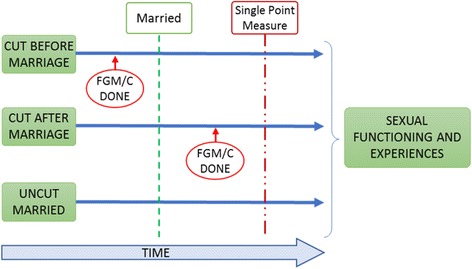
Quantitative and qualitative data collection methods were used. Quantitative data were obtained from 318 married women selected through multistage sampling. The women were categorized into: cut before marriage, cut after marriage and the uncut. A questionnaire was used to collect demographic information while psychometric data were obtained using a female sexual functioning index (FSFI) tool. The resulting quantitative data were analyzed using SPSS® Version 22. Qualitative data were obtained from five FGDs and two case narratives. The data were organized into themes, analyzed and interpreted. Ethical approval for the study was granted by Kenyatta National Hospital-University of Nairobi Ethics and Research Committee.
The mean age of the respondents was 30.59 ± 7.36 years. The majority (74.2%) had primary education and 76.1% were farmers. Age (p = 0.008), number of children (p = 0.035) and education (p = 0.038) were found to be associated with sexual functioning. The cut women reported lower sexual functioning compared to the uncut. ANOVA results show the reported overall sexual functioning to be significantly (p = 0.019) different across the three groups. Women cut after marriage (mean = 22.81 ± 4.87) scored significantly lower (p = 0.056) than the uncut (mean = 25.35 ± 3.56). However, in comparison to the cut before marriage there was no significant difference (mean = 23.99 ± 6.63). Among the sexual functioning domains, lubrication (p = 0.008), orgasm (p = 0.019) and satisfaction (p = 0.042) were significantly different across the three groups. However, desire, arousal and pain were not statistically different.
Generally, cut women had negative sexual experiences and specifically adverse changes in desire, arousal and satisfaction were experienced among cut after marriage. FGM/C mitigating strategies need to routinely provide sexual complications management to safeguard women's sexual right to pleasure subsequently improving their general well-being.
女性外阴残割/切割(FGM/C)与女性的性并发症有关,尽管关于经历过这种文化习俗的已婚女性的性体验的研究证据很少。本研究旨在调查纳库鲁县毛奇区已婚妇女的性体验。
采用定量和定性数据收集方法。通过多阶段抽样选择了 318 名已婚妇女进行定量数据收集。这些妇女被分为婚前切割、婚后切割和未切割。使用问卷收集人口统计学信息,使用女性性功能指数(FSFI)工具获取心理测量数据。使用 SPSS®版本 22 分析所得定量数据。从五个焦点小组讨论和两个案例叙述中获取定性数据。对数据进行主题组织、分析和解释。该研究获得了肯雅塔国立医院-内罗毕大学伦理和研究委员会的批准。
受访者的平均年龄为 30.59 ± 7.36 岁。大多数(74.2%)接受过小学教育,76.1%是农民。年龄(p=0.008)、孩子数量(p=0.035)和教育(p=0.038)与性功能有关。切割妇女报告的性功能低于未切割妇女。方差分析结果表明,三组之间的总体性功能报告差异具有统计学意义(p=0.019)。婚后切割的妇女(均值=22.81±4.87)的评分明显较低(p=0.056),低于未切割的妇女(均值=25.35±3.56)。然而,与婚前切割相比,没有显著差异(均值=23.99±6.63)。在性功能领域,润滑(p=0.008)、高潮(p=0.019)和满意度(p=0.042)在三组之间存在显著差异。然而,欲望、唤起和疼痛在统计学上没有差异。
一般来说,切割妇女有负面的性体验,特别是婚后切割的妇女经历了欲望、唤起和满意度的明显变化。女性外阴残割/切割缓解策略需要常规提供性并发症管理,以保障妇女享受性愉悦的权利,进而提高她们的整体幸福感。