• 文献检索
  • 文档翻译
  • 深度研究
  • 学术资讯
  • Suppr Zotero 插件Zotero 插件
  • 邀请有礼
  • 套餐&价格
  • 历史记录
应用&插件
Suppr Zotero 插件Zotero 插件浏览器插件Mac 客户端Windows 客户端微信小程序
定价
高级版会员购买积分包购买API积分包
服务
文献检索文档翻译深度研究API 文档MCP 服务
关于我们
关于 Suppr公司介绍联系我们用户协议隐私条款
关注我们

Suppr 超能文献

核心技术专利:CN118964589B侵权必究
粤ICP备2023148730 号-1Suppr @ 2026

文献检索

告别复杂PubMed语法,用中文像聊天一样搜索,搜遍4000万医学文献。AI智能推荐,让科研检索更轻松。

立即免费搜索

文件翻译

保留排版,准确专业,支持PDF/Word/PPT等文件格式,支持 12+语言互译。

免费翻译文档

深度研究

AI帮你快速写综述,25分钟生成高质量综述,智能提取关键信息,辅助科研写作。

立即免费体验

智能手机应用程序对抑郁症患者的疗效:一项系统评价。

Efficacy of Smartphone Apps in Patients With Depressive Disorders: A Systematic Review.

作者信息

Hernández-Gómez Alba, Valdés-Florido María José, Lahera Guillermo, Andrade-González Nelson

机构信息

Department of Personality, Assessment and Clinical Psychology, Complutense University of Madrid, Madrid, Spain.

Psychiatry Service, University Hospital of Gran Canaria Dr. Negrín, Las Palmas de Gran Canaria, Spain.

出版信息

Front Psychiatry. 2022 Aug 12;13:871966. doi: 10.3389/fpsyt.2022.871966. eCollection 2022.

DOI:10.3389/fpsyt.2022.871966
PMID:36032248
原文链接:https://pmc.ncbi.nlm.nih.gov/articles/PMC9411805/
Abstract

BACKGROUND

Digital interventions have become an accessible format in clinical practice to provide better support for patients with mental disorders. However, the clinical efficacy in patients with depressive disorders is not well known. We aimed to determine the efficacy of smartphone applications (apps) in patients diagnosed with a depressive disorder.

METHOD

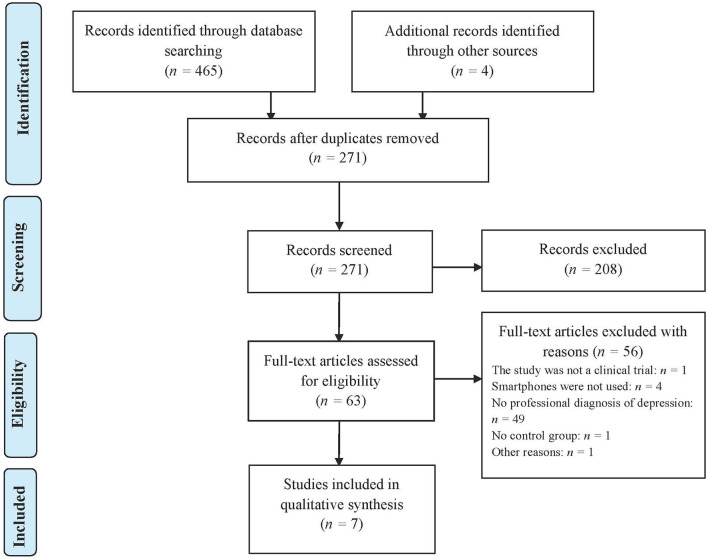
An electronic database search was performed of PubMed, PsycINFO, and Web of Science, to identify relevant articles up to June 12, 2021. Peer-reviewed articles were screened and selected based on predetermined inclusion and exclusion criteria.

RESULTS

Seven articles met the inclusion criteria and therefore were selected for the systematic review, which included a total of 651 patients. The results were heterogeneous, essentially due to the different methodologies used in the selected studies.

CONCLUSIONS

Digital smartphone-delivered interventions do not appear to reduce depressive symptomatology nor improve the quality of life in patients diagnosed with depressive disorders when compared to an active control group. Taking into account the inherent methodological difficulties and the variability among such studies, it is apparent that further research-with more methodologically refined clinical trials, including larger sample sizes-is needed.

摘要

背景

数字干预已成为临床实践中一种可获取的形式,旨在为精神障碍患者提供更好的支持。然而,其对抑郁症患者的临床疗效尚不明确。我们旨在确定智能手机应用程序(应用)对被诊断为抑郁症的患者的疗效。

方法

对PubMed、PsycINFO和科学网进行电子数据库检索,以识别截至2021年6月12日的相关文章。根据预先确定的纳入和排除标准对同行评审文章进行筛选和选择。

结果

七篇文章符合纳入标准,因此被选入系统评价,共纳入651例患者。结果存在异质性,主要是由于所选研究中使用的方法不同。

结论

与积极对照组相比,通过智能手机提供的数字干预似乎并不能减轻被诊断为抑郁症患者的抑郁症状,也不能改善其生活质量。考虑到此类研究固有的方法学困难和变异性,显然需要开展更多方法学上更精细的临床试验,包括更大样本量的进一步研究。
https://cdn.ncbi.nlm.nih.gov/pmc/blobs/4d2b/9411805/540e6345e029/fpsyt-13-871966-g0001.jpg

相似文献

1
Efficacy of Smartphone Apps in Patients With Depressive Disorders: A Systematic Review.智能手机应用程序对抑郁症患者的疗效:一项系统评价。
Front Psychiatry. 2022 Aug 12;13:871966. doi: 10.3389/fpsyt.2022.871966. eCollection 2022.
2
Smartphone and tablet self management apps for asthma.用于哮喘的智能手机和平板电脑自我管理应用程序。
Cochrane Database Syst Rev. 2013 Nov 27;2013(11):CD010013. doi: 10.1002/14651858.CD010013.pub2.
3
Asynchronous mHealth Interventions in Rheumatoid Arthritis: Systematic Scoping Review.类风湿关节炎的异步移动医疗干预措施:系统范围综述。
JMIR Mhealth Uhealth. 2020 Nov 5;8(11):e19260. doi: 10.2196/19260.
4
Digital Health Technologies for Long-term Self-management of Osteoporosis: Systematic Review and Meta-analysis.数字健康技术用于骨质疏松症的长期自我管理:系统评价和荟萃分析。
JMIR Mhealth Uhealth. 2022 Apr 21;10(4):e32557. doi: 10.2196/32557.
5
Beyond the black stump: rapid reviews of health research issues affecting regional, rural and remote Australia.超越黑木树:影响澳大利亚地区、农村和偏远地区的健康研究问题的快速综述。
Med J Aust. 2020 Dec;213 Suppl 11:S3-S32.e1. doi: 10.5694/mja2.50881.
6
Smartphone-Based Monitoring of Objective and Subjective Data in Affective Disorders: Where Are We and Where Are We Going? Systematic Review.基于智能手机的情感障碍客观和主观数据监测:我们现状如何,又将走向何方?系统评价
J Med Internet Res. 2017 Jul 24;19(7):e262. doi: 10.2196/jmir.7006.
7
Smartphone Apps to Support Coordinated Specialty Care for Prodromal and Early Course Schizophrenia Disorders: Systematic Review.支持前驱期和早期精神分裂症障碍协调专科护理的智能手机应用程序:系统评价
J Med Internet Res. 2019 Nov 12;21(11):e16393. doi: 10.2196/16393.
8
Reducing depressive symptomatology with a smartphone app: study protocol for a randomized, placebo-controlled trial.使用智能手机应用程序减轻抑郁症状:一项随机、安慰剂对照试验的研究方案。
Trials. 2017 May 12;18(1):215. doi: 10.1186/s13063-017-1960-1.
9
Dropout rates in clinical trials of smartphone apps for depressive symptoms: A systematic review and meta-analysis.智能手机应用程序治疗抑郁症状的临床试验中的脱落率:系统评价和荟萃分析。
J Affect Disord. 2020 Feb 15;263:413-419. doi: 10.1016/j.jad.2019.11.167. Epub 2019 Dec 3.
10
Systematic Review of Smartphone Apps as a mHealth Intervention to Address Substance Abuse in Adolescents and Adults.智能手机应用程序作为一种移动健康干预手段,用于解决青少年和成年人药物滥用问题的系统评价。
J Addict Nurs. 2021;32(3):180-187. doi: 10.1097/JAN.0000000000000416.

引用本文的文献

1
Digitally managing depression: A fully remote randomised attention-placebo controlled trial.数字方式管理抑郁症:一项完全远程的随机注意力安慰剂对照试验。
Digit Health. 2024 Jun 7;10:20552076241260409. doi: 10.1177/20552076241260409. eCollection 2024 Jan-Dec.
2
An umbrella review of effectiveness and efficacy trials for app-based health interventions.基于应用程序的健康干预措施有效性和功效试验的综合评价
NPJ Digit Med. 2023 Dec 16;6(1):233. doi: 10.1038/s41746-023-00981-x.

本文引用的文献

1
Mobile phone-based interventions for mental health: A systematic meta-review of 14 meta-analyses of randomized controlled trials.基于手机的心理健康干预措施:对14项随机对照试验的荟萃分析进行的系统元综述。
PLOS Digit Health. 2022;1(1). doi: 10.1371/journal.pdig.0000002. Epub 2022 Jan 18.
2
Impact of Smartphone App-Based Psychological Interventions for Reducing Depressive Symptoms in People With Depression: Systematic Literature Review and Meta-analysis of Randomized Controlled Trials.基于智能手机应用的心理干预对抑郁症患者抑郁症状的影响:系统文献回顾和随机对照试验的荟萃分析。
JMIR Mhealth Uhealth. 2022 Jan 27;10(1):e29621. doi: 10.2196/29621.
3
Global prevalence and burden of depressive and anxiety disorders in 204 countries and territories in 2020 due to the COVID-19 pandemic.
2020 年 COVID-19 大流行期间 204 个国家和地区的抑郁和焦虑障碍的全球患病率和负担。
Lancet. 2021 Nov 6;398(10312):1700-1712. doi: 10.1016/S0140-6736(21)02143-7. Epub 2021 Oct 8.
4
A therapist-guided smartphone app for major depression in young adults: A randomized clinical trial.治疗师指导的智能手机应用程序治疗青年成年人重度抑郁症:一项随机临床试验。
J Affect Disord. 2021 May 1;286:228-238. doi: 10.1016/j.jad.2021.02.007. Epub 2021 Feb 5.
5
Investigating Popular Mental Health Mobile Application Downloads and Activity During the COVID-19 Pandemic.调查新冠疫情期间热门心理健康移动应用程序的下载量和使用活跃度
Hum Factors. 2023 Feb;65(1):50-61. doi: 10.1177/0018720821998110. Epub 2021 Mar 7.
6
Smartphone apps for depression and anxiety: a systematic review and meta-analysis of techniques to increase engagement.用于治疗抑郁和焦虑的智能手机应用程序:提高参与度技术的系统评价与荟萃分析
NPJ Digit Med. 2021 Feb 11;4(1):20. doi: 10.1038/s41746-021-00386-8.
7
Effectiveness of Smartphone-Based Cognitive Behavioral Therapy Among Patients With Major Depression: Systematic Review of Health Implications.基于智能手机的认知行为疗法对重度抑郁症患者的疗效:健康影响的系统评价。
JMIR Mhealth Uhealth. 2021 Feb 10;9(2):e24703. doi: 10.2196/24703.
8
Does cognitive impairment in bipolar disorder impact on a SIMPLe app use?双相情感障碍的认知障碍是否会影响 SIMPLe 应用程序的使用?
J Affect Disord. 2021 Mar 1;282:488-494. doi: 10.1016/j.jad.2020.12.168. Epub 2020 Dec 29.
9
The effect of smartphone-based monitoring and treatment on the rate and duration of psychiatric readmission in patients with unipolar depressive disorder: The RADMIS randomized controlled trial.基于智能手机的监测和治疗对单相抑郁障碍患者精神科再入院率和再入院持续时间的影响:RADMIS 随机对照试验。
J Affect Disord. 2021 Mar 1;282:354-363. doi: 10.1016/j.jad.2020.12.141. Epub 2020 Dec 30.
10
Effectiveness of self-help mobile telephone applications (apps) for suicide prevention: A systematic review.自助式手机应用程序在预防自杀方面的有效性:一项系统评价。
Med J Islam Repub Iran. 2020 Jul 27;34:85. doi: 10.34171/mjiri.34.85. eCollection 2020.