Shim Miseon, Hwang Han-Jeong, Lee Seung-Hwan
Industry Development Institute, Korea University, Sejong, South Korea.
Department of Electronics and Information Engineering, Korea University, Sejong, South Korea.
Front Psychiatry. 2022 Aug 11;13:811766. doi: 10.3389/fpsyt.2022.811766. eCollection 2022.
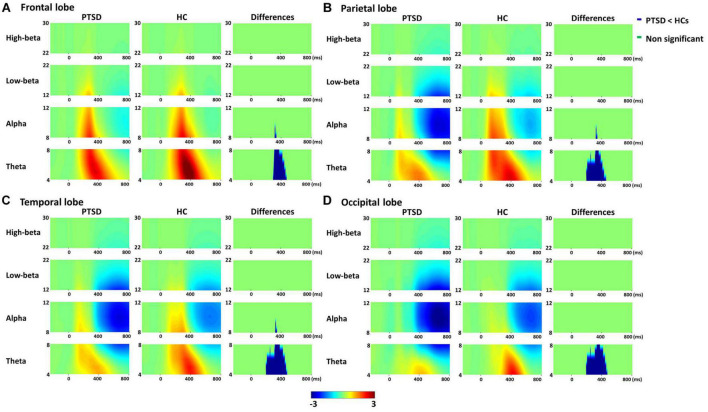
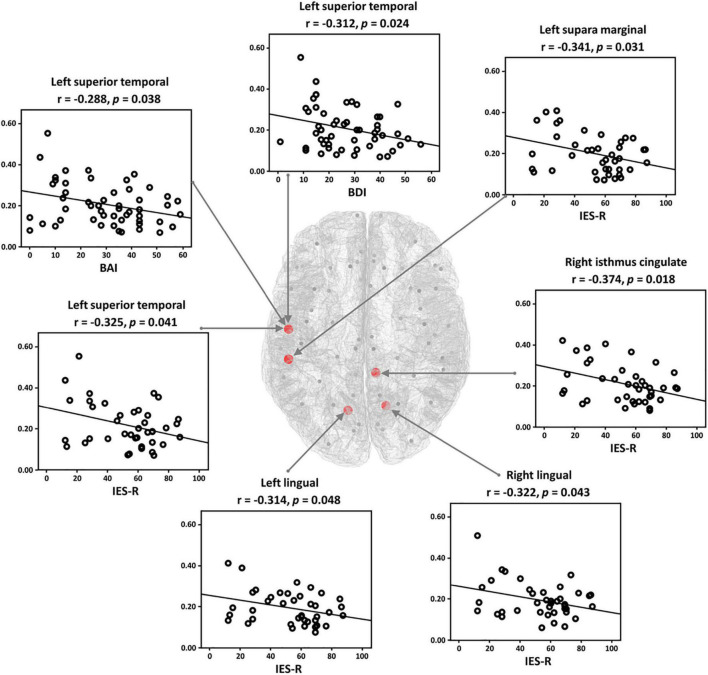
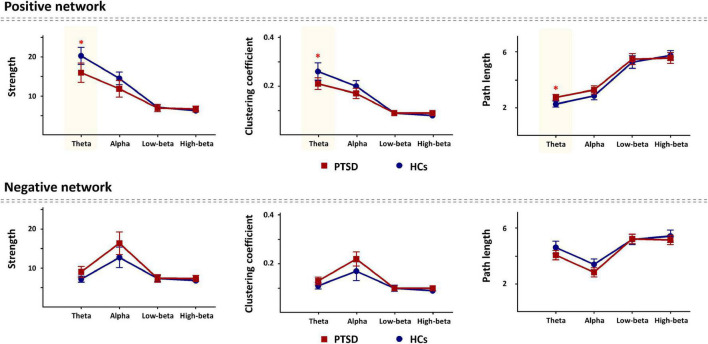
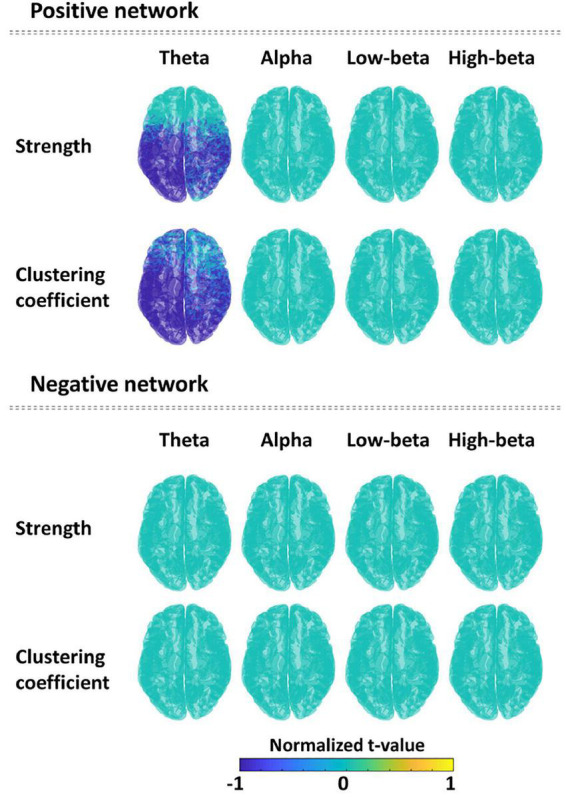
Impaired cognitive function related to intrusive memories of traumatic experiences is the most noticeable characteristic of post-traumatic stress disorder (PTSD); nevertheless, the brain mechanism involved in the cognitive processing is still elusive. To improve the understanding of the neuropathology in PTSD patients, we investigated functional cortical networks that are based on graph theory, by using electroencephalogram (EEG). EEG signals, elicited by an auditory oddball paradigm, were recorded from 53 PTSD patients and 39 healthy controls (HCs). Source signals in 68 regions of interests were estimated using EEG data for each subject using minimum-norm estimation. Then, using source signals of each subject, time-frequency analysis was conducted, and a functional connectivity matrix was constructed using the imaginary part of coherence, which was used to evaluate three global-level (strength, clustering coefficient, and path length) and two nodal-level (strength and clustering coefficients) network indices in four frequency bands (theta, alpha, low-beta, and high-beta). The relationships between the network indices and symptoms were evaluated using Pearson's correlation. Compared with HCs, PTSD patients showed significantly reduced spectral powers around P300 periods and significantly altered network indices (diminished strength and clustering coefficient, and prolonged path length) in theta frequency band. In addition, the nodal strengths and nodal clustering coefficients in theta band of PTSD patients were significantly reduced, compared with those of HCs, and the reduced nodal clustering coefficients in parieto-temporo-occipital regions had negative correlations with the symptom scores (Impact of Event Scale-Revises, Beck Depression Inventory, and Beck Anxiety Inventory). The characterization of this disrupted pattern improves the understanding of the neuropathophysiology underlying the impaired cognitive function in PTSD patients.
与创伤经历的侵入性记忆相关的认知功能受损是创伤后应激障碍(PTSD)最显著的特征;然而,参与认知加工的脑机制仍不清楚。为了更好地理解PTSD患者的神经病理学,我们通过脑电图(EEG)研究了基于图论的功能性皮质网络。由听觉oddball范式诱发的EEG信号记录于53例PTSD患者和39名健康对照者(HCs)。使用最小范数估计法,根据每个受试者的EEG数据估计68个感兴趣区域的源信号。然后,利用每个受试者的源信号进行时频分析,并使用相干虚部构建功能连接矩阵,用于评估四个频段(θ、α、低β和高β)的三个全局水平(强度、聚类系数和路径长度)和两个节点水平(强度和聚类系数)网络指标。使用Pearson相关性评估网络指标与症状之间的关系。与HCs相比,PTSD患者在P300期间周围的频谱功率显著降低,并且在θ频段的网络指标显著改变(强度和聚类系数降低,路径长度延长)。此外,与HCs相比,PTSD患者θ频段的节点强度和节点聚类系数显著降低,顶颞枕区降低的节点聚类系数与症状评分(事件影响量表修订版、贝克抑郁量表和贝克焦虑量表)呈负相关。这种破坏模式的特征有助于更好地理解PTSD患者认知功能受损背后的神经病理生理学。