Zhao Tian, Lum Julian J
Trev and Joyce Deeley Research Centre, BC Cancer, Victoria, BC, Canada.
Department of Biochemistry and Microbiology, University of Victoria, Victoria, BC, Canada.
Front Oncol. 2022 Aug 10;12:969563. doi: 10.3389/fonc.2022.969563. eCollection 2022.
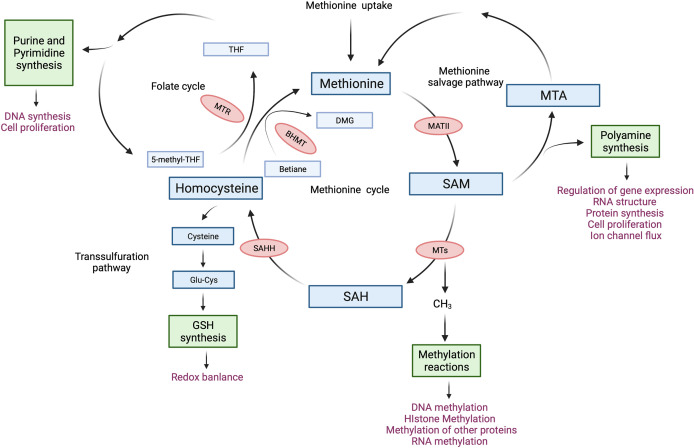
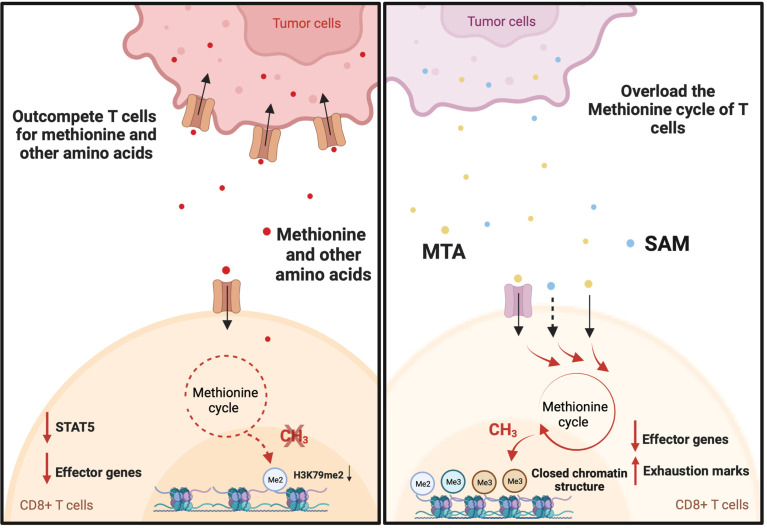
The methionine cycle comprises a series of reactions that catabolizes and regenerates methionine. This process is crucial to many cellular functions, including polyamine synthesis, DNA synthesis, redox balance, and DNA and histone methylation. In response to antigens, T cells activate the methionine cycle to support proliferation and differentiation, indicating the importance of the methionine cycle to T cell immunity. In cancer, T cells serve as important effectors of adaptive immunity by directly killing cancerous cells. However, the tumor microenvironment can induce a state of T cell exhaustion by regulating the methionine metabolism of T cells, posing a barrier to both endogenous T cell responses and T cell immunotherapy. Here we review the role of methionine cycle metabolites in regulating the activation and effector function of T cells and explore the mechanism by which tumor cells exploit the methionine pathway as a means of immune evasion. Finally, we discuss new perspectives on reprogramming the methionine cycle of T cells to enhance anti-tumor immunotherapy.
甲硫氨酸循环由一系列分解代谢并再生甲硫氨酸的反应组成。这一过程对许多细胞功能至关重要,包括多胺合成、DNA合成、氧化还原平衡以及DNA和组蛋白甲基化。响应抗原时,T细胞激活甲硫氨酸循环以支持增殖和分化,这表明甲硫氨酸循环对T细胞免疫的重要性。在癌症中,T细胞通过直接杀死癌细胞而成为适应性免疫的重要效应细胞。然而,肿瘤微环境可通过调节T细胞的甲硫氨酸代谢诱导T细胞耗竭状态,这对内源性T细胞反应和T细胞免疫疗法均构成障碍。在此,我们综述甲硫氨酸循环代谢物在调节T细胞激活和效应功能中的作用,并探讨肿瘤细胞利用甲硫氨酸途径作为免疫逃逸手段的机制。最后,我们讨论重编程T细胞甲硫氨酸循环以增强抗肿瘤免疫疗法的新观点。