Algehyne Ebrahem A, Alrihieli Haifaa F, Bilal Muhammad, Saeed Anwar, Weera Wajaree
Department of Mathematics, Faculty of Science, University of Tabuk, P.O. Box 741, Tabuk71491, Saudi Arabia.
Nanotechnology Research Unit (NRU), University of Tabuk, Tabuk71491, Saudi Arabia.
ACS Omega. 2022 Aug 11;7(33):29380-29390. doi: 10.1021/acsomega.2c03634. eCollection 2022 Aug 23.
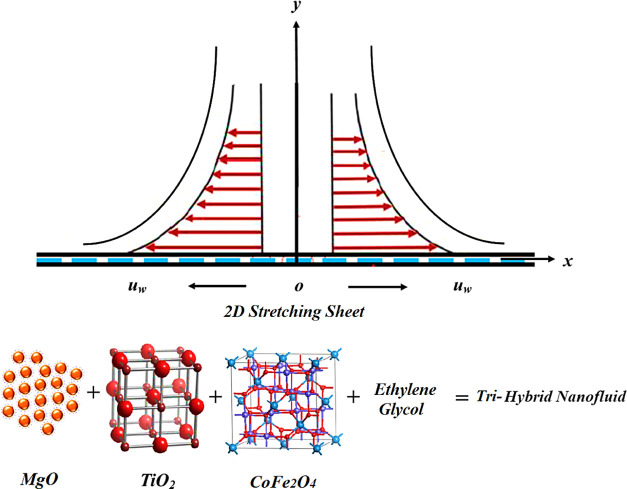
In the current study, the pseudoplastic model is used to analyze the mass and energy transmission through trihybrid nanofluid flow across a stretched permeable surface. The Darcy-Forchheimer relation is employed in the momentum equation to examine the influence of porosity. Energy and mass diffusion expressions are obtained by employing the double diffusion theories, which were proposed by Cattaneo and Christov and is broadly used by several researchers. The thermal efficiency of the trihybrid nanocrystals is evaluated by integrating them with a pseudoplastic substrate. The study of titanium dioxide (TiO), cobalt ferrite (CoFeO), and magnesium oxide (MgO) nanocomposite base hybrid nanofluids across a stretchable sheet is receiving considerable interest in innovation and research due to their extensive spectrum of applicability. For this reason, the phenomena are modeled in the form of a system of PDEs with the effects of a heat source, magnetic field, natural convection, and chemical reaction. Through resemblance substitutions, these are reduced to an ODE system. The resultant first-order differential equations are further processed using the computational approach PCM. For authenticity and reliability, the values are reviewed against the existing literature. The findings are displayed through figures. When compared to the simple nanofluid, the hybrid and trihybrid nanofluid have a greater tendency for fluid energy and velocity propagation rate. The velocity and heat transition rate enhance 11.73% by varying nanoparticles' values from 0.01 to 0.04, while the thermal conductivity of base fluid boosts with the addition of hybrid and trihybrid nanocomposites, up to 32% and 61%, respectively.
在当前的研究中,采用假塑性模型来分析三元混合纳米流体流过拉伸渗透表面时的质量和能量传递。动量方程中采用达西 - 福希海默关系来研究孔隙率的影响。通过采用由卡塔尼奥和克里斯托夫提出并被多位研究人员广泛使用的双扩散理论,得到了能量和质量扩散表达式。通过将三元混合纳米晶体与假塑性基底相结合来评估其热效率。由于其广泛的适用性,对二氧化钛(TiO)、钴铁氧体(CoFeO)和氧化镁(MgO)纳米复合基混合纳米流体在可拉伸薄板上的研究在创新和研究方面受到了相当大的关注。因此,以具有热源、磁场、自然对流和化学反应影响的偏微分方程组的形式对这些现象进行建模。通过相似变换,将其简化为一个常微分方程组。使用计算方法PCM对所得的一阶微分方程进行进一步处理。为了保证真实性和可靠性,将这些值与现有文献进行了对比。研究结果通过图表展示。与简单纳米流体相比,混合纳米流体和三元混合纳米流体具有更大的流体能量和速度传播速率趋势。通过将纳米颗粒的值从0.01变化到0.04,速度和热传递速率提高了11.73%,而基础流体的热导率随着混合和三元混合纳米复合材料的添加而提高,分别高达32%和61%。