Ewbank Ana Carolina, Fuentes-Castillo Danny, Sacristán Carlos, Esposito Fernanda, Fuga Bruna, Cardoso Brenda, Godoy Silvia Neri, Zamana Roberta Ramblas, Gattamorta Marco Aurélio, Catão-Dias José Luiz, Lincopan Nilton
Laboratory of Wildlife Comparative Pathology, Department of Pathology, School of Veterinary Medicine and Animal Sciences, University of São Paulo, São Paulo, Brazil.
Departamento de Patología y Medicina Preventiva, Facultad de Ciencias Veterinarias, Universidad de Concepción, Chillán, Chile.
Front Microbiol. 2022 Aug 11;13:940600. doi: 10.3389/fmicb.2022.940600. eCollection 2022.
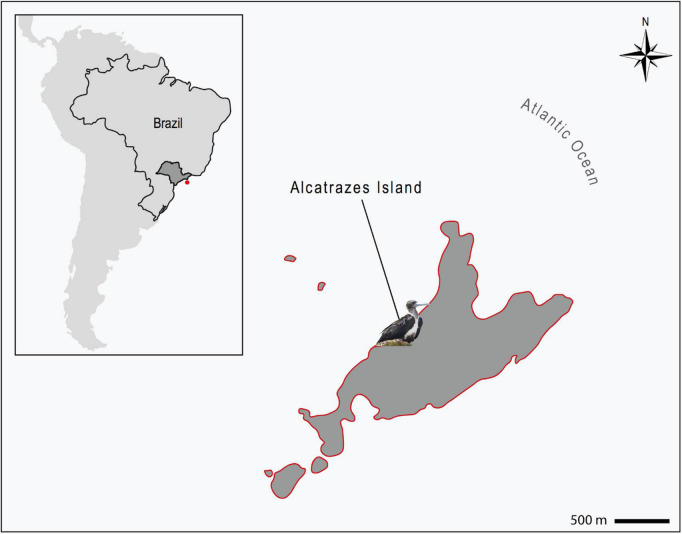
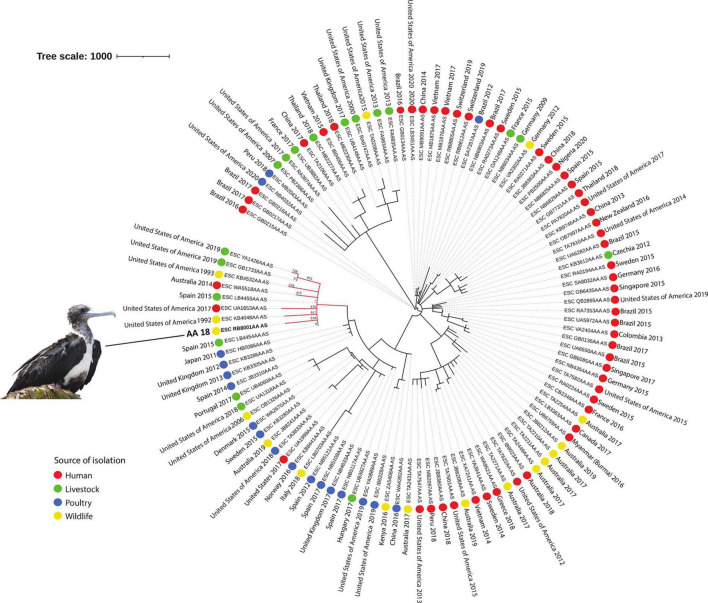
Antimicrobial resistance is an ancient natural phenomenon increasingly pressured by anthropogenic activities. has been used as markers of environmental contamination and human-related activity. Seabirds may be bioindicators of clinically relevant bacterial pathogens and their antimicrobial resistance genes, including extended-spectrum-beta-lactamase (ESBL) and/or plasmid-encoded AmpC (pAmpC), in anthropized and remote areas. We evaluated cloacal swabs of 20 wild magnificent frigatebirds () of the Alcatrazes Archipelago, the biggest breeding colony of magnificent frigatebirds in the southern Atlantic and a natural protected area with no history of human occupation, located in the anthropized southeastern Brazilian coast. We characterized a highly virulent multidrug-resistant ST648 (O153:H9) pandemic clone, harboring , , and , and virulence genes characteristic of avian pathogenic (APEC) (, and ) and other extraintestinal (ExPEC) (, and ). To our knowledge, this is the first report of ST648 co-producing ESBL and pAmpC in wild birds inhabiting insular environments. We suggest this potentially zoonotic and pathogenic lineage was likely acquired through indirect anthropogenic contamination of the marine environment, ingestion of contaminated seafood, or by intra and/or interspecific contact. Our findings reinforce the role of wild birds as anthropization sentinels in insular environments and the importance of wildlife surveillance studies on pathogens of critical priority classified by the World Health Organization.
抗菌耐药性是一种古老的自然现象,正日益受到人为活动的压力。已被用作环境污染和人类相关活动的标志物。海鸟可能是临床相关细菌病原体及其抗菌耐药基因的生物指示物,包括超广谱β-内酰胺酶(ESBL)和/或质粒编码的AmpC(pAmpC),存在于受人类影响的地区和偏远地区。我们评估了阿尔卡特拉兹群岛20只野生大军舰鸟的泄殖腔拭子,该群岛是南大西洋最大的大军舰鸟繁殖地,也是一个没有人类居住历史的自然保护区,位于受人类影响的巴西东南海岸。我们鉴定出一个高毒力的多重耐药ST648(O153:H9)大流行克隆,携带、、和,以及禽致病性大肠杆菌(APEC)(、和)和其他肠道外致病性大肠杆菌(ExPEC)(、和)的毒力基因。据我们所知,这是在栖息于岛屿环境的野生鸟类中首次报道ST648同时产生ESBL和pAmpC。我们认为,这种潜在的人畜共患病和致病谱系可能是通过海洋环境的间接人为污染、摄入受污染的海鲜或通过种内和/或种间接触获得的。我们的研究结果强化了野生鸟类作为岛屿环境中人类影响哨兵的作用,以及对世界卫生组织分类的关键优先病原体进行野生动物监测研究的重要性。