Deng Yunyan, Wang Kui, Hu Zhangxi, Hu Qiang, Tang Ying Zhong
CAS Key Laboratory of Marine Ecology and Environmental Sciences, Institute of Oceanology, Chinese Academy of Sciences, Qingdao, China.
Laboratory of Marine Ecology and Environmental Science, Qingdao National Laboratory for Marine Science and Technology, Qingdao, China.
Front Microbiol. 2022 Aug 4;13:967610. doi: 10.3389/fmicb.2022.967610. eCollection 2022.
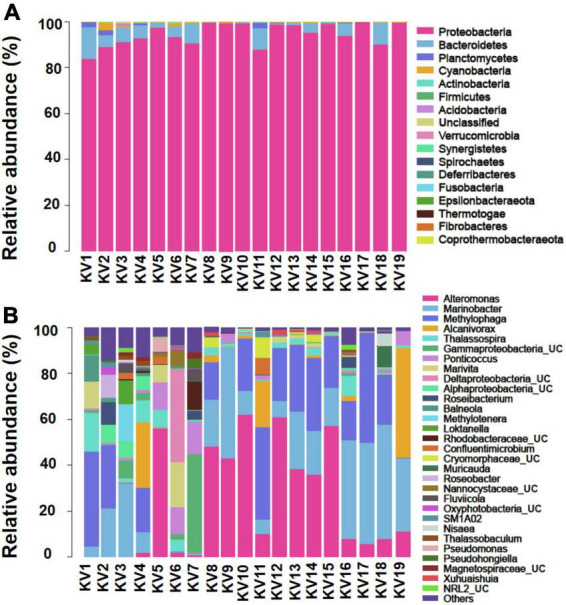
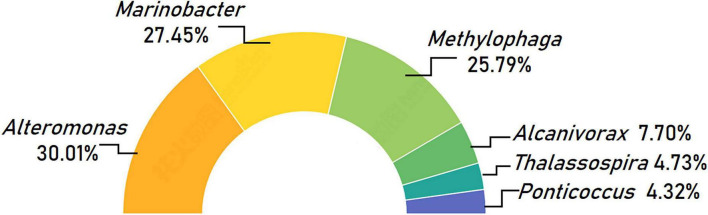
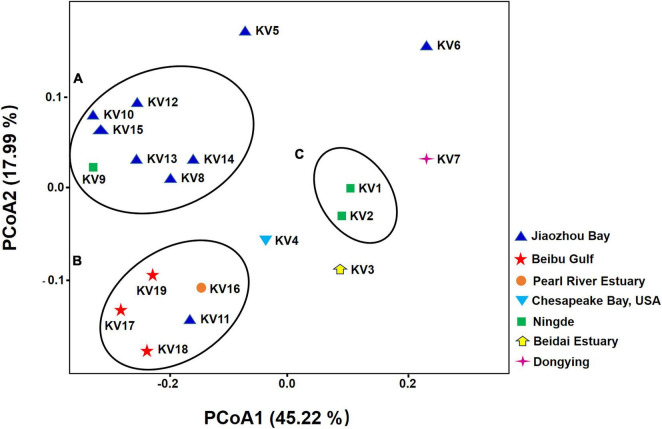
Identification of a core microbiome (a group of taxa commonly present and consistently abundant in most samples of host populations) is important to capture the key microbes closely associated with a host population, as this process may potentially contribute to further revealing their spatial distribution, temporal stability, ecological influence, and even impacts on their host's functions and fitness. The naked dinoflagellate is a cosmopolitan and toxic species, which is also notorious in forming harmful algal blooms (HABs) and causing massive fish-kills. Here we reported the core microbiome tightly associated with 19 strains of that were originally isolated from 6 geographic locations along the coast of China and from an estuary of Chesapeake Bay, United States, and have been maintained in the laboratory for several months to over 14 years. Using high-throughput metabarcoding of the partial 16S rRNA gene amplicons, a total of 1,417 prokaryotic features were detected in the entire bacterial microbiome, which were assigned to 17 phyla, 35 classes, 90 orders, 273 families, and 716 genera. Although the bacterial communities associated with cultures displayed heterogeneity in feature (sequences clustered at 100% sequence similarity) composition among strains, a core set of 6 genera were found persistent in their phycospheres, which could contribute up to 74.54% of the whole bacterial microbiome. Three γ-proteobacteria members of the "core," namely, , , and , were the predominant core genera and made up 83.25% of the core bacterial microbiome. The other 3 core genera, , , and , are reported to preferably utilize hydrocarbons as sole or major source of carbon and energy, and two of which ( and ) are recognized as obligate hydrocarbonoclastic bacteria (OHCB). Since OHCB generally present in extremely low abundance in marine water and elevate their abundance mostly in petroleum-impacted water, our detection in cultures suggests that the occurrence of obligate and generalist hydrocarbon-degrading bacteria living with dinoflagellates may be more frequent in nature. Our work identified a core microbiome with stable association with the harmful alga and opened a window for further characterization of the physiological mechanisms and ecological implications for the dinoflagellate-bacteria association.
识别核心微生物群(在宿主群体的大多数样本中普遍存在且始终丰富的一组分类群)对于捕获与宿主群体密切相关的关键微生物很重要,因为这一过程可能有助于进一步揭示它们的空间分布、时间稳定性、生态影响,甚至对宿主功能和适应性的影响。裸甲藻是一种世界性的有毒物种,在形成有害藻华(HABs)和导致大量鱼类死亡方面也声名狼藉。在这里,我们报告了与19株裸甲藻紧密相关的核心微生物群,这些裸甲藻最初从中国沿海的6个地理位置以及美国切萨皮克湾的一个河口分离出来,并已在实验室中保存了数月至14年以上。通过对部分16S rRNA基因扩增子进行高通量元条形码分析,在整个细菌微生物群中总共检测到1417个原核生物特征,这些特征被归为17个门、35个纲、90个目、273个科和716个属。尽管与裸甲藻培养物相关的细菌群落在菌株间的特征(序列在100%序列相似性处聚类)组成上表现出异质性,但在它们的藻球中发现了一组由6个属组成的核心菌群,它们在整个细菌微生物群中所占比例可达74.54%。“核心”菌群中的三个γ-变形菌成员,即嗜甲基菌属、海杆菌属和假交替单胞菌属,是主要的核心属,占核心细菌微生物群的83.25%。其他三个核心属,即食烷菌属、嗜油菌属和嗜环烷菌属,据报道更倾向于利用碳氢化合物作为唯一或主要的碳源和能源,其中两个属(嗜油菌属和嗜环烷菌属)被认为是专性嗜油菌(OHCB)。由于专性嗜油菌在海水中的丰度通常极低,且大多在受石油污染的水中丰度升高,我们在裸甲藻培养物中的检测表明,与裸甲藻共生的专性和通用型碳氢化合物降解细菌在自然界中可能更频繁地出现。我们的工作识别出了与有害藻类裸甲藻具有稳定关联的核心微生物群,并为进一步表征裸甲藻-细菌关联的生理机制和生态意义打开了一扇窗口。