Cho Nicholas S, Hagiwara Akifumi, Eldred Blaine S C, Raymond Catalina, Wang Chencai, Sanvito Francesco, Lai Albert, Nghiemphu Phioanh, Salamon Noriko, Steelman Lori, Hassan Islam, Cloughesy Timothy F, Ellingson Benjamin M
Medical Scientist Training Program, David Geffen School of Medicine, University of California, Los Angeles, Los Angeles, CA, USA.
UCLA Brain Tumor Imaging Laboratory (BTIL), Center for Computer Vision and Imaging Biomarkers, University of California, Los Angeles, Los Angeles, CA, USA.
Neurooncol Adv. 2022 Aug 4;4(1):vdac124. doi: 10.1093/noajnl/vdac124. eCollection 2022 Jan-Dec.
Inhibition of the isocitrate dehydrogenase (IDH)-mutant enzyme is a novel therapeutic target in IDH-mutant gliomas. Imaging biomarkers of IDH inhibitor treatment efficacy in human IDH-mutant gliomas are largely unknown. This study investigated early volumetric, perfusion, and diffusion MRI changes in IDH1-mutant gliomas during IDH inhibitor treatment.
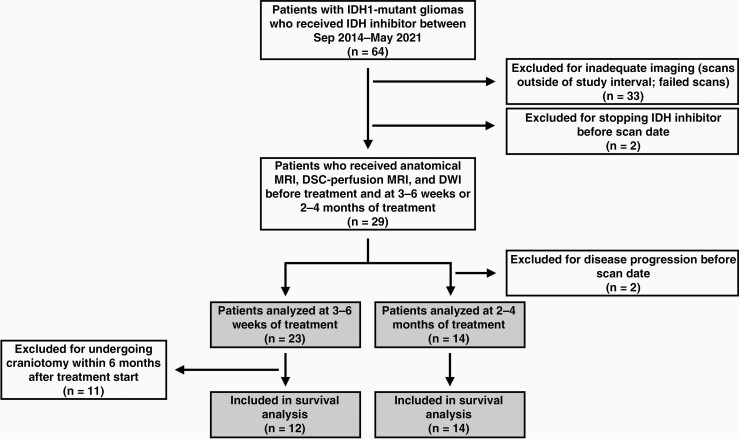
Twenty-nine IDH1-mutant glioma patients who received IDH inhibitor and obtained anatomical, perfusion, and diffusion MRI pretreatment at 3-6 weeks ( = 23) and/or 2-4 months ( = 14) of treatment were retrospectively studied. Normalized relative cerebral blood volume (nrCBV), apparent diffusion coefficient (ADC), and fluid-attenuated inversion recovery (FLAIR) hyperintensity volume were analyzed.
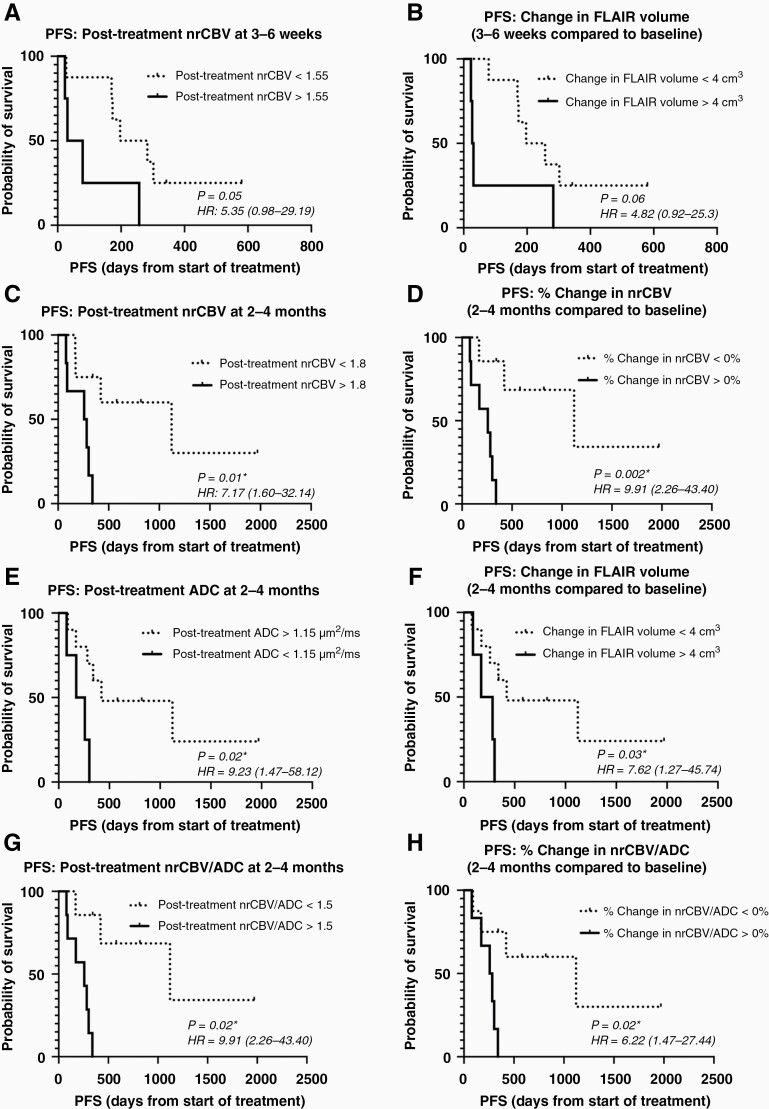
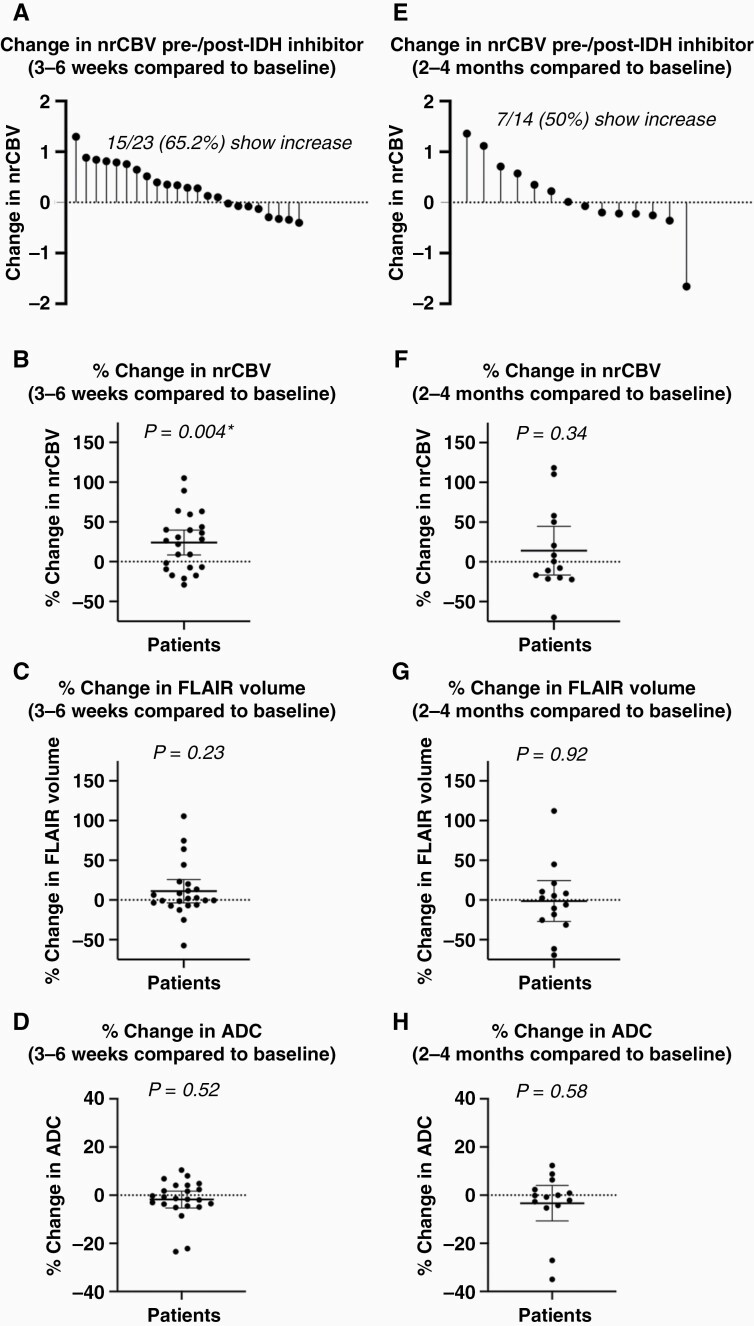
After 3-6 weeks of treatment, nrCBV was significantly increased ( = .004; mean %change = 24.15%) but not FLAIR volume ( = .23; mean %change = 11.05%) or ADC ( = .52; mean %change = -1.77%). Associations between shorter progression-free survival (PFS) with posttreatment nrCBV > 1.55 ( = .05; median PFS, 240 vs 55 days) and increased FLAIR volume > 4 cm ( = .06; 227 vs 29 days) trended toward significance. After 2-4 months, nrCBV, FLAIR volume, and ADC were not significantly different from baseline, but an nrCBV increase > 0% ( = .002; 1121 vs 257 days), posttreatment nrCBV > 1.8 ( = .01; 1121 vs. 270 days), posttreatment ADC < 1.15 μm/ms ( = .02; 421 vs 215 days), median nrCBV/ADC ratio increase > 0% ( = .02; 1121 vs 270 days), and FLAIR volume change > 4 cm ( = .03; 421 vs 226.5 days) were associated with shorter PFS.
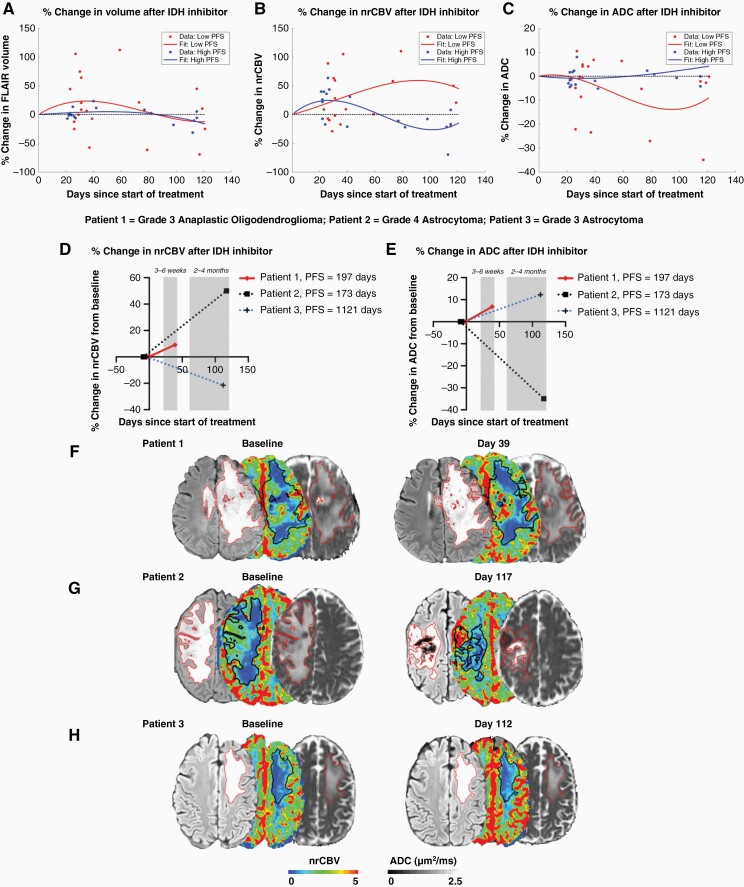
Increased nrCBV at 3-6 weeks of treatment may reflect transient therapeutic and/or tumor growth changes, whereas nrCBV, ADC, and FLAIR volume changes occurring at 2-4 months of treatment may more accurately reflect antitumor response to IDH inhibition.
抑制异柠檬酸脱氢酶(IDH)突变型酶是IDH突变型胶质瘤的一种新型治疗靶点。IDH抑制剂治疗人类IDH突变型胶质瘤疗效的影像学生物标志物在很大程度上尚不清楚。本研究调查了IDH1突变型胶质瘤在IDH抑制剂治疗期间早期的体积、灌注和扩散磁共振成像(MRI)变化。
回顾性研究了29例接受IDH抑制剂治疗的IDH1突变型胶质瘤患者,这些患者在治疗3 - 6周(n = 23)和/或2 - 4个月(n = 14)时进行了解剖、灌注和扩散MRI预处理。分析了标准化相对脑血容量(nrCBV)、表观扩散系数(ADC)和液体衰减反转恢复(FLAIR)高信号体积。
治疗3 - 6周后,nrCBV显著增加(P = .004;平均变化百分比 = 24.15%),但FLAIR体积(P = .23;平均变化百分比 = 11.05%)或ADC(P = .52;平均变化百分比 = -1.77%)无显著变化。无进展生存期(PFS)较短与治疗后nrCBV > 1.55(P = .05;中位PFS,240天对55天)以及FLAIR体积增加 > 4 cm³(P = .06;分别为227天和29天)之间的关联有显著趋势。治疗2 - 4个月后,nrCBV、FLAIR体积和ADC与基线相比无显著差异,但nrCBV增加 > 0%(P = .002;分别为1121天和257天)、治疗后nrCBV > 1.8(P = .01;分别为1121天和270天)、治疗后ADC < 1.15 µm²/ms(P = .02;分别为421天和215天)、nrCBV/ADC比值中位数增加 > 0%(P = .02;分别为1121天和270天)以及FLAIR体积变化 > 4 cm³(P = .03;分别为421天和226.5天)与较短的PFS相关。
治疗3 - 6周时nrCBV增加可能反映了短暂的治疗和/或肿瘤生长变化,而治疗2 - 4个月时发生的nrCBV、ADC和FLAIR体积变化可能更准确地反映了对IDH抑制的抗肿瘤反应。