UCLA Brain Tumor Imaging Laboratory (BTIL), Center for Computer Vision and Imaging Biomarkers, University of California, Los Angeles, Los Angeles, CA, USA.
Department of Radiological Sciences, David Geffen School of Medicine, University of California, Los Angeles, Los Angeles, CA, USA.
J Neurooncol. 2023 Jun;163(2):417-427. doi: 10.1007/s11060-023-04363-x. Epub 2023 Jun 9.
There is limited knowledge about the associations between sodium and proton MRI measurements in brain tumors. The purpose of this study was to quantify intra- and intertumoral correlations between sodium, diffusion, and perfusion MRI in human gliomas.
Twenty glioma patients were prospectively studied on a 3T MRI system with multinuclear capabilities. Three mutually exclusive tumor volumes of interest (VOIs) were segmented: contrast-enhancing tumor (CET), T2/FLAIR hyperintense non-enhancing tumor (NET), and necrosis. Median and voxel-wise associations between apparent diffusion coefficient (ADC), normalized relative cerebral blood volume (nrCBV), and normalized sodium measurements were quantified for each VOI.
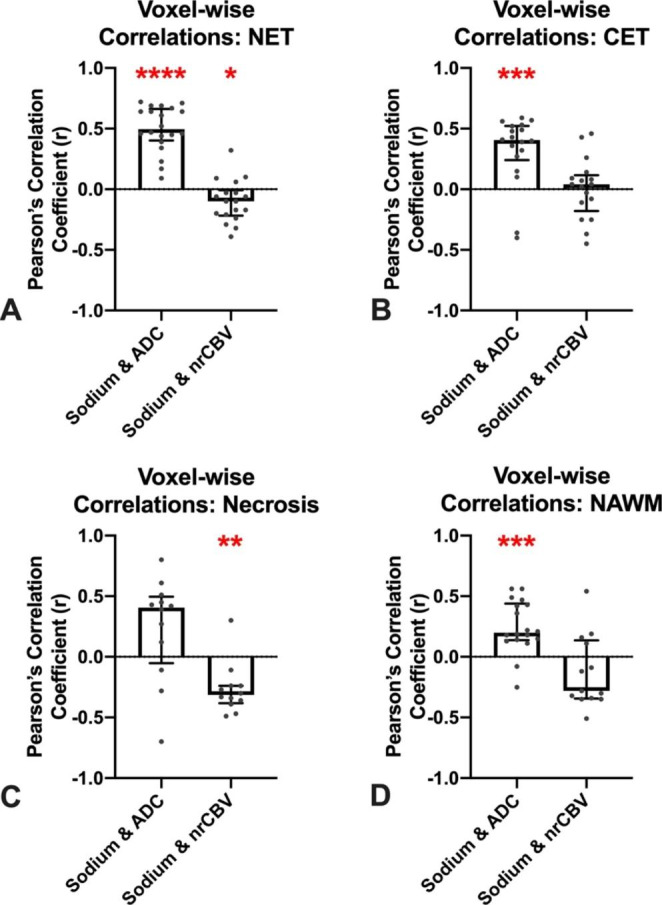
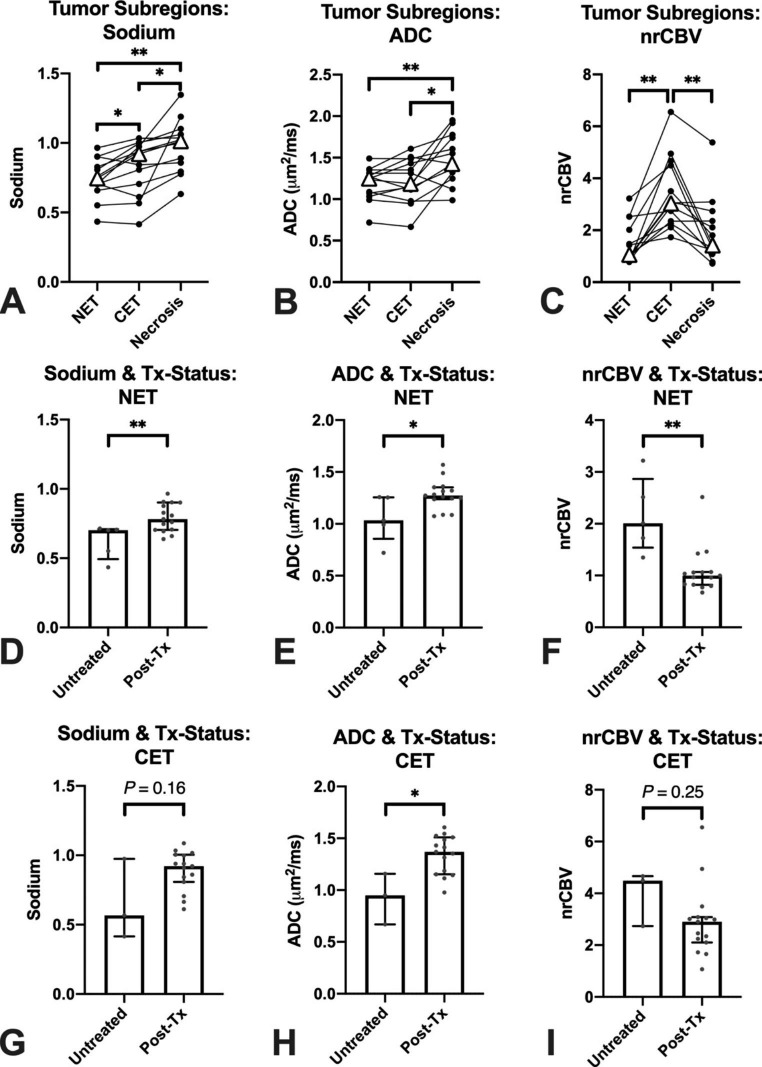
Both relative sodium concentration and ADC were significantly higher in areas of necrosis compared to NET (P = 0.003 and P = 0.008, respectively) and CET (P = 0.02 and P = 0.02). Sodium concentration was higher in CET compared to NET (P = 0.04). Sodium and ADC were higher in treated compared to treatment-naïve gliomas within NET (P = 0.006 and P = 0.01, respectively), and ADC was elevated in CET (P = 0.03). Median ADC and sodium concentration were positively correlated across patients in NET (r = 0.77, P < 0.0001) and CET (r = 0.84, P < 0.0001), but not in areas of necrosis (r = 0.45, P = 0.12). Median nrCBV and sodium concentration were negatively correlated across patients in areas of NET (r=-0.63, P = 0.003). Similar associations were observed when examining voxel-wise correlations within VOIs.
Sodium MRI is positively correlated with proton diffusion MRI measurements in gliomas, likely reflecting extracellular water. Unique areas of multinuclear MRI contrast may be useful in future studies to understand the chemistry of the tumor microenvironment.
目前对于脑肿瘤中钠和质子 MRI 测量之间的相关性知之甚少。本研究的目的是定量研究人类脑胶质瘤中钠、弥散和灌注 MRI 之间的瘤内和瘤间相关性。
20 例胶质瘤患者前瞻性地在具有多核功能的 3T MRI 系统上进行研究。三个相互排斥的肿瘤感兴趣区(VOI)被分割:对比增强肿瘤(CET)、T2/FLAIR 高信号非增强肿瘤(NET)和坏死区。对每个 VOI 量化平均扩散系数(ADC)、归一化相对脑血容量(nrCBV)和归一化钠测量值之间的中位数和体素相关性。
与 NET(P=0.003 和 P=0.008)和 CET(P=0.02 和 P=0.02)相比,坏死区的相对钠浓度和 ADC 均显著升高,与 CET 相比,NET 区的钠浓度更高(P=0.04)。与 NET 内治疗前胶质瘤相比,治疗后胶质瘤的钠浓度和 ADC 更高(P=0.006 和 P=0.01),CET 区的 ADC 升高(P=0.03)。NET(r=0.77,P<0.0001)和 CET(r=0.84,P<0.0001)中,患者间的 ADC 和钠浓度中位数呈正相关,但坏死区(r=0.45,P=0.12)无相关性。NET 区患者的中位 nrCBV 和钠浓度呈负相关(r=-0.63,P=0.003)。在 VOI 内检查体素相关性时也观察到了类似的相关性。
胶质瘤中钠 MRI 与质子弥散 MRI 测量值呈正相关,可能反映细胞外水。多核 MRI 对比的独特区域可能有助于未来研究了解肿瘤微环境的化学性质。