Powell Jonathan R, Cotto Jennifer, Kurth Jordan D, Cash Rebecca E, Gugiu Mihaiela R, Panchal Ashish R
National Registry of Emergency Medical Technicians Columbus Ohio USA.
Division of Epidemiology The Ohio State University College of Public Health Columbus Ohio USA.
J Am Coll Emerg Physicians Open. 2022 Aug 25;3(4):e12808. doi: 10.1002/emp2.12808. eCollection 2022 Aug.
As the COVID-19 pandemic began, there were significant concerns for the strength and stability of the emergency medical services (EMS) workforce. These concerns were heightened with the closure of examination centers and the cessation of certification examinations. The impact of this interruption on the EMS workforce is unclear. Our objective was to evaluate the impact of COVID-19 on initial EMS certification in the United States. In addition, we evaluated mitigation measures taken to address these interruptions.
This study was a cross-sectional evaluation of the National Certification Cognitive Examination administration and results for emergency medical technician (EMT) and paramedic candidates. We compared the number of examinations administered and first-attempt pass rates in 2020 (pandemic) to 2019 (control). Descriptive statistics and 2 one-sided tests of equivalence were used to assess if there was a relevant difference of ±5 percentage points.
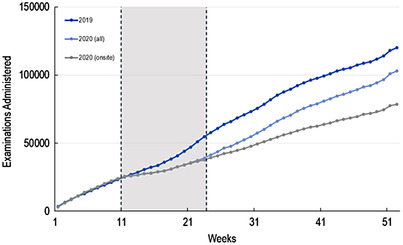
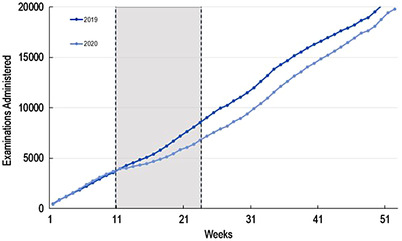
Total number of examinations administered decreased by 15% (EMT, 14%; paramedic, 7%). Without the addition of EMT remote proctoring, the EMT reduction would have been 35%. First-time pass rates were similar in both EMT (-0.9%) and paramedic (-1.9%) candidates, which did not meet our threshold of a relevant difference.
COVID-19 has had a measurable impact on examination administration for both levels of certification. First-time pass rates remained unaffected. EMT remote proctoring mitigated some of the impact of COVID-19 on examination administration, although a comparison with mitigation was not assessed. These reductions indicate a potential decrease in the newly certified workforce, but future evaluations will be necessary to assess the presence and magnitude of this impact.
在新冠疫情开始时,人们对紧急医疗服务(EMS)人员队伍的实力和稳定性深感担忧。随着考试中心关闭和认证考试停止,这些担忧加剧。这种中断对EMS人员队伍的影响尚不清楚。我们的目的是评估新冠疫情对美国EMS初始认证的影响。此外,我们评估了为应对这些中断而采取的缓解措施。
本研究是对紧急医疗技术员(EMT)和护理人员候选人的国家认证认知考试管理及结果的横断面评估。我们将2020年(疫情期间)与2019年(对照)的考试管理数量和首次通过率进行了比较。使用描述性统计和两个单侧等效性检验来评估是否存在±5个百分点的相关差异。
考试管理总数下降了15%(EMT为14%;护理人员为7%)。如果没有增加EMT远程监考,EMT的降幅将达到35%。EMT和护理人员候选人的首次通过率相似(分别为-0.9%和-1.9%),未达到我们设定的相关差异阈值。
新冠疫情对两个认证级别的考试管理都产生了可衡量的影响。首次通过率未受影响。EMT远程监考减轻了新冠疫情对考试管理的部分影响,不过未对缓解措施进行比较评估。这些降幅表明新认证人员队伍可能减少,但未来还需要进行评估以确定这种影响的存在及程度。