Laboratory of Neuroendocrinology, GIGA-Neurosciences, University of Liege, Liege, Belgium.
Front Endocrinol (Lausanne). 2022 Aug 10;13:957114. doi: 10.3389/fendo.2022.957114. eCollection 2022.
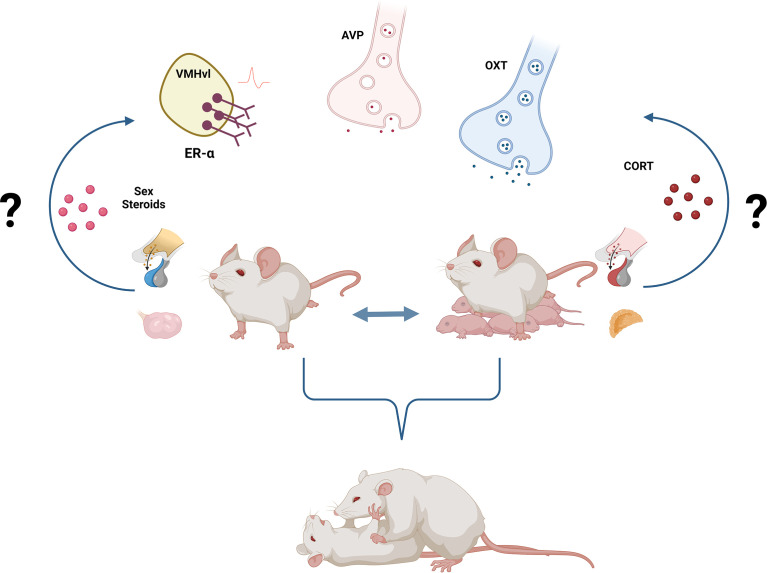
Classically the neurobiology of aggression has been studied exclusively in males. Thus, females have been considered mildly aggressive except during lactation. Interestingly, recent studies in rodents and humans have revealed that non-lactating females can show exacerbated and pathological aggression similarly to males. This review provides an overview of recent findings on the neuroendocrine mechanisms regulating aggressive behavior in females. In particular, the focus will be on novel rodent models of exaggerated aggression established in non-lactating females. Among the neuromodulatory systems influencing female aggression, special attention has been given to sex-steroids and sex-steroid-sensitive neuronal populations (i.e., the core nuclei of the neural pathway of aggression) as well as to the neuropeptides oxytocin and vasopressin which are major players in the regulation of social behaviors.
经典的攻击性神经生物学研究仅在雄性中进行。因此,女性被认为只有在哺乳期才具有轻微的攻击性。有趣的是,最近在啮齿动物和人类中的研究表明,非哺乳期的女性可以表现出类似于男性的加剧和病理性攻击行为。这篇综述提供了一个关于调节女性攻击行为的神经内分泌机制的最新发现概述。特别是,重点将放在非哺乳期雌性建立的夸大攻击性的新型啮齿动物模型上。在影响女性攻击性的神经调节系统中,特别关注了影响女性攻击性的神经调节系统,特别关注了性激素和性激素敏感神经元群体(即攻击性神经通路的核心核团),以及神经肽催产素和加压素,它们是调节社会行为的主要参与者。