Haykir Ozkan, Yagli Ibrahim
Finance and Banking Department, Nigde Omer Halisdemir University, Nigde, Turkey.
Accounting and Finance Department, Nevsehir Hacı Bektas Veli University, Nevsehir, Turkey.
Financ Innov. 2022;8(1):78. doi: 10.1186/s40854-022-00383-0. Epub 2022 Aug 23.
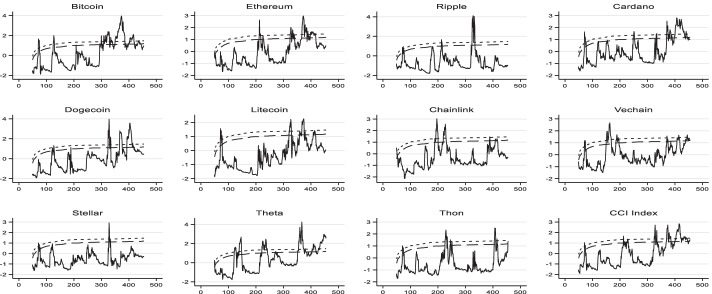
This study investigates speculative bubbles in the cryptocurrency market and factors affecting bubbles during the COVID-19 pandemic. Our results indicate that each cryptocurrency covered in the study presented bubbles. Moreover, we found that explosive behavior in one currency leads to explosivity in other cryptocurrencies. During the pandemic, herd behavior was evident among investors; however, this diminishes during bubbles, indicating that bubbles are not explained by herd behavior. Regarding cryptocurrency and market-specific factors, we found that Google Trends and volume are positively associated with predicting speculative bubbles in time-series and panel probit regressions. Hence, investors should exercise caution when investing in cryptocurrencies and follow both crypto currency and market-related factors to estimate bubbles. Alternative liquidity, volatility, and Google Trends measures are used for robustness analysis and yield similar results. Overall, our results suggest that bubble behavior is common in the cryptocurrency market, contradicting the efficient market hypothesis.
本研究调查了加密货币市场中的投机泡沫以及新冠疫情期间影响泡沫的因素。我们的结果表明,该研究涵盖的每种加密货币都出现了泡沫。此外,我们发现一种货币的爆发性行为会导致其他加密货币也出现爆发性。在疫情期间,投资者中羊群行为明显;然而,在泡沫期间这种行为会减少,这表明泡沫并非由羊群行为所致。关于加密货币和特定市场因素,我们发现在时间序列和面板概率回归中,谷歌趋势和交易量与预测投机泡沫呈正相关。因此,投资者在投资加密货币时应谨慎行事,并关注加密货币和市场相关因素以评估泡沫。使用替代流动性、波动性和谷歌趋势指标进行稳健性分析,得出了类似的结果。总体而言,我们的结果表明泡沫行为在加密货币市场中很常见,这与有效市场假说相矛盾。