Yuan Xiaoya, Cui Huanxian, Jin Yuxi, Zhao Wenjuan, Liu Xiaojing, Wang Yongli, Ding Jiqiang, Liu Li, Wen Jie, Zhao Guiping
State Key Laboratory of Animal Nutrition, Institute of Animal Sciences, Chinese Academy of Agricultural Sciences, Beijing, China.
Front Genet. 2022 Aug 12;13:902180. doi: 10.3389/fgene.2022.902180. eCollection 2022.
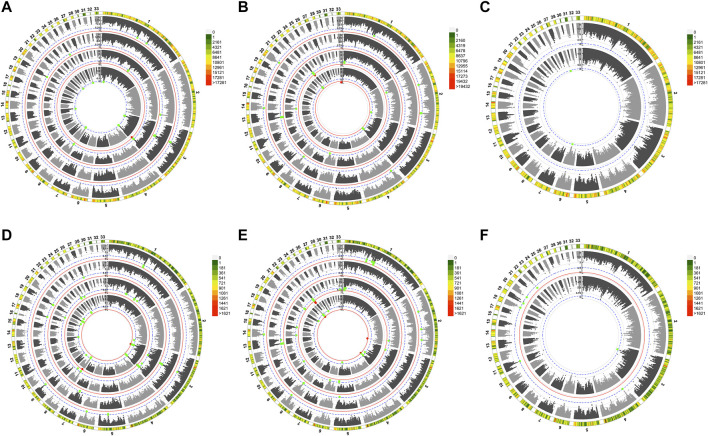
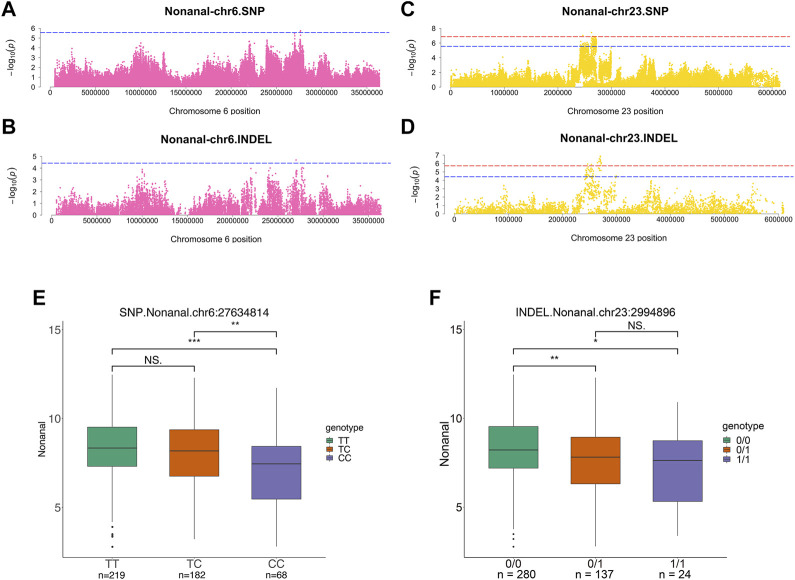
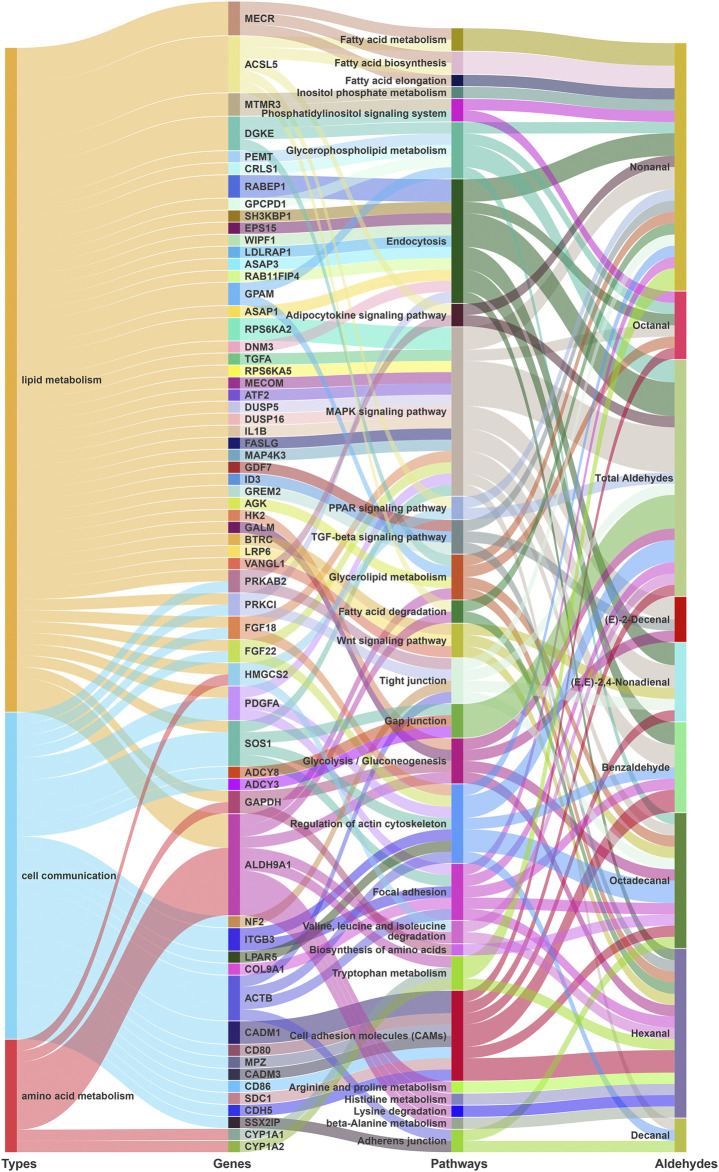
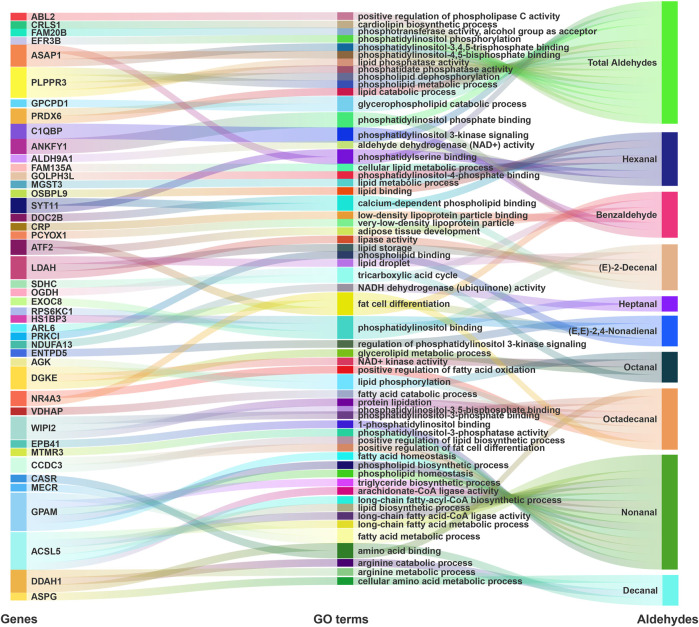
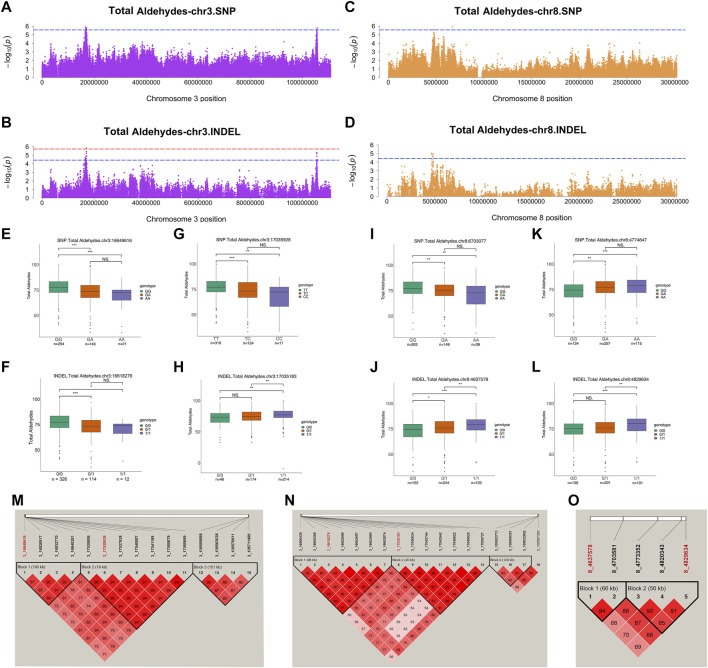
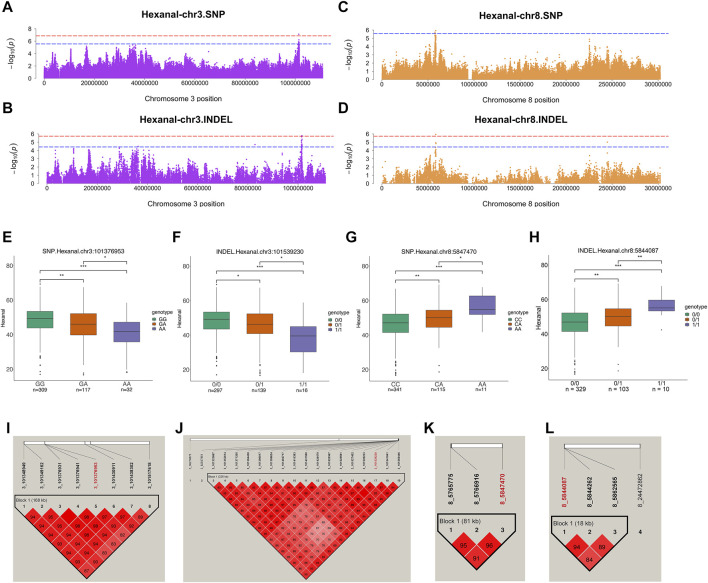
Aldehydes are primary volatile organic compounds (VOCs) in local Chinese chicken meat and contribute green grass, fatty, citrus, and bitter almond aromas to chicken meat. To understand the genetic basis of these aldehyde VOC aromas, we used approximately 500 Chinese Jingxing Yellow (JXY) chickens to conduct genome-wide association studies (GWAS) on the flavor traits with the data of single nucleotide polymorphisms (SNPs) and insertions and deletions (INDELs). In total, 501 association variants (253 SNPs and 248 INDELs) were found to be suggestively (SNPs: value 2.77e-06 and INDELs: value 3.78e-05) associated with total aldehydes (the sum of nine aldehydes), hexanal, heptanal, benzaldehyde, (E,E)-2,4-nonadienal, octanal, (E)-2-decenal, nonanal, decanal, and octadecanal. Of them, six SNPs and 23 INDELs reached a genome-wide significance level (SNPs: value 1.38e-07 and INDELs: value 1.89e-06). Potential candidate aldehyde genes were functionally annotated for lipid metabolism, especially fatty acid-related pathways and phospholipid-related gene ontology (GO) terms. Moreover, the GWAS analysis of total aldehydes, hexanal, and nonanal generated the most significant signals, and phenotypic content differed between different genotypes at candidate gene-related loci. For total aldehydes and hexanal traits, candidate genes were annotated based on the significant and suggestive variants on chromosomes 3 and 8 with highly polymorphic linkage blocks. The following candidate genes were also identified: , , , , , , , , , , , , , and . We also found that polyunsaturated fatty acids (PUFAs) (C18:2n6c linoleic acid and C18:3n3 linolenic acid) were significantly correlated with total aldehydes and hexanal contents. PUFAs are important aldehyde precursors, and consistently, our results suggested that candidate genes involved in fatty acid pathways and phospholipid GO terms were identified in association loci. This work provides an understanding of the genetic basis of aldehyde formation, which is a key flavor-forming compound.
醛类是中国地方鸡肉中的主要挥发性有机化合物(VOCs),赋予鸡肉青草、脂肪、柑橘和苦杏仁香气。为了解这些醛类VOC香气的遗传基础,我们使用了约500只中国京星黄鸡(JXY),利用单核苷酸多态性(SNP)和插入缺失(INDEL)数据对风味性状进行全基因组关联研究(GWAS)。总共发现501个关联变异(253个SNP和248个INDEL)与总醛类(9种醛类之和)、己醛、庚醛、苯甲醛、(E,E)-2,4-壬二烯醛、辛醛、(E)-2-癸烯醛、壬醛、癸醛和十八醛存在潜在关联(SNP:值2.77e-06,INDEL:值3.78e-05)。其中,6个SNP和23个INDEL达到全基因组显著性水平(SNP:值1.38e-07,INDEL:值1.89e-06)。对潜在的候选醛类基因进行功能注释,发现其与脂质代谢相关,尤其是脂肪酸相关途径和磷脂相关的基因本体(GO)术语。此外,对总醛类、己醛和壬醛的GWAS分析产生了最显著的信号,且候选基因相关位点不同基因型之间的表型含量存在差异。对于总醛类和己醛性状,基于3号和8号染色体上具有高度多态性连锁块的显著和潜在变异对候选基因进行注释。还鉴定出以下候选基因: 、 、 、 、 、 、 、 、 、 、 、 、 和 。我们还发现多不饱和脂肪酸(PUFAs)(C18:2n6c亚油酸和C18:3n3亚麻酸)与总醛类和己醛含量显著相关。PUFAs是重要的醛类前体,因此,我们的结果表明在关联位点鉴定出了参与脂肪酸途径和磷脂GO术语的候选基因。这项工作有助于了解醛类形成的遗传基础,醛类是一种关键的风味形成化合物。