Zhao Rui, Shi Jie, Song Yichuan, Zhang Rui
Department of Clinical Laboratory, Beijing Chaoyang Hospital, Capital Medical University, Beijing, PR China.
Department of Clinical Laboratory, Beijing Chaoyang Hospital, Capital Medical University, No. 8, Gongtinan Road, Chaoyang District, Beijing 100020, PR China.
Therap Adv Gastroenterol. 2022 Aug 22;15:17562848221116264. doi: 10.1177/17562848221116264. eCollection 2022.
The Coronavirus Disease 2019 (COVID-19) pandemic poses a massive crisis to global public health. Gastrointestinal (GI) symptoms are increasingly reported in COVID-19. The characteristics of laboratory findings of COVID-19 are critical for clinical diagnosis and treatment.
The study aimed to summarize laboratory features in COVID-19 with GI symptoms and non-GI symptoms.
This study was a systematic review and meta-analysis. Electronic literature searches were conducted for studies that included patients infected COVID-19 with GI symptoms and non-GI symptoms. GI symptoms included diarrhea, abdominal pain, nausea and vomiting, and anorexia. This study used a random-effects model to assess pooled data.
We systematically searched PubMed, Embase, Cochrane, Web of Science for studies through 31 October 2021, with no language restrictions. We used the following search terms: 'COVID-19' OR '2019-nCoV' OR 'SARS-CoV-2' OR 'coronavirus 2019' OR 'severe acute respiratory syndrome coronavirus 2' OR 'coronavirus' OR 'novel coronavirus' OR 'nCoV' AND 'gastrointestinal symptoms' OR 'digestive symptoms' AND 'clinical feature' OR 'clinical characteristics.' Data mostly originated from Chinese and American studies.
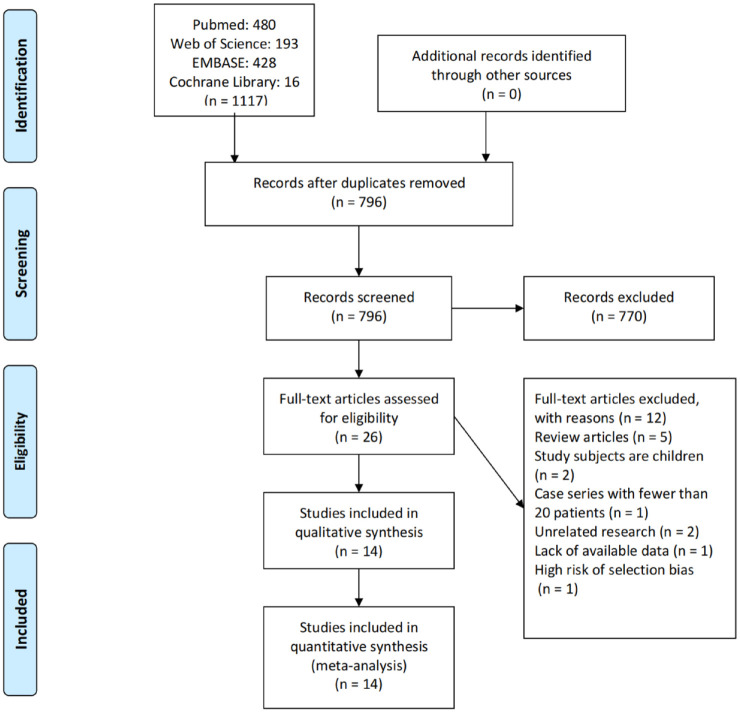
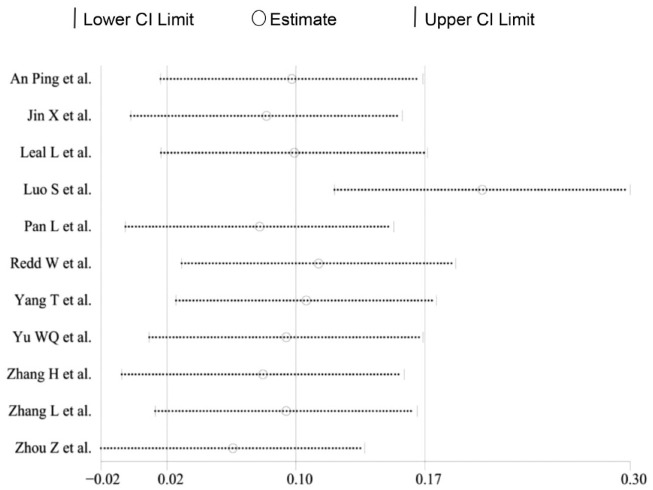
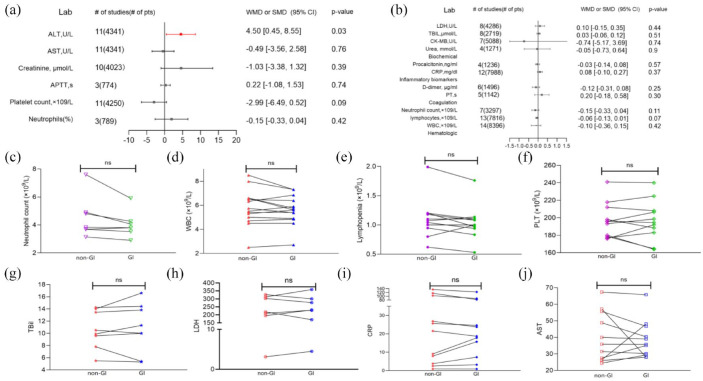
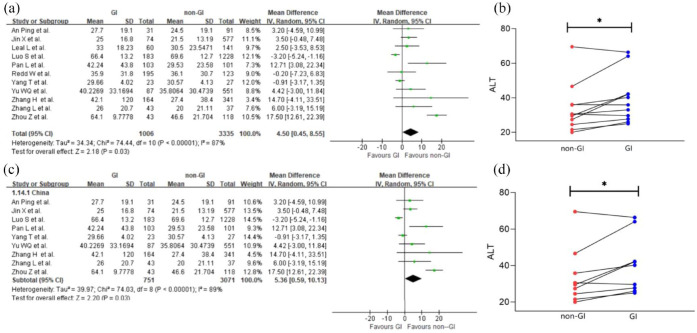
Of 796 identified studies, 14 were eligible and were included in our analysis ( = 8396 participants). Meta-analysis showed that GI symptoms group had an elevated alanine aminotransferase (ALT) [pooled mean difference (MD), 4.5 U/L; 95% confidence interval, [0.45, 8.55]; = 0.03; = 87%]. No publication bias was detected by Begg's and Egger's regression test ( = 0.130). COVID-19 with the GI symptoms also showed a trend toward decreased white blood cell count, lymphopenia, neutrophilia, thrombocytopenia and elevated total bilirubin.
GI symptoms are common in COVID-19. No significant differences were found in most laboratory indicators except elevated ALT.
CRD42020209039 (PROSPERO).
2019冠状病毒病(COVID-19)大流行给全球公共卫生带来了巨大危机。COVID-19患者中胃肠道(GI)症状的报告日益增多。COVID-19的实验室检查结果特征对临床诊断和治疗至关重要。
本研究旨在总结有胃肠道症状和无胃肠道症状的COVID-19患者的实验室特征。
本研究为系统评价和荟萃分析。通过电子文献检索纳入感染COVID-19且有胃肠道症状和无胃肠道症状患者的研究。胃肠道症状包括腹泻、腹痛、恶心、呕吐和食欲不振。本研究采用随机效应模型评估汇总数据。
我们系统检索了截至2021年10月31日的PubMed、Embase、Cochrane、Web of Science数据库中的研究,无语言限制。检索词如下:“COVID-19”或“2019-nCoV”或“SARS-CoV-2”或“coronavirus 2019”或“severe acute respiratory syndrome coronavirus 2”或“coronavirus”或“novel coronavirus”或“nCoV”以及“胃肠道症状”或“消化系统症状”以及“临床特征”或“临床特点”。数据大多来自中国和美国的研究。
在796项检索到的研究中,14项符合纳入标准并纳入我们的分析(n = 8396名参与者)。荟萃分析显示,胃肠道症状组丙氨酸氨基转移酶(ALT)升高[合并平均差(MD),4.5 U/L;95%置信区间,[0.45,8.55];P = 0.03;I² = 87%]。Begg法和Egger法回归检验未检测到发表偏倚(P = 0.130)。有胃肠道症状的COVID-19患者还表现出白细胞计数降低、淋巴细胞减少、中性粒细胞增多、血小板减少和总胆红素升高的趋势。
胃肠道症状在COVID-19患者中很常见。除ALT升高外,大多数实验室指标无显著差异。
CRD42020209039(PROSPERO)