Huehnchen Petra, Bangemann Nikola, Lischewski Sandra, Märschenz Stefanie, Paul Friedemann, Schmitz-Hübsch Tanja, Blohmer Jens-Uwe, Eberhardt Cornelia, Rauch Geraldine, Flöel Agnes, Adam Sophie, Schwenkenbecher Philipp, Meinhold-Heerlein Ivo, Hoffmann Oliver, Ziemssen Tjalf, Endres Matthias, Boehmerle Wolfgang
Charité - Universitätsmedizin Berlin, Corporate Member of Freie Universität Berlin, Klinik und Hochschulambulanz für Neurologie, Humboldt-Universität zu Berlin, Berlin, Germany.
Berlin Institute of Health at Charité - Universitätsmedizin Berlin, Berlin, Germany.
Front Med (Lausanne). 2022 Aug 11;9:967964. doi: 10.3389/fmed.2022.967964. eCollection 2022.
Chemotherapy-induced polyneuropathy (CIPN) and post-chemotherapy cognitive impairment (PCCI) are frequent side effects of paclitaxel treatment. CIPN/PCCI are potentially irreversible, reduce quality of life and often lead to treatment limitations, which affect patients' outcome. We previously demonstrated that paclitaxel enhances an interaction of the Neuronal calcium sensor-1 protein (NCS-1) with the Inositol-1,4,5-trisphosphate receptor (InsPR), which disrupts calcium homeostasis and triggers neuronal cell death via the calcium-dependent protease calpain in dorsal root ganglia neurons and neuronal precursor cells. Prophylactic treatment of rodents with lithium inhibits the NCS1-InsPR interaction and ameliorates paclitaxel-induced polyneuropathy and cognitive impairment, which is in part supported by limited retrospective clinical data in patients treated with lithium carbonate at the time of chemotherapy. Currently no data are available from a prospective clinical trial to demonstrate its efficacy.
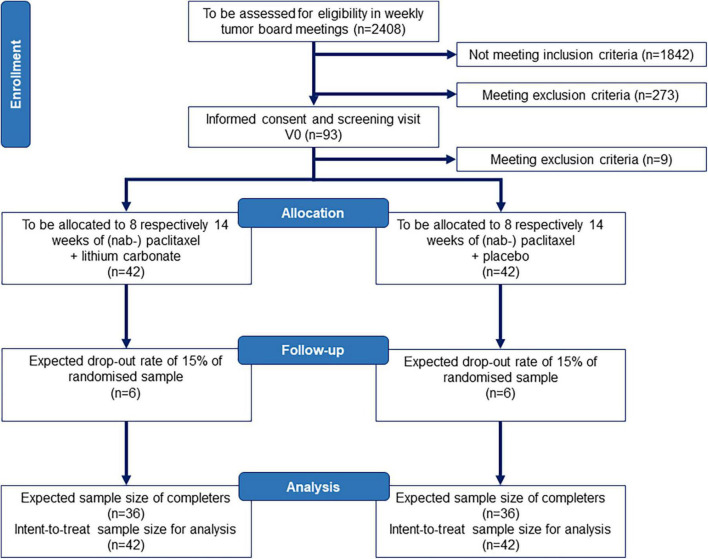
The PREPARE study will be conducted as a multicenter, randomized, double-blind, placebo-controlled phase-2 trial with parallel group design. = 84 patients with breast cancer will be randomized 1:1 to either lithium carbonate treatment (targeted serum concentration 0.5-0.8 mmol/l) or placebo with sham dose adjustments as add-on to (nab-) paclitaxel. The primary endpoint is the validated Total Neuropathy Score reduced (TNSr) at 2 weeks after the last (nab-) paclitaxel infusion. The aim is to show that the lithium carbonate group is superior to the placebo group, meaning that the mean TNSr after (nab-) paclitaxel is lower in the lithium carbonate group than in the placebo group. Secondary endpoints include: (1) severity of CIPN, (2) amount and dose of pain medication, (3) cumulative dose of (nab-) paclitaxel, (4) patient-reported symptoms of CIPN, quality of life and symptoms of anxiety and depression, (5) severity of cognitive impairment, (6) hippocampal volume and changes in structural/functional connectivity and (7) serum Neurofilament light chain protein concentrations.
The study protocol was approved by the Berlin ethics committee (reference: 21/232 - IV E 10) and the respective federal agency (Bundesinstitut für Arzneimittel und Medizinprodukte, reference: 61-3910-4044771). The results of the study will be published in peer-reviewed medical journals as well as presented at relevant (inter)national conferences.
[https://www.drks.de/drks_web/navigate.do?navigationId=trial.HTML&TRIAL_ID=DRKS00027165], identifier [DRKS00027165].
化疗引起的周围神经病变(CIPN)和化疗后认知障碍(PCCI)是紫杉醇治疗常见的副作用。CIPN/PCCI可能是不可逆的,会降低生活质量,并常常导致治疗受限,进而影响患者的治疗结果。我们之前证明,紫杉醇可增强神经元钙传感器1蛋白(NCS-1)与肌醇-1,4,5-三磷酸受体(InsPR)的相互作用,这会破坏钙稳态,并通过钙依赖性蛋白酶钙蛋白酶触发背根神经节神经元和神经前体细胞的神经元细胞死亡。用锂对啮齿动物进行预防性治疗可抑制NCS1-InsPR相互作用,并改善紫杉醇引起的周围神经病变和认知障碍,这在一定程度上得到了化疗时接受碳酸锂治疗患者有限的回顾性临床数据的支持。目前尚无前瞻性临床试验数据证明其疗效。
PREPARE研究将作为一项多中心、随机、双盲、安慰剂对照的2期试验,采用平行组设计。84例乳腺癌患者将按1:1随机分为碳酸锂治疗组(目标血清浓度0.5-0.8 mmol/l)或安慰剂组,安慰剂组进行假剂量调整,作为(纳米)紫杉醇的附加治疗。主要终点是最后一次(纳米)紫杉醇输注后2周时经验证的总神经病变评分降低(TNSr)。目的是证明碳酸锂组优于安慰剂组,即碳酸锂组(纳米)紫杉醇治疗后的平均TNSr低于安慰剂组。次要终点包括:(1)CIPN的严重程度,(2)止痛药物的用量和剂量,(3)(纳米)紫杉醇的累积剂量,(4)患者报告的CIPN症状、生活质量以及焦虑和抑郁症状,(5)认知障碍的严重程度,(6)海马体积以及结构/功能连接性的变化,(7)血清神经丝轻链蛋白浓度。
研究方案已获得柏林伦理委员会批准(参考编号:21/232 - IV E 10)以及相应的联邦机构批准(联邦药品和医疗器械研究所,参考编号:61-3910-4044771)。研究结果将发表在同行评审的医学期刊上,并在相关的(国际)会议上展示。