Bopp Nathen E, Bouyer Donald H, Gibbs Christopher M, Nichols Joan E, Ntiforo Corrie A, Grimaldo Miguel A
Department of Pathology, University of Texas Medical Branch, Galveston, TX, USA.
Division of Infectious Disease, Department of Internal Medicine, University of Texas Medical Branch, Galveston, TX, USA.
Appl Biosaf. 2020 Sep 1;25(3):150-156. doi: 10.1177/1535676020924171.
During pandemic situations like the one caused by the emergent coronavirus SARS-CoV-2, healthcare systems face the challenge of limited personal protective equipment and impaired supply chains. This problem poses a threat to healthcare workers, first responders, and the public, which demands solutions that can span the gap between institutional shortages and resupplies.
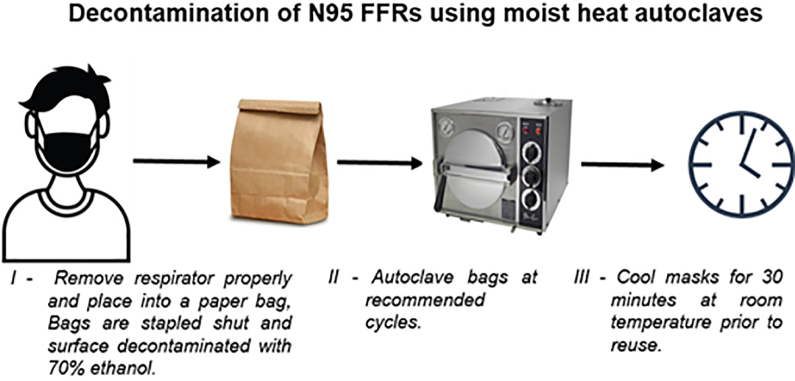
To examine the efficacy of autoclave-based decontamination for the reuse of single-use surgical masks and N95 filtering facepiece respirators (FFRs). This method is the most readily available form of decontamination in the hospital and laboratory settings.
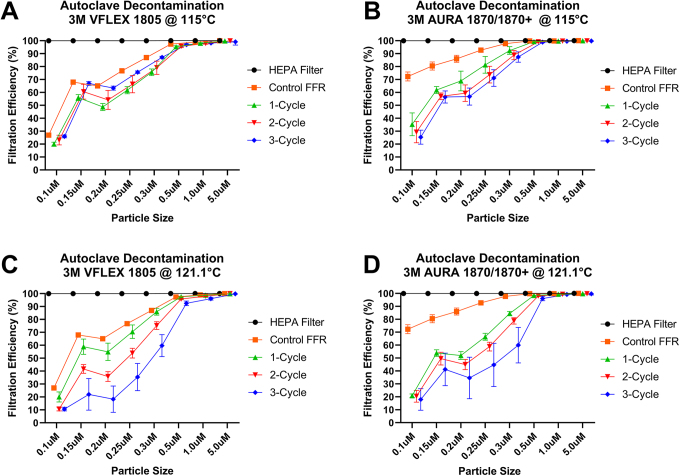
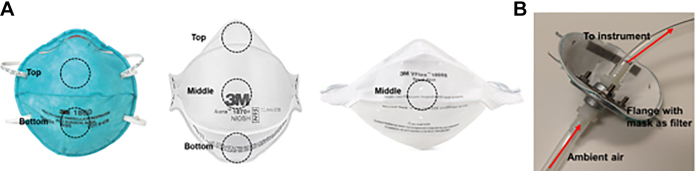
Three models of N95 FFRs and two procedural masks were evaluated in this study. A moist heat autoclave using four different autoclave cycles: 115°C for one hour, 121.1°C for 30 minutes, 130°C for two minutes, and 130°C for four minutes was used. After the autoclave process, the FFRs were NIOSH fit tested and particle counting was performed for both coarse particles of 5 micrometers (µM) and fine particles from 0.1µM to 1.0µM.
We observed negligible alterations in the functionality and integrity of 3M 1805 and 3M 1870/1870+ N95 FFRs after three autoclave cycles. Surgical masks also showed minimal changes in functionality and integrity. The 3M 1860 FFR failed fit test after a single autoclave decontamination cycle.
The study finds that specific surgical masks and N95 FFR models can withstand autoclave decontamination for up to three cycles. Additionally, the autoclave cycles tested were those that could be readily achieved by both clinical and research institutions.
在由新型冠状病毒SARS-CoV-2引发的大流行情况下,医疗系统面临着个人防护装备有限和供应链受损的挑战。这个问题对医护人员、急救人员和公众构成了威胁,需要能够弥补机构短缺和再供应之间差距的解决方案。
研究基于高压灭菌的一次性手术口罩和N95过滤式面罩呼吸器(FFR)再利用的去污效果。这种方法是医院和实验室环境中最容易获得的去污形式。
本研究评估了三种型号的N95 FFR和两种手术口罩。使用了一个湿热高压灭菌器,采用四种不同的高压灭菌周期:115°C一小时、121.1°C 30分钟、130°C两分钟和130°C四分钟。高压灭菌过程后,对FFR进行了美国国家职业安全与健康研究所(NIOSH)的适合性测试,并对5微米(µM)的粗颗粒和0.1µM至1.0µM的细颗粒进行了颗粒计数。
我们观察到,经过三个高压灭菌周期后,3M 1805和3M 1870/1870+ N95 FFR的功能和完整性变化可忽略不计。手术口罩的功能和完整性也显示出最小的变化。3M 1860 FFR在单次高压灭菌去污周期后未能通过适合性测试。
该研究发现,特定的手术口罩和N95 FFR型号最多可承受三个周期的高压灭菌去污。此外,所测试的高压灭菌周期是临床和研究机构都能轻松实现的。