Lin Zebin, Liu Xia, Xiao Li, Li Yin, Qi Chenlu, Song Siqi, Zhao Yiping, Zou Lili
Department of Geriatrics, Zhongshan Hospital Affiliated to Xiamen University, Xiamen, China.
Department of Pulmonary and Critical Care Medicine, First Affiliated Hospital, Bengbu Medical College, Bengbu, China.
Front Cardiovasc Med. 2022 Aug 11;9:985503. doi: 10.3389/fcvm.2022.985503. eCollection 2022.
The relationship between the MELD-XI score, a modified version of the MELD score, and the long-term prognosis of hospitalized patients with chronic heart failure is unclear. The aim of this study was to determine the long-term prognostic relationship of MELD-XI score in patients with chronic heart failure.
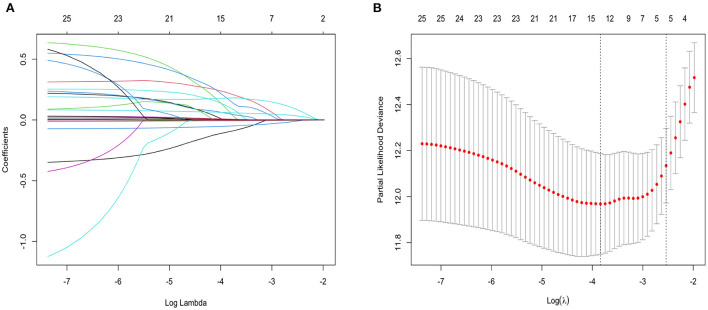
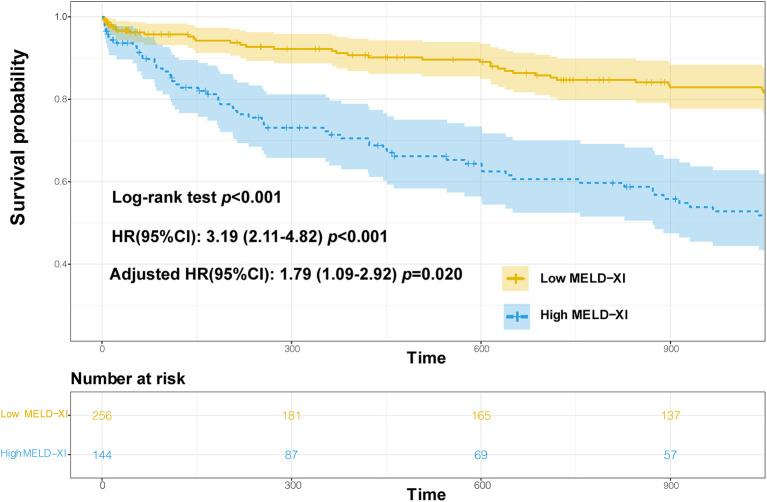
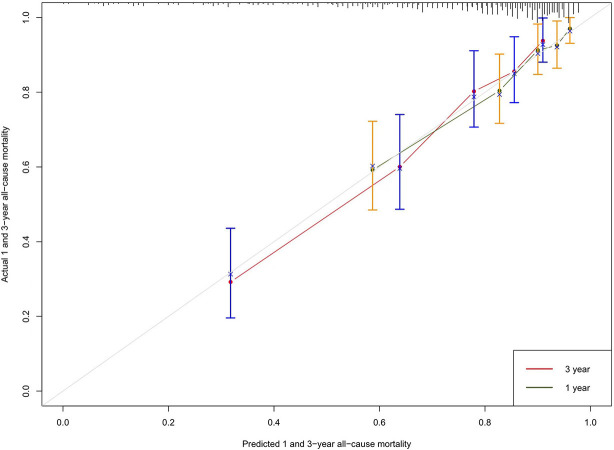
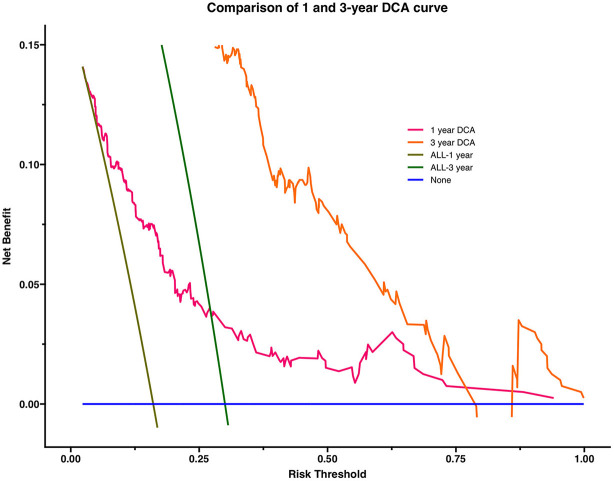
This is a retrospective cohort study of patients with chronic heart failure who were initially hospitalized in the Second Affiliated Hospital of Chongqing Medical University from February 2017 to December 2017. The primary clinical outcome was all-cause mortality within 3 years. Cox regression and lasso regression were used to screen variables and build a prognostic model. Combined with the MELD-XI score, the final model was adjusted, and the predictive ability of the model was evaluated. Survival curves were estimated using the Kaplan-Meier method and compared by the log rank test.
A total of 400 patients with chronic heart failure were included (median age 76 years, 51.5% female). During the 3-year follow-up period, there were 97 all-cause deaths, including 63 cardiac deaths. Six characteristic variables (NT-proBNP, BUN, RDW CV, Na and prealbumin) were selected by univariate Cox regression and lasso regression. Survival analysis results showed that elevated MELD-XI score at baseline predicted the risk of all-cause mortality at 3 years in patients (HR 3.19, 95% CI 2.11-4.82, < 0.001; HR 1.79, 95% CI 1.09-2.92, = 0.020). Subgroup analysis showed that MELD-XI score still had prognostic value in the subgroup without chronic kidney disease (HR 3.30 95%CI 2.01-5.42 < 0.001; HR 1.88 95%CI 1.06-3.35 = 0.032, for interaction = 0.038).
This study proved that the MELD-XI score at admission was related to the poor prognosis of hospitalized patients with chronic heart failure within 3 years.
改良终末期肝病模型(MELD)评分的修正版MELD-XI评分与慢性心力衰竭住院患者的长期预后之间的关系尚不清楚。本研究旨在确定MELD-XI评分与慢性心力衰竭患者长期预后的关系。
这是一项对2017年2月至2017年12月在重庆医科大学附属第二医院首次住院的慢性心力衰竭患者进行的回顾性队列研究。主要临床结局是3年内的全因死亡率。采用Cox回归和套索回归筛选变量并建立预后模型。结合MELD-XI评分对最终模型进行调整,并评估模型的预测能力。采用Kaplan-Meier法估计生存曲线,并通过对数秩检验进行比较。
共纳入400例慢性心力衰竭患者(中位年龄76岁,女性占51.5%)。在3年随访期内,有97例全因死亡,其中63例为心源性死亡。通过单因素Cox回归和套索回归选择了6个特征变量(N末端脑钠肽前体、尿素氮、红细胞分布宽度变异系数、钠和前白蛋白)。生存分析结果显示,基线时MELD-XI评分升高可预测患者3年内全因死亡风险(风险比3.19,95%置信区间2.11-4.82,P<0.001;风险比1.79,95%置信区间1.09-2.92,P=0.020)。亚组分析显示,MELD-XI评分在无慢性肾脏病的亚组中仍具有预后价值(风险比3.30,95%置信区间2.01-5.42,P<0.001;风险比1.88,95%置信区间1.06-3.35,P=0.032,交互作用P=0.038)。
本研究证明入院时的MELD-XI评分与慢性心力衰竭住院患者3年内的不良预后相关。