Genovesi Simonetta, Montelisciani Laura, Viazzi Francesca, Giussani Marco, Lieti Giulia, Patti Ilenia, Orlando Antonina, Antolini Laura, Salvi Paolo, Parati Gianfranco
School of Medicine and Surgery, University of Milano-Bicocca, Milan, Italy.
Cardiology Unit, Istituto Auxologico Italiano, IRCCS, Milan, Italy.
Front Cardiovasc Med. 2022 Aug 11;9:978366. doi: 10.3389/fcvm.2022.978366. eCollection 2022.
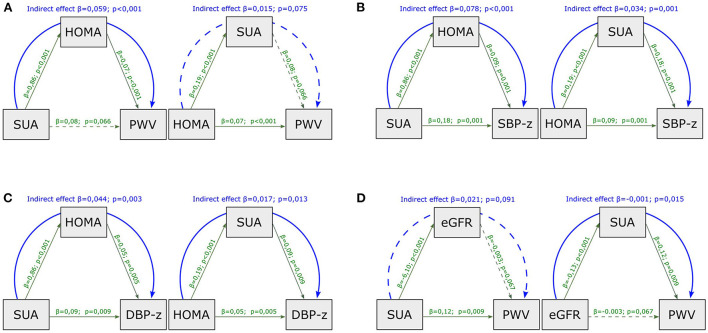
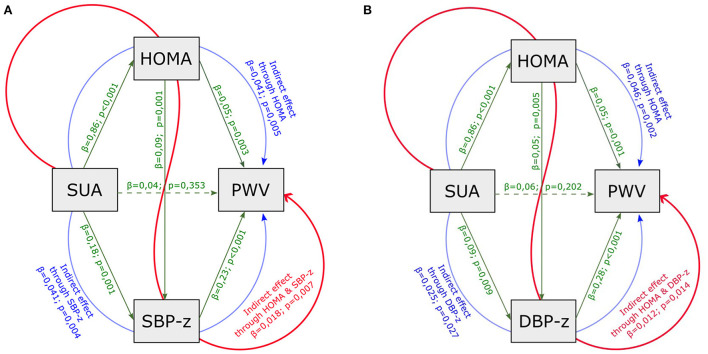
Several studies describe the association between serum uric acid (SUA) and arterial stiffness in adults. Uric acid contributes through several mechanisms to the increase in blood pressure (BP) and adversely affects the insulin signaling pathway. Moreover, SUA predict the development of hypertension and insulin resistance up to type 2 diabetes. Early arterial stiffening, estimated by carotid-femoral pulse wave velocity (PWV), may already be present in pediatric age. Aim of our study was to investigate the relationship between SUA and PWV in a pediatric population and its interaction with insulin resistance and BP. In 322 children and adolescents (56.2% male, mean age 11.3 [SD 2.8] years), we measured weight, height, waist circumference, BP and PWV. We also assayed SUA and estimated glomerular filtration rate (eGFR) and calculated HOMA-index as a marker of insulin resistance. Simple and multiple regression analyses were performed to assess variables associated with PWV. Mediation models were applied to identify the direct and indirect effects of individual variables on PWV. On univariate analysis, age ( < 0.001), waist circumference-to-height ratio ( = 0.036), systolic and diastolic BP (SBP and DBP) score ( < 0.001), heart rate ( = 0.028), SUA ( = 0.002), HOMA-index ( < 0.001), and eGFR ( = 0.014) were significantly associated with PWV. The multiple regression model showed that only age ( = 0.028), SBP score ( = 0.006), and heart rate ( = 0.001) were significantly associated with PWV. The results were superimposable when the DBP score replaced the SBP score in the model. Mediation models showed that the effect of eGFR on PWV was fully mediated by SUA ( = 0.015) and that the effect of SUA on PWV was totally mediated by HOMA-index ( < 0.001). Both SUA ( < 0.01) and HOMA-index ( < 0.01) had a significant association with higher SBP (DBP) scores. The double mediation model including both BP and HOMA-index showed that the SUA effect on PWV was totally mediated by both variables ( = 0.005, for HOMA-index, = 0.004, for SBP score and = 0.007, for combined effect). The results were superimposable when the DBP score replaced the SBP score in the model. In conclusion, insulin resistance and BP are both important mediators of the association between SUA and vascular stiffness in pediatric age.
多项研究描述了成人血清尿酸(SUA)与动脉僵硬度之间的关联。尿酸通过多种机制导致血压(BP)升高,并对胰岛素信号通路产生不利影响。此外,SUA可预测高血压和直至2型糖尿病的胰岛素抵抗的发展。通过颈股脉搏波速度(PWV)估计的早期动脉僵硬度在儿童期可能就已存在。我们研究的目的是调查儿科人群中SUA与PWV之间的关系及其与胰岛素抵抗和BP的相互作用。在322名儿童和青少年(男性占56.2%,平均年龄11.3[标准差2.8]岁)中,我们测量了体重、身高、腰围、BP和PWV。我们还检测了SUA和估算肾小球滤过率(eGFR),并计算了HOMA指数作为胰岛素抵抗的标志物。进行了简单和多元回归分析以评估与PWV相关的变量。应用中介模型来确定各个变量对PWV的直接和间接影响。单因素分析显示,年龄(<0.001)、腰围身高比(=0.036)、收缩压和舒张压(SBP和DBP)评分(<0.001)、心率(=0.028)、SUA(=0.002)、HOMA指数(<0.001)和eGFR(=0.014)与PWV显著相关。多元回归模型显示,只有年龄(=0.028)、SBP评分(=0.006)和心率(=0.001)与PWV显著相关。当模型中的DBP评分取代SBP评分时,结果是可叠加的。中介模型显示,eGFR对PWV 的影响完全由SUA介导(=0.015),SUA对PWV的影响完全由HOMA指数介导(<0.001)。SUA(<0.01)和HOMA指数(<0.01)均与较高的SBP(DBP)评分显著相关。包括BP和HOMA指数的双重中介模型显示,SUA对PWV的影响完全由这两个变量介导(HOMA指数=0.005,SBP评分为=0.004,联合效应为=0.007)。当模型中的DBP评分取代SBP评分时,结果是可叠加的。总之,胰岛素抵抗和BP都是儿科人群中SUA与血管僵硬度之间关联的重要中介因素。