Genovesi Simonetta, Montelisciani Laura, Giussani Marco, Lieti Giulia, Patti Ilenia, Orlando Antonina, Antolini Laura, Parati Gianfranco
School of Medicine and Surgery, University of Milano-Bicocca, Via Cadore 48, 20900 Monza, Italy.
Cardiologic Unit, IRCCS, Istituto Auxologico Italiano, 20100 Milan, Italy.
Metabolites. 2023 Feb 23;13(3):327. doi: 10.3390/metabo13030327.
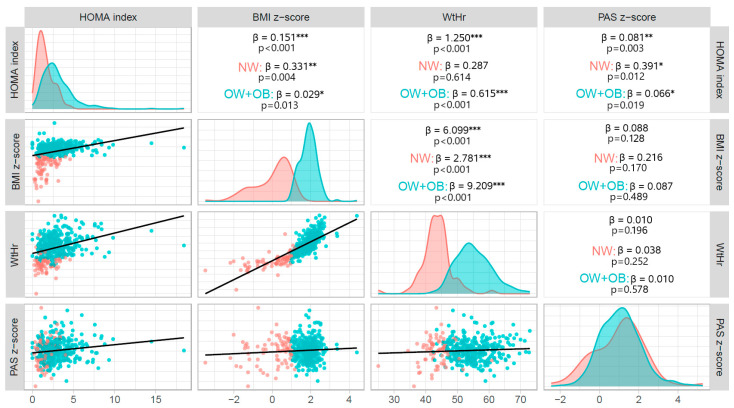
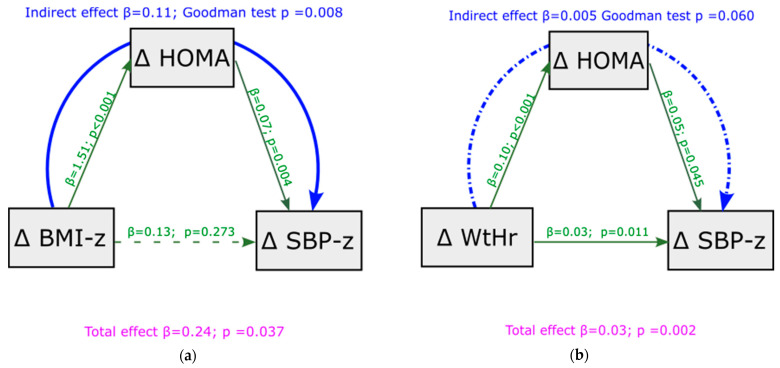
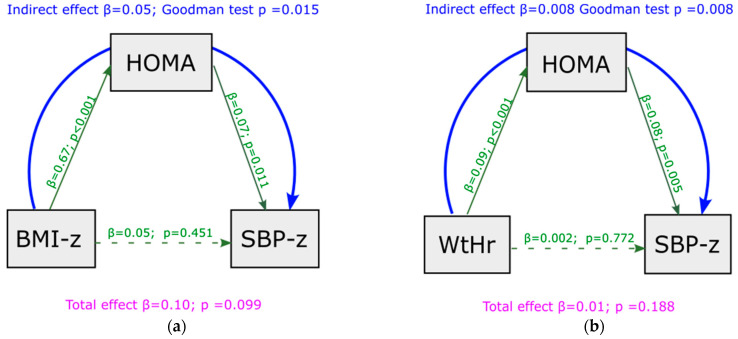
Excess weight and high waist circumference (WC) are associated with increased blood pressure (BP), starting from the pediatric age. Insulin resistance is associated with elevated BP in childhood. The aim of the study was to assess the role of insulin resistance in mediating the relationship between body mass index (BMI), WC, and BP values in a pediatric population referred to a cardio-pediatric center for the presence of one or more cardiovascular risk factors. In 419 children (mean age 10.7 [standard deviation, SD 2.5] years), the following parameters were collected both in basal conditions and after 18.6 (SD 9.3) months of follow-up during which a treatment based on lifestyle and dietary modifications was given: systolic and diastolic BP (SBP and DBP), WC, plasma glucose, and insulin values. The HOMA (Homeostasis Model Assessment)-index was considered as an expression of insulin resistance. At baseline there was a significant correlation between HOMA-index and SBP z-score (β = 0.081, = 0.003), and insulin resistance was a mediator of the relationship between BMI and SBP z-score ( = 0.015), and between waist circumference to height (WtHr) and SBP z-score ( = 0.008). The effect of BMI z-score modifications on SBP z-score changes from baseline to follow-up was totally mediated by HOMA-index changes ( = 0.008), while HOMA-index only partially mediated the effect of WtHr modifications on SBP z-score changes ( = 0.060). Our study strongly suggests that, in a pediatric population at cardiovascular risk, the HOMA-index is an important mediator of the relationship between BMI, WC and SBP.
从儿童期开始,超重和高腰围(WC)就与血压(BP)升高有关。胰岛素抵抗与儿童期血压升高有关。本研究的目的是评估胰岛素抵抗在一个因存在一种或多种心血管危险因素而被转诊至儿童心脏病中心的儿科人群中,介导体重指数(BMI)、腰围和血压值之间关系的作用。在419名儿童(平均年龄10.7[标准差,SD 2.5]岁)中,在基础条件下以及在18.6(SD 9.3)个月的随访期间(在此期间给予基于生活方式和饮食调整的治疗)收集了以下参数:收缩压和舒张压(SBP和DBP)、腰围、血浆葡萄糖和胰岛素值。稳态模型评估(HOMA)指数被视为胰岛素抵抗的一种表达。在基线时,HOMA指数与SBP z评分之间存在显著相关性(β = 0.081,P = 0.003),并且胰岛素抵抗是BMI与SBP z评分之间关系的中介因素(P = 0.015),以及腰围身高比(WtHr)与SBP z评分之间关系的中介因素(P = 0.008)。从基线到随访期间,BMI z评分变化对SBP z评分变化的影响完全由HOMA指数变化介导(P = 0.008),而HOMA指数仅部分介导WtHr变化对SBP z评分变化的影响(P = 0.060)。我们的研究强烈表明,在有心血管风险的儿科人群中,HOMA指数是BMI、腰围和SBP之间关系的重要中介因素。