Department of Microbiology, Institute of Medical Sciencesgrid.463154.1, Banaras Hindu University, Varanasi, Uttar Pradesh, India.
Department of Microbiology, All India Institute of Medical Sciencesgrid.463154.1, Raipur, Chattisgarh, India.
Microbiol Spectr. 2022 Oct 26;10(5):e0087122. doi: 10.1128/spectrum.00871-22. Epub 2022 Aug 29.
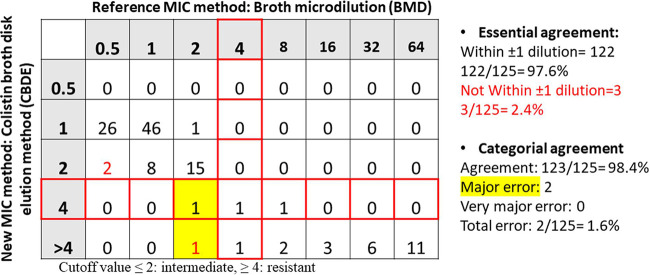
The rapid emergence of drug resistance in Acinetobacter baumannii has put forward the use of colistin as a last-resort treatment for infections with A. baumannii. Empirical colistin use without prior susceptibility testing has been one of the factors that has been promoting drug resistance in low-resource settings. In this regard, while the advocated broth microdilution (BMD) method for colistin susceptibility testing is often considered cumbersome, the preferable colistin broth disk elution (CBDE) method has not yet been approved for A. baumannii. To prevent the underreporting of colistin susceptibility, we tested the CBDE method for A. baumannii and compared the results with those of BMD. A total of 125 A. baumannii, including 100 susceptible and 25 resistant isolates were tested via the CBDE method and compared with the standard BMD method. The essential agreement, categorical agreement, sensitivity, and specificity for CBDE were 97.6% ( = 122), 98.4% ( = 123), 100%, and 98.40%, respectively. The percentage of major error found was 1.6% ( = 2), and no very major error was found. CBDE in A. baumannii could be considered in low-resource settings. The relatively cumbersome broth microdilution (BMD) method for routine colistin susceptibility testing has not been adopted, especially in low-resource settings, often leading to the underreporting of colistin susceptibility and the promotion of the empirical use of colistin. In this regard, the much-preferred colistin broth disk elution (CBDE) method has not yet been approved for A. baumannii. We evaluated colistin susceptibility via the CBDE method, compared the results with those of the BMD method in 125 A. baumannii isolates with various profiles, and inferred that the CBDE method using 50 μL inoculum could be helpful, at least in resource-limited setups, versus not reporting susceptibility testing for colistin.
鲍曼不动杆菌耐药性的迅速出现,使得多粘菌素被用作治疗鲍曼不动杆菌感染的最后手段。在资源匮乏的环境中,没有进行药敏试验就经验性地使用多粘菌素,是导致耐药性产生的因素之一。在这方面,虽然推荐使用肉汤微量稀释法(BMD)进行多粘菌素药敏试验,但繁琐的操作往往令人望而却步,而更好的多粘菌素肉汤纸片洗脱法(CBDE)尚未被批准用于鲍曼不动杆菌。为了防止低估多粘菌素的药敏率,我们对鲍曼不动杆菌的 CBDE 方法进行了测试,并将结果与 BMD 方法进行了比较。共检测了 125 株鲍曼不动杆菌,包括 100 株敏感株和 25 株耐药株,采用 CBDE 法进行检测,并与标准 BMD 法进行比较。CBDE 的符合率、符合率、敏感性和特异性分别为 97.6%(=122)、98.4%(=123)、100%和 98.40%。主要误差率为 1.6%(=2),没有发现非常大的误差。CBDE 可用于资源匮乏的环境中。在资源匮乏的环境中,特别是在资源匮乏的环境中,通常不会采用常规多粘菌素药敏试验繁琐的肉汤微量稀释(BMD)方法,这往往导致低估多粘菌素的药敏率,并促进经验性使用多粘菌素。在这方面,更好的多粘菌素肉汤纸片洗脱(CBDE)方法尚未被批准用于鲍曼不动杆菌。我们评估了 CBDE 方法对 125 株鲍曼不动杆菌不同表型菌株的多粘菌素药敏率,并将结果与 BMD 方法进行了比较,推断使用 50μL 接种物的 CBDE 方法至少在资源有限的环境中是有帮助的,而不是不报告多粘菌素的药敏试验。