Pharmacovigilance Center, Hospital University Pharmacotoxicology Department, Hospices civils de Lyon, 69003 Lyon, France.
Poison control and toxicovigilance center, Hospital University Pharmacotoxicology Department, Hospices civils de Lyon, 69003 Lyon, France; Laboratoire de Biométrie et Biologie Evolutive UMR 5558, CNRS, Université Lyon 1, Université de Lyon, 69100 Villeurbanne, France.
Therapie. 2023 May-Jun;78(3):279-292. doi: 10.1016/j.therap.2022.07.009. Epub 2022 Aug 1.
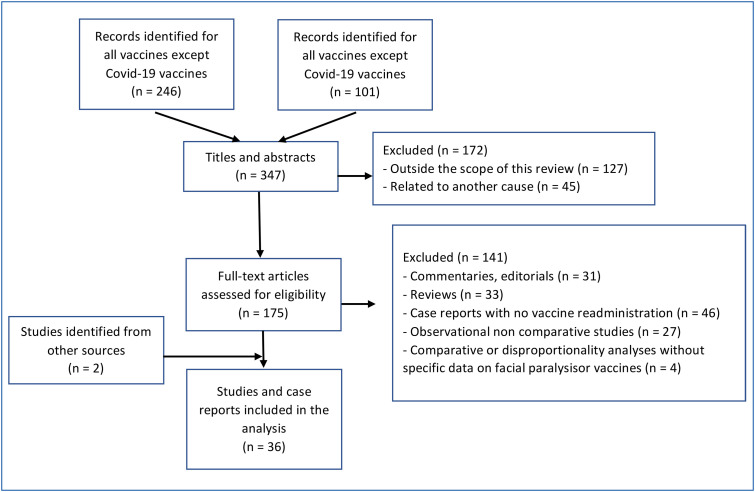
The association between vaccines and peripheral facial palsy (PFP), an issue that has been the subject of debate for many years, has been raised again following results of clinical trials assessing mRNA based COVID-19 vaccines. To review the available literature on this topic, PubMed was searched from inception until February 25, 2022. Inclusion criteria were case reports with documented rechallenge and comparative epidemiological studies. Cases of COVID-19 vaccine-induced PFP with available data on vaccine rechallenge were also identified from Vigibase until December 31, 2021. Of the 347 articles retrieved, 32 comparative epidemiological studies, 1 meta-analysis and 4 case reports met our criteria, of which 13 involved COVID-19 vaccines. Eight studies found an association between at least one vaccine and the occurrence of PFP, whereas 24 did not. Positive studies involved seasonal or pandemic H1N1 influenza vaccines administered parenterally (4 studies) or intranasally (1 study with a toxin-adjuvanted vaccine), BNT162b2, a mRNA COVID-19 vaccine (1 disproportionality analysis and 1 observed-to-expected analysis) and an inactivated virus COVID-19 vaccine (CoronaVac®) (1 study combining a case-control and an observed-to-expected approach). Strong evidence was found only for the intranasal influenza vaccine while other positive studies detected only a marginal association between PFP and vaccination. Of the four case reports with documented rechallenge, only two were positive and involved an influenza vaccine and tozinameran in one case each. In Vigibase, rechallenge was documented in 49 reports with 29 (59.2%) cases being negative and 20 (40.8%) positive. The available data did not confirm an excess risk of PFP after vaccination in most studies. Moreover, of the eight epidemiological studies suggesting a possible excess risk of PFP after any vaccine, three were disproportionality analyses and two observed-to excepted analyses, suggesting great caution should be taken when interpreting these results.
疫苗与周围性面神经麻痹(PFP)之间的关联是一个多年来备受争议的问题,在评估 mRNA 基于 COVID-19 疫苗的临床试验结果公布后,这一问题再次受到关注。为了回顾这一主题的现有文献,我们对 PubMed 进行了检索,检索时间从建库开始至 2022 年 2 月 25 日。纳入标准为有记录再挑战的病例报告和比较性流行病学研究。还从 Vigibase 中确定了有 COVID-19 疫苗诱导性 PFP 数据和疫苗再挑战数据的病例报告,检索时间截至 2021 年 12 月 31 日。在检索到的 347 篇文章中,有 32 项比较性流行病学研究、1 项荟萃分析和 4 篇病例报告符合我们的标准,其中 13 项涉及 COVID-19 疫苗。有 8 项研究发现至少有一种疫苗与 PFP 的发生之间存在关联,而有 24 项研究没有发现这种关联。阳性研究涉及的疫苗为季节性或大流行 H1N1 流感疫苗(4 项研究)或鼻内接种疫苗(1 项研究使用了毒素佐剂疫苗)、BNT162b2(1 项基于比例失衡分析和 1 项观察到的预期分析)以及一种灭活病毒 COVID-19 疫苗(CoronaVac®)(1 项病例对照研究和观察到的预期分析相结合的研究)。仅对鼻内流感疫苗有强有力的证据,而其他阳性研究仅检测到 PFP 与疫苗接种之间存在轻微关联。在有记录再挑战的 4 篇病例报告中,仅有 2 篇为阳性,分别涉及流感疫苗和 tozinameran。在 Vigibase 中,再挑战在 49 份报告中得到记录,其中 29 份(59.2%)为阴性,20 份(40.8%)为阳性。在大多数研究中,疫苗接种后 PFP 的风险并未增加。此外,在提示任何疫苗接种后 PFP 风险可能增加的 8 项流行病学研究中,有 3 项为比例失衡分析,2 项为观察到的预期分析,这表明在解释这些结果时应非常谨慎。