Rugo Hope S, Tolaney Sara M, Loirat Delphine, Punie Kevin, Bardia Aditya, Hurvitz Sara A, O'Shaughnessy Joyce, Cortés Javier, Diéras Véronique, Carey Lisa A, Gianni Luca, Piccart Martine J, Loibl Sibylle, Goldenberg David M, Hong Quan, Olivo Martin, Itri Loretta M, Kalinsky Kevin
Department of Medicine, University of California San Francisco Helen Diller Family Comprehensive Cancer Center, San Francisco, CA, USA.
Department of Medical Oncology, Dana-Farber Cancer Institute, Boston, MA, USA.
NPJ Breast Cancer. 2022 Aug 29;8(1):98. doi: 10.1038/s41523-022-00467-1.
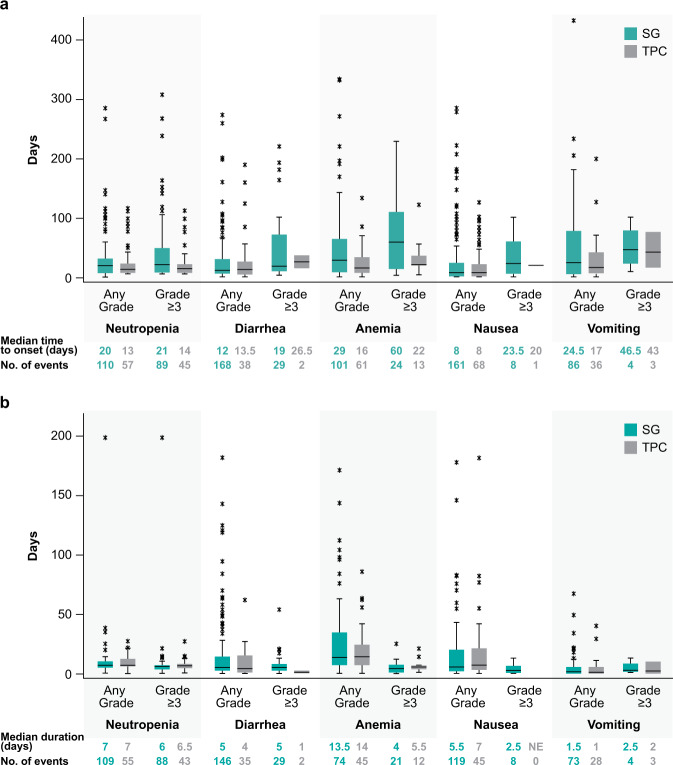
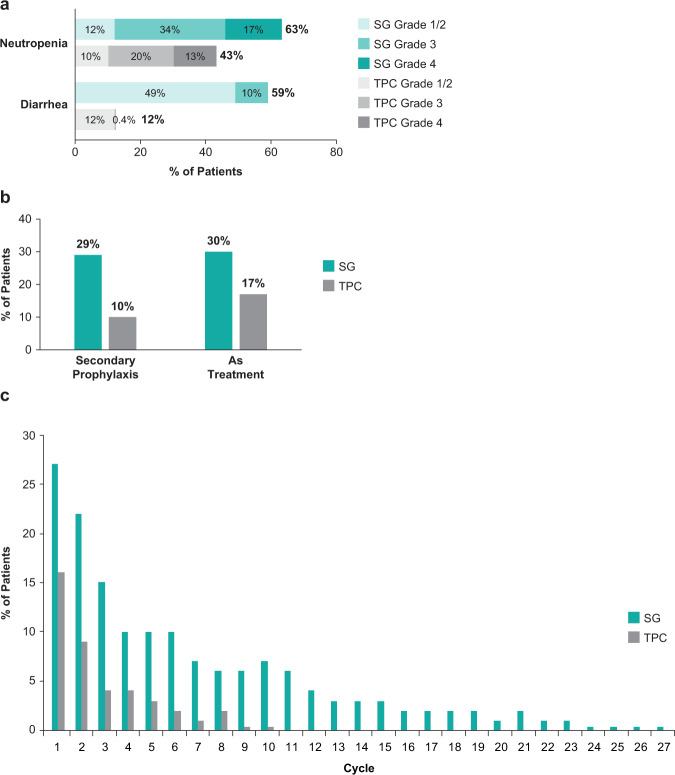
Sacituzumab govitecan (SG) is an anti-Trop-2 antibody-drug conjugate with an SN-38 payload. In the ASCENT study, patients with metastatic triple-negative breast cancer (mTNBC) relapsed/refractory to ≥2 prior chemotherapy regimens (≥1 in the metastatic setting), received SG or single-agent treatment of physician's choice (eribulin, vinorelbine, capecitabine, or gemcitabine). This ASCENT safety analysis includes the impact of age and UGT1A1 polymorphisms, which hinder SN-38 detoxification. SG demonstrated a manageable safety profile in patients with mTNBC, including those ≥65 years; neutropenia/diarrhea are key adverse events (AE). Patients with UGT1A1 *28/*28 genotype versus those with 1/*28 and *1/*1 genotypes had higher rates of grade ≥3 SG-related neutropenia (59% vs 47% and 53%), febrile neutropenia (18% vs 5% and 3%), anemia (15% vs 6% and 4%), and diarrhea (15% vs 9% and 10%), respectively. Individuals with UGT1A1 *28/*28 genotype should be monitored closely; active monitoring and routine AE management allow optimal therapeutic exposure of SG.
戈沙妥珠单抗(SG)是一种带有SN-38有效载荷的抗Trop-2抗体药物偶联物。在ASCENT研究中,既往接受过≥2种化疗方案(≥1种为转移性疾病治疗方案)后复发/难治的转移性三阴性乳腺癌(mTNBC)患者,接受了SG或医生选择的单药治疗(艾日布林、长春瑞滨、卡培他滨或吉西他滨)。这项ASCENT安全性分析纳入了年龄和UGT1A1基因多态性的影响,这些因素会阻碍SN-38的解毒过程。SG在mTNBC患者中显示出可控的安全性,包括65岁及以上的患者;中性粒细胞减少症/腹泻是主要不良事件(AE)。与携带1/28和1/*1基因型的患者相比,携带UGT1A1 *28/*28基因型的患者发生≥3级SG相关中性粒细胞减少症、发热性中性粒细胞减少症、贫血和腹泻的比例更高,分别为59%对47%和53%、18%对5%和3%、15%对6%和4%、15%对9%和10%。携带UGT1A1 *28/*28基因型的个体应密切监测;积极监测和常规不良事件管理可使SG达到最佳治疗暴露水平。