Akao Keiji, Ishida Yusuke, Nakazawa Koichi, Okada Toshio, Fujiyoshi Toshiki, Kawachi Aya, Uchino Hiroyuki
Department of Anesthesiology, Tokyo Medical University Hospital, Tokyo, JPN.
Department of Cardiovascular Surgery, Tokyo Medical University Hospital, Tokyo, JPN.
Cureus. 2022 Jul 26;14(7):e27292. doi: 10.7759/cureus.27292. eCollection 2022 Jul.
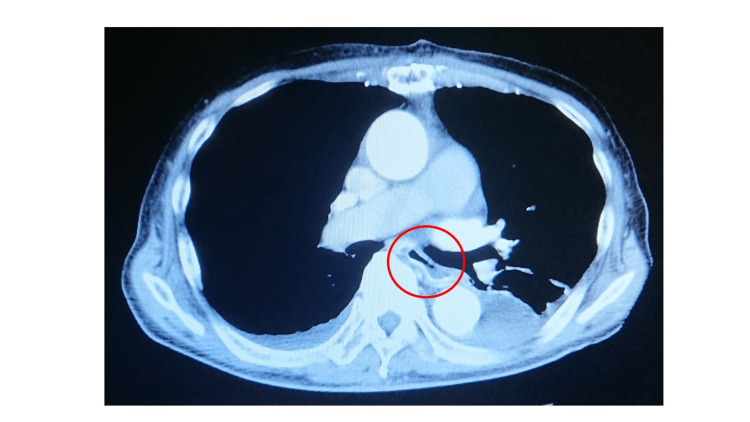
Transesophageal echocardiography (TEE) is a necessary diagnostic tool for cardiac surgery, including for intraoperative evaluation of the morphology and function of each structure. On the other hand, many complications caused by insertion and manipulation of the TEE probe have been reported, such as gastrointestinal injuries and hematoma, as well as esophageal perforation. Here, we report a case in which a large submucosal esophageal hematoma was found on the fourth postoperative day after surgery using TEE for mitral regurgitation. The patient was an 81-year-old man who underwent mitral valve replacement for mitral regurgitation. On the fourth postoperative day, anorexia and blood-tinged sputum were observed. A computed tomography (CT) scan of the chest displayed a giant esophageal submucosal hematoma. When performing TEE, to avoid complications, it is important to handle the TEE probe with care and to avoid leaving the device at the same site for long periods of time.
经食管超声心动图(TEE)是心脏手术中必不可少的诊断工具,包括用于术中评估各结构的形态和功能。另一方面,已经报道了许多由TEE探头插入和操作引起的并发症,如胃肠道损伤、血肿以及食管穿孔。在此,我们报告一例在使用TEE治疗二尖瓣反流术后第四天发现巨大食管黏膜下血肿的病例。患者为一名81岁男性,因二尖瓣反流接受二尖瓣置换术。术后第四天,观察到患者出现厌食和痰中带血。胸部计算机断层扫描(CT)显示巨大食管黏膜下血肿。在进行TEE检查时,为避免并发症,小心操作TEE探头并避免将设备长时间留在同一部位非常重要。