Instituto Gonçalo Moniz, Fundação Oswaldo Cruz (FIOCRUZ), Salvador, BA, Brazil.
Department of Chemistry and Biochemistry, Border Biomedical Research Center, The University of Texas at El Paso, El Paso, Texas, U.S.A.
Emerg Microbes Infect. 2022 Dec;11(1):2147-2159. doi: 10.1080/22221751.2022.2114852.
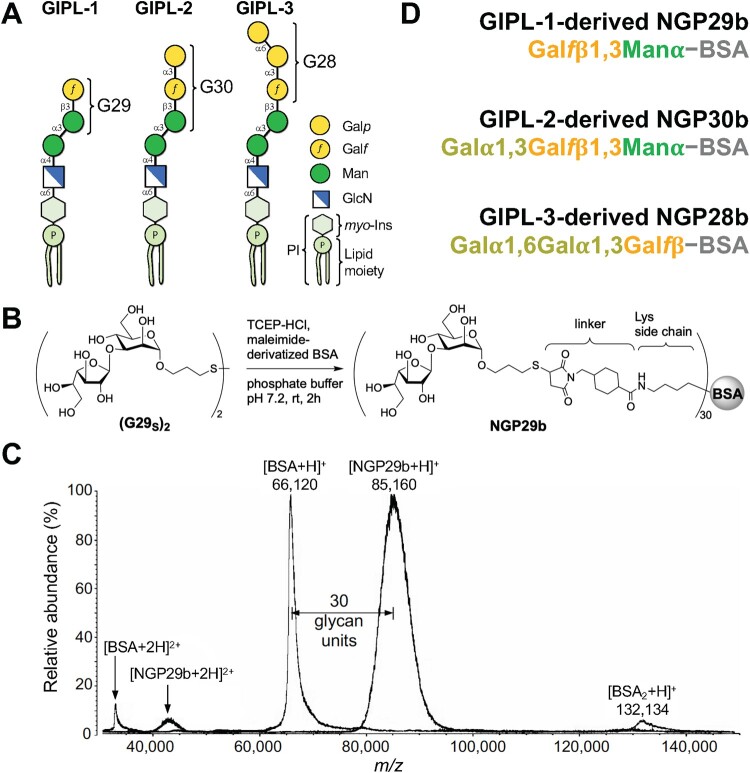
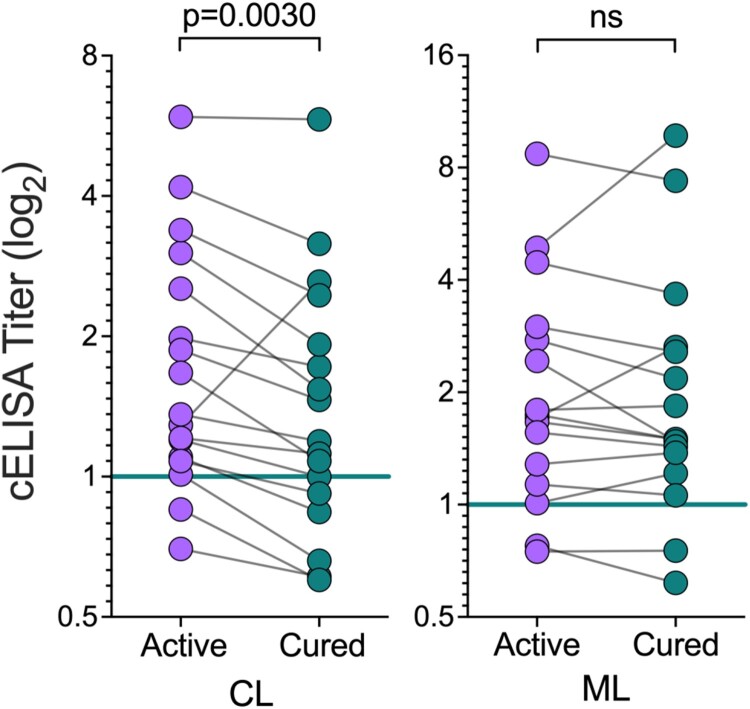
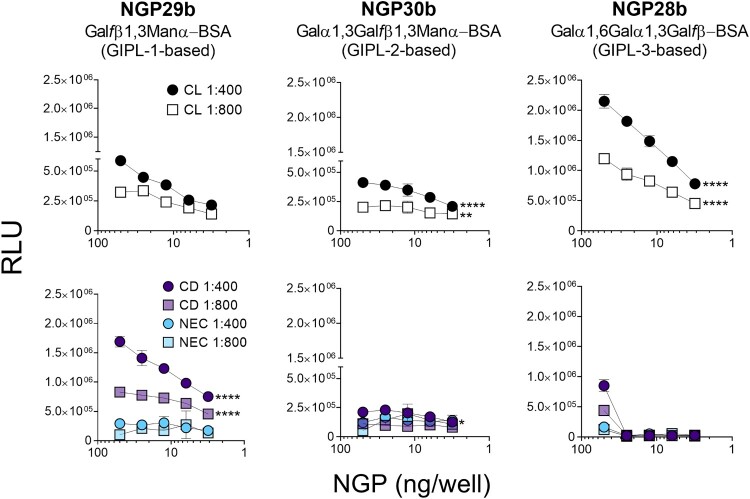
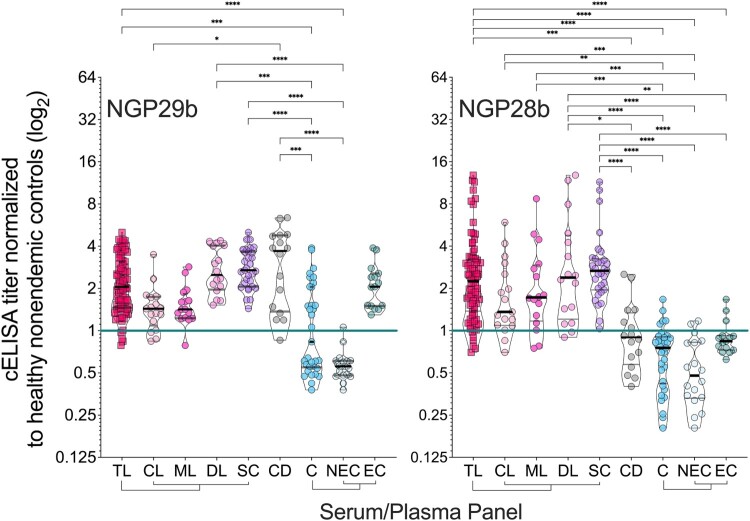
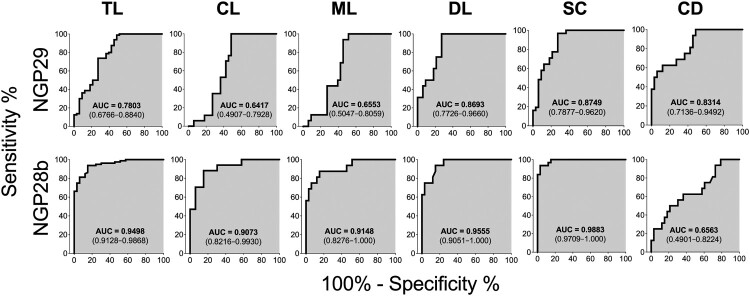
American tegumentary leishmaniasis (TL) caused by is characterized by a spectrum of clinical presentations, ranging from localized cutaneous ulcers (CL), mucosal (ML), or disseminated (DL) disease, to a subclinical (SC) asymptomatic form. Current diagnosis based on parasite culture and/or microscopy lacks sensitivity and specificity. Previous studies showed that patients with CL and ML have very high levels of -specific anti-α-Gal antibodies. However, the native parasite α-Gal glycotope(s) is(are) still elusive, thus they have not yet been explored for a more accurate TL diagnosis. Using a chemiluminescent immunoassay, we evaluated the seroreactivity of TL patients across its clinical spectrum, and of endemic (EC) and nonendemic healthy controls (NEC) against three synthetic neoglycoproteins (NGP29b, NGP30b, and NGP28b), respectively comprising the derived type-2 glycoinositolphospholipid (GIPL)-1 (Galβ1,3Manα), GIPL-2 (Galα1,3Galβ1,3Manα), and GIPL-3 (Galα1,6Galα1,3Galβ) glycotopes. Contrary to NGP29b and NGP30b, NGP28b exhibited high sensitivity and specificity to a CL serum pool. More importantly, NGP28b reacted strongly and specifically with individual sera from distinct clinical forms of TL, especially with SC sera, with 94% sensitivity and 97% specificity, by post-two-graph receiver-operating characteristic curve analysis. Contrary to NGP29b, NGP28b showed low cross-reactivity with Chagas disease and control (NEC/EC) sera. Additionally, seroreactivity of CL patients against NGP28b was significantly decreased after successful chemotherapy, indicating that -specific anti-α-Gal antibodies may serve as an early biomarker of cure in CL. Our data also points towards the applicability of type-2 GIPL-3-derived Galα1,6Galα1,3Galβ glycotope for the serological diagnosis of American TL, particularly of the subclinical form.
美国皮肤利什曼病(TL)由 引起,其临床表现多样,从局限性皮肤溃疡(CL)、黏膜(ML)或播散性(DL)疾病,到无症状的亚临床(SC)形式。目前基于寄生虫培养和/或显微镜检查的诊断缺乏敏感性和特异性。以前的研究表明,CL 和 ML 患者具有非常高水平的 -特异性抗-α-Gal 抗体。然而,天然寄生虫 α-Gal 糖基表位仍然难以捉摸,因此尚未对其进行更准确的 TL 诊断的探索。我们使用化学发光免疫分析评估了不同临床类型 TL 患者、流行地区(EC)和非流行地区健康对照(NEC)对三种合成糖基化蛋白(NGP29b、NGP30b 和 NGP28b)的血清反应性,这三种糖基化蛋白分别包含衍生的 II 型糖基肌醇磷脂(GIPL)-1(Galβ1,3Manα)、GIPL-2(Galα1,3Galβ1,3Manα)和 GIPL-3(Galα1,6Galα1,3Galβ)糖基表位。与 NGP29b 和 NGP30b 相反,NGP28b 对 CL 血清池具有高灵敏度和特异性。更重要的是,NGP28b 与不同临床类型 TL 的个体血清强烈且特异性反应,特别是与 SC 血清,通过后双图接收者操作特征曲线分析,其敏感性为 94%,特异性为 97%。与 NGP29b 相反,NGP28b 与恰加斯病和对照(NEC/EC)血清的交叉反应性较低。此外,CL 患者对 NGP28b 的血清反应性在成功化疗后显著降低,表明 -特异性抗-α-Gal 抗体可能作为 CL 治愈的早期生物标志物。我们的数据还表明,II 型 GIPL-3 衍生的 Galα1,6Galα1,3Galβ 糖基表位可用于美国 TL 的血清学诊断,特别是亚临床形式。