Departmentof Pediatrics, Tampere University Hospital, Faculty of Medicine and Health Technology, University of Tampere, Tampere, Finland.
Human Microbiome Research Program, Faculty of Medicine, University of Helsinki, Helsinki, Finland.
Inflamm Bowel Dis. 2023 Jan 5;29(1):116-124. doi: 10.1093/ibd/izac182.
The role of intestinal microbiota in inflammatory bowel diseases is intensively researched. Pediatric studies on the relation between microbiota and treatment response are sparse. We aimed to determine whether absolute abundances of gut microbes characterize the response to infliximab induction in pediatric inflammatory bowel disease.
We recruited pediatric patients with inflammatory bowel disease introduced to infliximab at Children's Hospital, University of Helsinki. Stool samples were collected at 0, 2, and 6 weeks for microbiota and calprotectin analyses. We defined treatment response as fecal calprotectin value <100 µg/g at week 6. Intestinal microbiota were analyzed by 16S ribosomal RNA gene amplicon sequencing using the Illumina MiSeq platform. We analyzed total bacterial counts using quantitative polymerase chain reaction and transformed the relative abundances into absolute abundances based on the total counts.
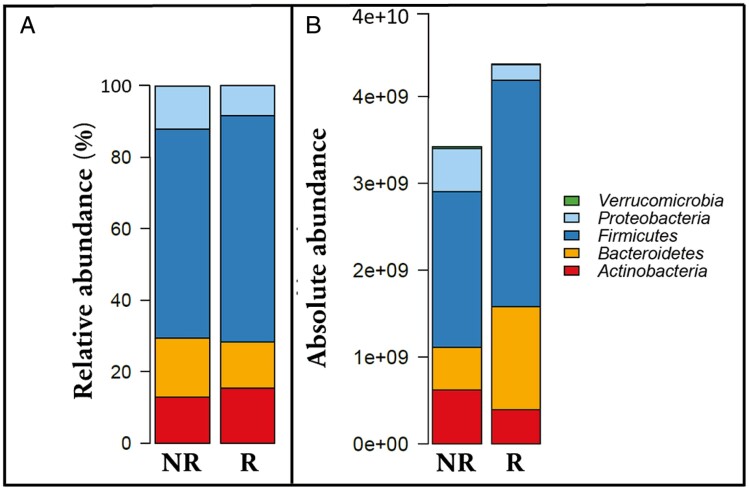
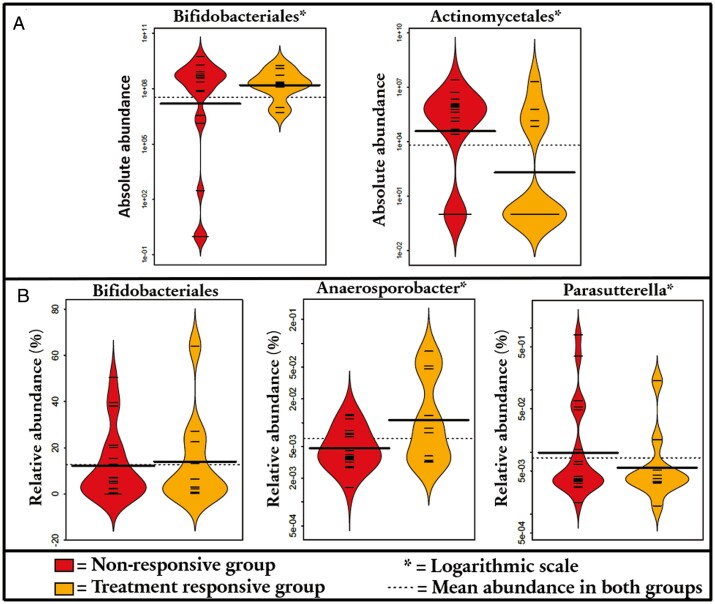
At baseline, the intestinal microbiota in the treatment responsive group (n = 10) showed a higher absolute abundance of Bifidobacteriales and a lower absolute abundance of Actinomycetales than nonresponders (n = 19). The level of inflammation according to fecal calprotectin showed no statistically significant association with the absolute abundances of fecal microbiota. The results on relative abundances differed from the absolute abundances. At the genus level, the responders had an increased relative abundance of Anaerosporobacter but a reduced relative abundance of Parasutterella at baseline.
High absolute abundance of Bifidobacteriales in the gut microbiota of pediatric patients reflects anti-inflammatory characteristics associated with rapid response to therapy. This warrants further studies on whether modification of pretreatment microbiota might improve the outcomes.
肠道微生物群在炎症性肠病中的作用正在被深入研究。儿科领域中关于微生物群与治疗反应之间关系的研究较少。我们旨在确定肠道微生物的绝对丰度是否可以反映儿科炎症性肠病患者对英夫利昔单抗诱导治疗的反应。
我们招募了在赫尔辛基大学儿童医院接受英夫利昔单抗治疗的炎症性肠病儿科患者。在 0、2 和 6 周时采集粪便样本进行微生物群和钙卫蛋白分析。我们将粪便钙卫蛋白值在第 6 周时<100 µg/g 定义为治疗反应。通过 Illumina MiSeq 平台使用 16S 核糖体 RNA 基因扩增子测序分析肠道微生物群。我们使用定量聚合酶链反应分析总细菌计数,并根据总计数将相对丰度转换为绝对丰度。
在基线时,治疗反应组(n=10)的肠道微生物群中双歧杆菌目(Bifidobacteriales)的绝对丰度较高,而放线菌目(Actinomycetales)的绝对丰度较低,而非反应组(n=19)则相反。根据粪便钙卫蛋白水平,炎症程度与粪便微生物群的绝对丰度无统计学显著关联。相对丰度的结果与绝对丰度不同。在属水平上,反应者的Anaerosporobacter 相对丰度增加,而 Parasutterella 的相对丰度降低。
儿科患者肠道微生物群中双歧杆菌目的高绝对丰度反映了与快速治疗反应相关的抗炎特征。这表明进一步研究预处理微生物群的改变是否可以改善治疗结果是有必要的。