Klingberg Eva, Strid Hans, Ståhl Arne, Deminger Anna, Carlsten Hans, Öhman Lena, Forsblad-d'Elia Helena
Department of Rheumatology and Inflammation Research, Sahlgrenska Academy at the University of Gothenburg, Guldhedsgatan 10A, S-413 46, Gothenburg, Sweden.
Department of Internal Medicine, Södra Älvsborgs Sjukhus, Borås, Sweden.
Arthritis Res Ther. 2017 Feb 2;19(1):21. doi: 10.1186/s13075-017-1223-2.
Patients with ankylosing spondylitis (AS) are at increased risk of developing inflammatory bowel disease (IBD). We aimed to determine the variation in fecal calprotectin in AS over 5 years in relation to disease activity and medication and also to study the incidence of and predictors for development of IBD.
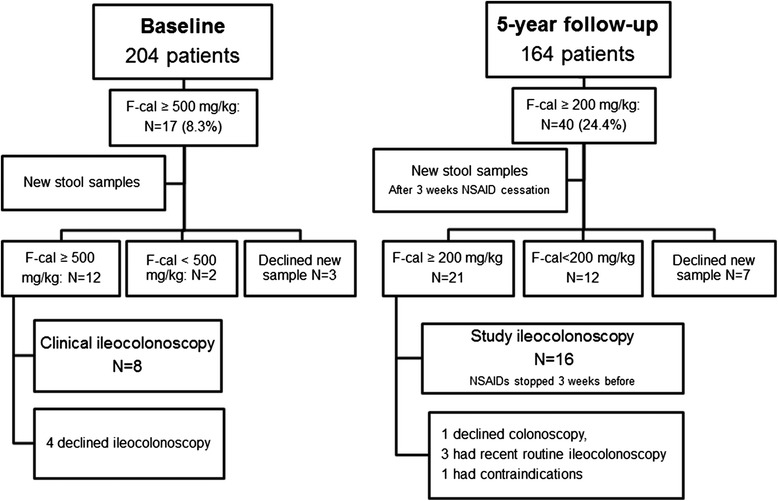
Fecal calprotectin was assessed at baseline (n = 204) and at 5-year follow-up (n = 164). The patients answered questionnaires and underwent clinical evaluations. At baseline and at 5-year follow-up, ileocolonoscopy was performed in patients with fecal calprotectin ≥500 mg/kg and ≥200 mg/kg, respectively. The medical records were checked for diagnoses of IBD during the follow-up period.
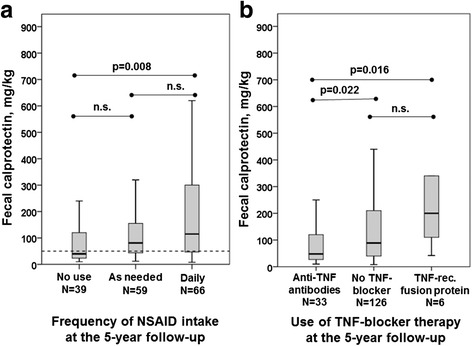
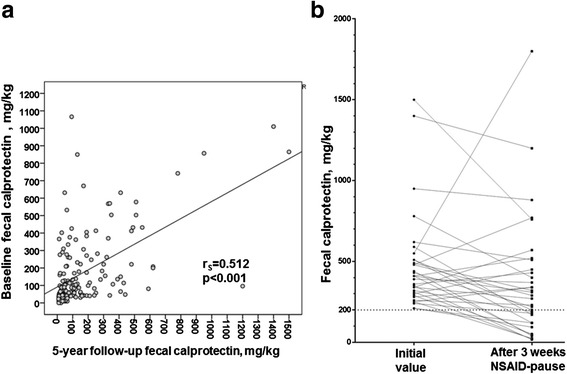
Fecal calprotectin >50 mg/kg was found in two-thirds of the patients at both study visits. In 80% of the patients, fecal calprotectin changed by <200 mg/kg between the two measuring points. Baseline fecal calprotectin was positively correlated with Ankylosing Spondylitis Disease Activity Score based on C-reactive protein, Bath Ankylosing Spondylitis Disease Activity Index, Bath Ankylosing Spondylitis Functional Index, C-reactive protein, erythrocyte sedimentation rate, and fecal calprotectin at 5-year follow-up. The use of nonsteroidal anti-inflammatory drugs (NSAIDs) was associated with higher fecal calprotectin, and 3-week cessation of NSAIDs resulted in a drop of a median 116 mg/kg in fecal calprotectin. The use of tumor necrosis factor (TNF) blockers was associated with lower fecal calprotectin at both visits, but the users of TNF receptor fusion proteins had significantly higher fecal calprotectin than users of anti-TNF antibodies at 5-year follow-up. The 5-year incidence of Crohn's disease (CD) was 1.5% and was predicted by high fecal calprotectin.
Fecal calprotectin was elevated in a majority of the patients and was associated with disease activity and medication at both visits. CD developed in 1.5% of the patients with AS, and a high fecal calprotectin was the main predictor thereof. The results support a link between inflammation in the gut and the musculoskeletal system in AS. We propose that fecal calprotectin may be a potential biomarker to identify patients with AS at risk of developing IBD.
ClinicalTrials.gov identifier: NCT00858819 . Registered 9 March 2009. Last updated 28 May 2015.
强直性脊柱炎(AS)患者发生炎症性肠病(IBD)的风险增加。我们旨在确定AS患者5年间粪便钙卫蛋白的变化及其与疾病活动度和药物治疗的关系,并研究IBD的发病率及发病预测因素。
在基线时(n = 204)和5年随访时(n = 164)评估粪便钙卫蛋白。患者回答问卷并接受临床评估。在基线和5年随访时,粪便钙卫蛋白≥500 mg/kg和≥200 mg/kg的患者分别接受回结肠镜检查。检查病历以确定随访期间IBD的诊断情况。
在两次研究访视中,三分之二的患者粪便钙卫蛋白>50 mg/kg。80%的患者在两个测量点之间粪便钙卫蛋白变化<200 mg/kg。基线粪便钙卫蛋白与基于C反应蛋白的强直性脊柱炎疾病活动评分、巴斯强直性脊柱炎疾病活动指数、巴斯强直性脊柱炎功能指数、C反应蛋白、红细胞沉降率以及5年随访时的粪便钙卫蛋白呈正相关。使用非甾体抗炎药(NSAIDs)与较高的粪便钙卫蛋白相关,停用NSAIDs 3周导致粪便钙卫蛋白中位数下降116 mg/kg。使用肿瘤坏死因子(TNF)阻滞剂在两次访视时均与较低的粪便钙卫蛋白相关,但在5年随访时,TNF受体融合蛋白使用者的粪便钙卫蛋白显著高于抗TNF抗体使用者。克罗恩病(CD)的5年发病率为1.5%,高粪便钙卫蛋白是其预测因素。
大多数患者粪便钙卫蛋白升高,且在两次访视时均与疾病活动度和药物治疗相关。1.5%的AS患者发生了CD,高粪便钙卫蛋白是其主要预测因素。结果支持AS患者肠道炎症与肌肉骨骼系统之间存在联系。我们提出粪便钙卫蛋白可能是识别有发生IBD风险的AS患者的潜在生物标志物。
ClinicalTrials.gov标识符:NCT00858819。2009年3月9日注册。最后更新于2015年5月28日。