College of Veterinary Medicine, Kyungpook National University, Daegu 41566, Korea.
Department of Animal Health and Welfare, College of Healthcare and Biotechnology, Semyung University, Jecheon 27136, Korea.
Korean J Parasitol. 2022 Aug;60(4):289-293. doi: 10.3347/kjp.2022.60.4.289. Epub 2022 Aug 24.
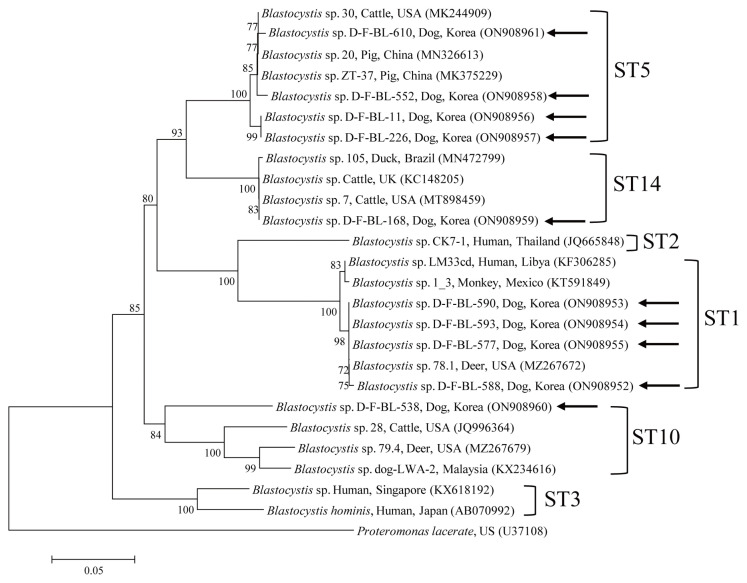
Blastocystis is a genus of unicellular heterokont parasites belonging to a group of organisms known as Stramenopiles, which includes algae, diatoms, and water molds. Blastocystis includes several species that habitat in the gastrointestinal tracts of organisms as diverse as humans, farm animals, birds, rodents, reptiles, amphibians, fish, and cockroaches. It is important to public health and distributed globally, but its prevalence in dogs in Korea has not been reported to date. Here, we collected 787 canine fecal samples and assessed Blastocystis infection by age, sex, region, season, and diarrhea symptoms. We determined Blastocystis subtypes using phylogenetic analyses based on 18S rRNA gene sequences. We identified, 10 Blastocystis positive samples (1.3%). A higher proportion of infected dogs was asymptomatic; however, infection rates did not significantly differ according to region, age, sex, and season. Phylogenetic analysis showed that the Blastocystis sp. identified belonged to 4 subtypes (STs), ST1, ST5, ST10, and ST14, thus revealed the genetic diversity of Blastocystis sp. in dogs Korean. This is first report on the presence of Blastocystis sp. in dogs Korean. This study revealed a lower infection rate than expected and differed from previous studies in STs. Further studies are warranted to observe the national infection status of Blastocystis in dogs and the genetic characteristics of this genus.
芽囊原虫是一种单细胞异养原生动物,属于被囊动物门的一个类群,其中包括藻类、硅藻和水霉菌。芽囊原虫包括几种栖息在人类、家畜、鸟类、啮齿动物、爬行动物、两栖动物、鱼类和蟑螂等生物的胃肠道中的物种。它对公共卫生很重要,分布广泛,但迄今为止,尚未有关于韩国犬中芽囊原虫流行率的报道。在这里,我们收集了 787 份犬粪便样本,并按年龄、性别、地区、季节和腹泻症状评估了芽囊原虫感染情况。我们通过基于 18S rRNA 基因序列的系统发育分析确定了芽囊原虫亚型。我们确定了 10 个芽囊原虫阳性样本(1.3%)。无症状感染犬的比例较高;然而,感染率与地区、年龄、性别和季节无关。系统发育分析表明,鉴定出的芽囊原虫属于 4 种亚型(ST),即 ST1、ST5、ST10 和 ST14,从而揭示了韩国犬中芽囊原虫的遗传多样性。这是首次在韩国犬中报告存在芽囊原虫。本研究显示的感染率低于预期,与之前的研究在 ST 方面存在差异。需要进一步研究来观察韩国犬中芽囊原虫的全国感染状况和该属的遗传特征。