Division of Chronic Disease Research Across the Lifecourse, Department of Population Medicine, Harvard Pilgrim Health Care Institute, Harvard Medical School, Harvard University, Boston, Massachusetts, USA.
Applied Clinical Research Center, Department of Pediatrics, Children's Hospital of Philadelphia, Philadelphia, Pennsylvania, USA.
Obesity (Silver Spring). 2022 Oct;30(10):1932-1937. doi: 10.1002/oby.23532. Epub 2022 Aug 30.
The aim of this study was to examine COVID-19 pandemic-related changes in obesity and BMI among patients aged 5 to <20 years with selected chronic conditions.
A longitudinal study in 293,341 patients aged 5 to <20 years who were prescribed one of five medication classes (for depression, psychosis, hypertension, diabetes, or epilepsy) and who had BMI measures from January 2019 to March 2021 was conducted. Generalized estimating equations and linear mixed-effects models were used, accounting for within-child repeated measures and stratified by age, race, ethnicity, gender, and class of medication prescribed, to compare obesity and BMI z score during the pandemic (June through December 2020) versus pre-pandemic (June through December 2019).
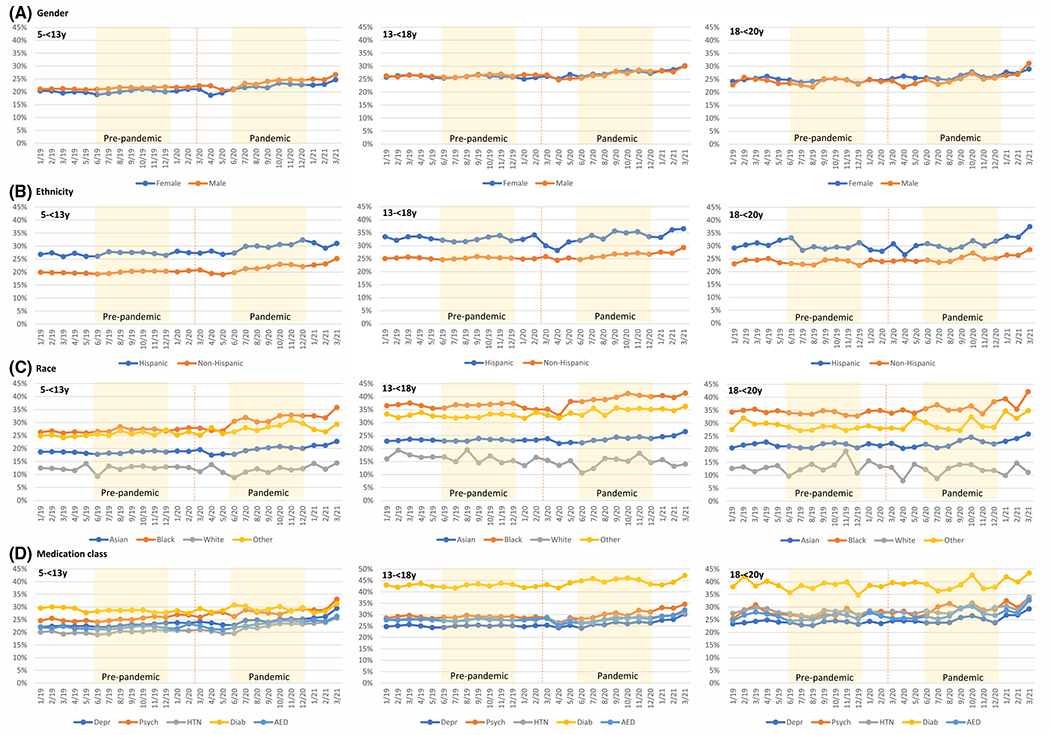
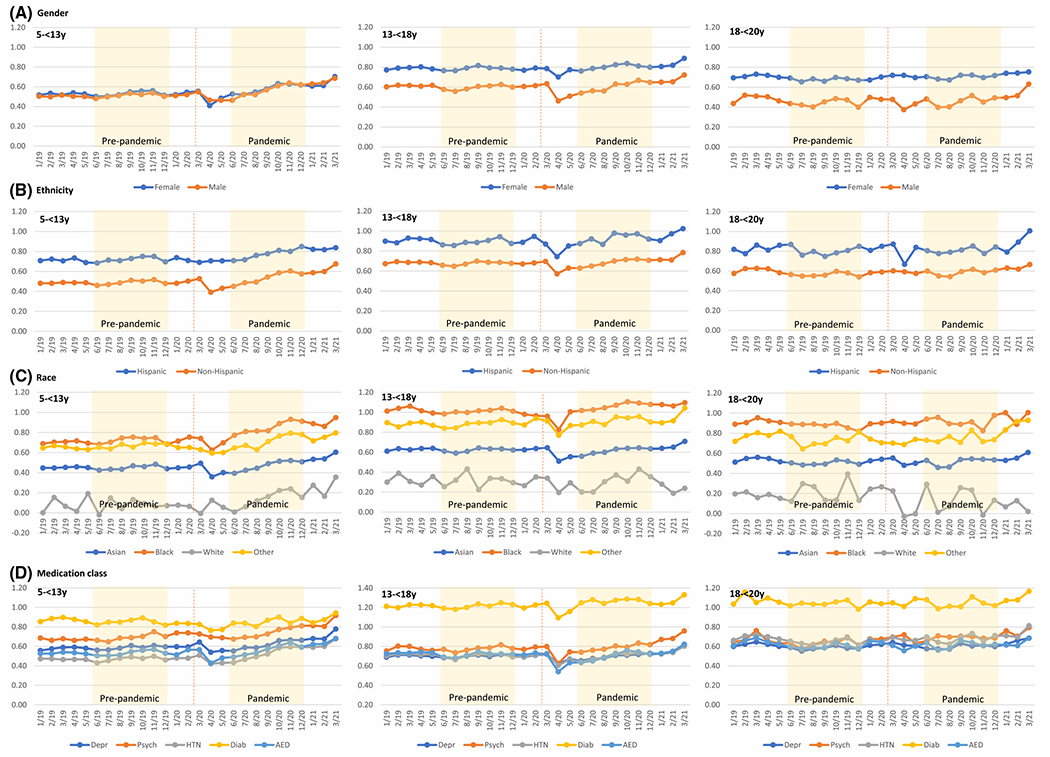
Obesity prevalence increased from 23.8% before the pandemic to 25.5% during the pandemic; mean (SD) BMI z score increased from 0.62 (1.26) to 0.65 (1.29). Obesity prevalence during the pandemic increased at a faster rate compared with pre-pandemic among children aged 5 to <13 years (0.27% per month; 95% CI: 0.11%-0.44%) and 13 to <18 years (0.24% per month; 95% CI: 0.09%-0.40%), with the largest increases among children aged 5 to <13 years who were male (0.42% per month), Black (0.35% per month), or Hispanic (0.59% per month) or who were prescribed antihypertensives (0.28% per month).
The COVID-19 pandemic has exacerbated the obesity epidemic and widened disparities among children with selected chronic conditions. These findings highlight the importance of continuing efforts to specifically help high-risk populations who are experiencing weight gain from the pandemic.
本研究旨在探讨 COVID-19 大流行期间,患有五类选定慢性病(抑郁症、精神病、高血压、糖尿病或癫痫)的 5 岁至<20 岁患者肥胖和 BMI 的变化情况。
对 293341 名 5 岁至<20 岁患者进行了一项纵向研究,这些患者在 2019 年 1 月至 2021 年 3 月期间接受了一种药物治疗,并且具有 BMI 测量值。采用广义估计方程和线性混合效应模型,考虑到儿童内的重复测量值,并按年龄、种族、民族、性别和开处方的药物类别进行分层,以比较大流行期间(2020 年 6 月至 12 月)与大流行前(2019 年 6 月至 12 月)肥胖和 BMI z 分数的变化。
大流行前肥胖患病率为 23.8%,大流行期间为 25.5%;平均(SD)BMI z 评分从 0.62(1.26)增加到 0.65(1.29)。在 5 岁至<13 岁(每月 0.27%;95%CI:0.11%-0.44%)和 13 至<18 岁(每月 0.24%;95%CI:0.09%-0.40%)儿童中,大流行期间的肥胖患病率增加速度快于大流行前,肥胖患病率增加最大的是 5 岁至<13 岁的男性(每月 0.42%)、黑人(每月 0.35%)或西班牙裔(每月 0.59%)或接受抗高血压药物治疗的儿童(每月 0.28%)。
COVID-19 大流行加剧了肥胖流行,并扩大了患有某些慢性疾病的儿童之间的差距。这些发现强调了继续努力专门帮助高风险人群的重要性,这些人群正经历着大流行带来的体重增加。