Department of Health Sciences, Lund University, Lund, Sweden.
Dalby Health Care Center, Region Skåne, Sweden.
BMC Public Health. 2022 Aug 30;22(1):1641. doi: 10.1186/s12889-022-14065-0.
Mobile health (mHealth), wearable activity trackers (WATs) and other digital solutions could support physical activity (PA) in individuals with hip and knee osteoarthritis (OA), but little is described regarding experiences and perceptions of digital support and the use of WAT to self-monitor PA. Thus, the aim of this study was to explore the experiences of using a WAT to monitor PA and the general perceptions of mHealth and digital support in OA care among individuals of working age with hip and knee OA.
We conducted a focus group study where individuals with hip and knee OA (n = 18) were recruited from the intervention group in a cluster-randomized controlled trial (C-RCT). The intervention in the C-RCT comprised of 12-weeks use of a WAT with a mobile application to monitor PA in addition to participating in a supported OA self-management program. In this study, three focus group discussions were conducted. The discussions were transcribed and qualitative content analysis with an inductive approach was applied.
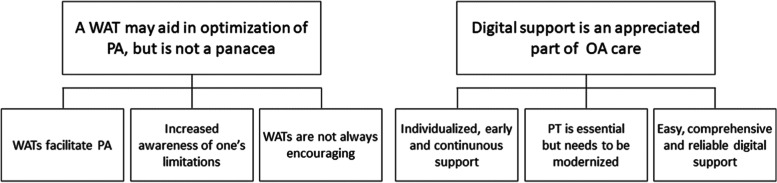
The analysis resulted in two main categories: A WAT may aid in optimization of PA, but is not a panacea with subcategories WATs facilitate PA; Increased awareness of one's limitations and WATs are not always encouraging, and the second main category was Digital support is an appreciated part of OA care with subcategories Individualized, early and continuous support; PT is essential but needs to be modernized and Easy, comprehensive, and reliable digital support.
WATs may facilitate PA but also aid individuals with OA to find the optimal level of activity to avoid increased pain. Digital support in OA care was appreciated, particularly as a part of traditional care with physical visits. The participants expressed that the digital support should be easy, comprehensive, early, and continuous.
移动健康(mHealth)、可穿戴活动追踪器(WAT)和其他数字解决方案可以支持髋膝关节骨关节炎(OA)患者的身体活动(PA),但对于数字支持的体验和认知以及使用 WAT 自我监测 PA 的描述甚少。因此,本研究旨在探讨使用 WAT 监测 PA 的体验以及中青年髋膝关节 OA 患者对 OA 护理中 mHealth 和数字支持的总体看法。
我们进行了一项焦点小组研究,参与者为来自一项集群随机对照试验(C-RCT)干预组的中青年髋膝关节 OA 患者(n=18)。C-RCT 的干预措施包括使用 WAT 和移动应用程序监测 PA 12 周,同时参与支持性 OA 自我管理计划。在此研究中,进行了 3 次焦点小组讨论。讨论内容被转录,并采用归纳法进行定性内容分析。
分析结果得出了两个主要类别:WAT 可能有助于优化 PA,但并非万能,其子类别为 WAT 有助于 PA;提高对自身局限性的认识和 WAT 并不总是令人鼓舞,第二个主要类别是数字支持是 OA 护理的一个值得赞赏的部分,其子类别为个体化、早期和持续支持;物理治疗(PT)是必不可少的,但需要现代化,并且数字支持需要简单、全面、可靠。
WAT 可能有助于促进 PA,但也有助于 OA 患者找到避免疼痛加剧的最佳活动水平。OA 护理中的数字支持受到赞赏,尤其是作为物理就诊传统护理的一部分。参与者表示,数字支持应该简单、全面、早期和持续。