Biotechnology Research Institute, Chinese Academy of Agricultural Sciences, Beijing, 100081, China.
Microb Cell Fact. 2022 Aug 30;21(1):177. doi: 10.1186/s12934-022-01904-3.
N-glycosylation is one of the most important post-translational modifications. Many studies have shown that N-glycosylation has a significant effect on the secretion level of heterologous glycoproteins in yeast cells. However, there have been few studies reporting a clear and unified explanation for the intracellular mechanism that N-glycosylation affect the secretion of heterologous glycoproteins so far. Pichia pastoris is an important microbial cell factory producing heterologous protein. It is of great significance to study the effect of N-glycosylation on the secretion level of heterologous protein. Camel chymosin is a glycoprotein with higher application potential in cheese manufacturing industry. We have expressed camel prochymosin in P. pastoris GS115, but the lower secretion level limits its industrial application. This study attempts to increase the secretion level of prochymosin through N-glycosylation, and explore the molecular mechanism of N-glycosylation affecting secretion.
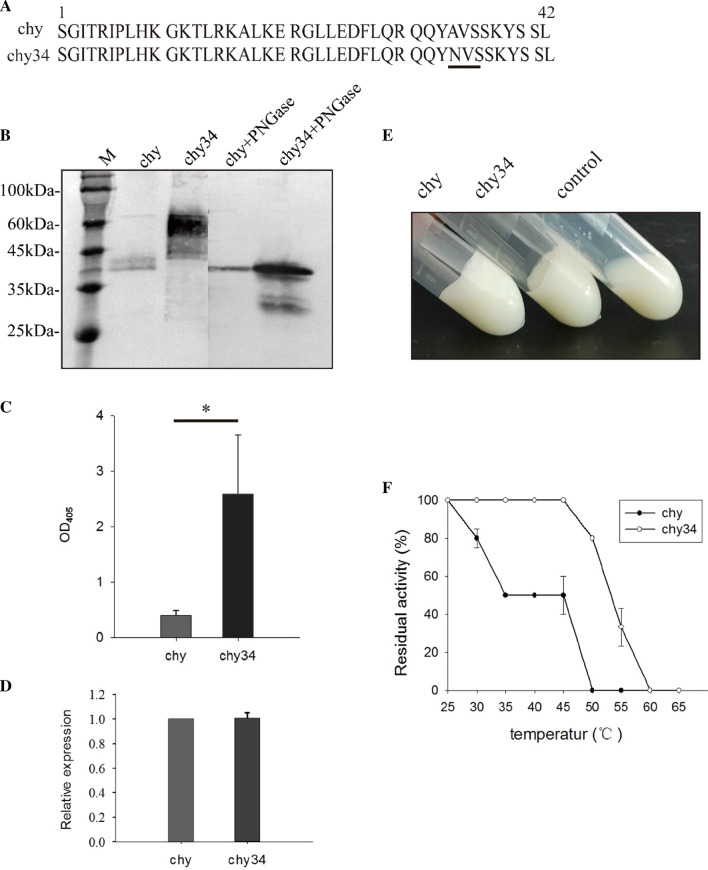
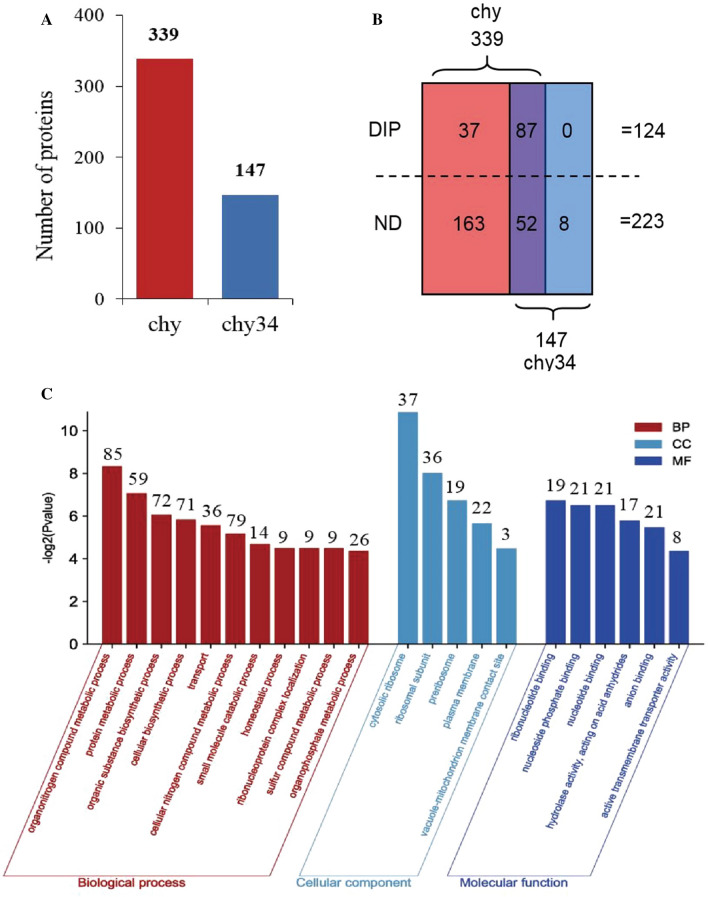
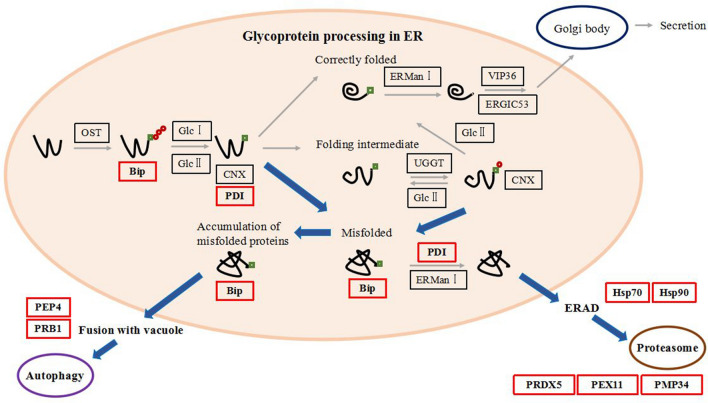
Adding an N-glycosylation site at the 34th amino acid of the propeptide of prochymosin significantly increased its secretion in P. pastoris. N-glycosylation improved the thermostability of prochymosin without affecting the enzymatic activity. Immunoprecipitation coupled to mass spectrometry (IP-MS) analysis showed that compared with the wild prochymosin (chy), the number of proteins interacting with N-glycosylated mutant (chy34) decreased, and all differential interacting proteins (DIPs) were down-regulated in chy34-GS115 cell. The DIPs in endoplasmic reticulum were mainly concentrated in the misfolded protein pathway. Among the five DIPs in this pathway, overexpression of BiP significantly increased the secretion of chy. The knockout of the possible misfolded protein recognition elements, UDP-glycose:glycoprotein glucosyltransferase 1 and 2 (UGGT1/2) had no effect on the growth of yeast cells and the secretion of prochymosin.
In conclusion, N-glycosylation increased the secretion of prochymosin in P. pastoris trough the adjustment of intracellular interacted proteins. The results of our study may help to elucidate the molecular mechanism of N-glycosylation affecting secretion and provide a new research method to improve the secretion of heterologous glycoprotein in P. pastoris.
N-糖基化是最重要的翻译后修饰之一。许多研究表明,N-糖基化对酵母细胞中异源糖蛋白的分泌水平有显著影响。然而,到目前为止,关于 N-糖基化影响异源糖蛋白分泌的细胞内机制,还没有一个明确的、统一的解释。巴斯德毕赤酵母是生产异源蛋白的重要微生物细胞工厂。研究 N-糖基化对异源蛋白分泌水平的影响具有重要意义。骆驼凝乳酶是一种在奶酪制造业中具有较高应用潜力的糖蛋白。我们已经在巴斯德毕赤酵母 GS115 中表达了骆驼前凝乳酶,但较低的分泌水平限制了其工业应用。本研究试图通过 N-糖基化提高前凝乳酶的分泌水平,并探讨 N-糖基化影响分泌的分子机制。
在前凝乳酶原肽的第 34 位氨基酸添加一个 N-糖基化位点,显著提高了其在巴斯德毕赤酵母中的分泌水平。N-糖基化提高了前凝乳酶的热稳定性,而不影响其酶活性。免疫沉淀结合质谱(IP-MS)分析表明,与野生前凝乳酶(chy)相比,与 N-糖基化突变体(chy34)相互作用的蛋白质数量减少,chy34-GS115 细胞中所有差异相互作用蛋白(DIPs)均下调。内质网中的 DIPs 主要集中在错误折叠蛋白途径。在该途径的五个 DIP 中,过表达 BiP 显著增加了 chy 的分泌。敲除可能的错误折叠蛋白识别元件 UDP-葡萄糖:糖蛋白葡萄糖基转移酶 1 和 2(UGGT1/2)对酵母细胞的生长和前凝乳酶的分泌没有影响。
总之,N-糖基化通过调节细胞内相互作用蛋白,增加了巴斯德毕赤酵母中前凝乳酶的分泌。本研究结果可能有助于阐明 N-糖基化影响分泌的分子机制,并为提高巴斯德毕赤酵母中异源糖蛋白的分泌提供新的研究方法。