Chen Shu-Wei, Chen Xipeng, Li Yang, Yang Yalin, Dong Yuchuan, Guo Jinwen, Wang Jinyi
College of Chemistry & Pharmacy, Northwest A&F University Yangling Shaanxi 712100 P. R. China
RSC Adv. 2022 Aug 10;12(34):22210-22218. doi: 10.1039/d2ra03435b. eCollection 2022 Aug 4.
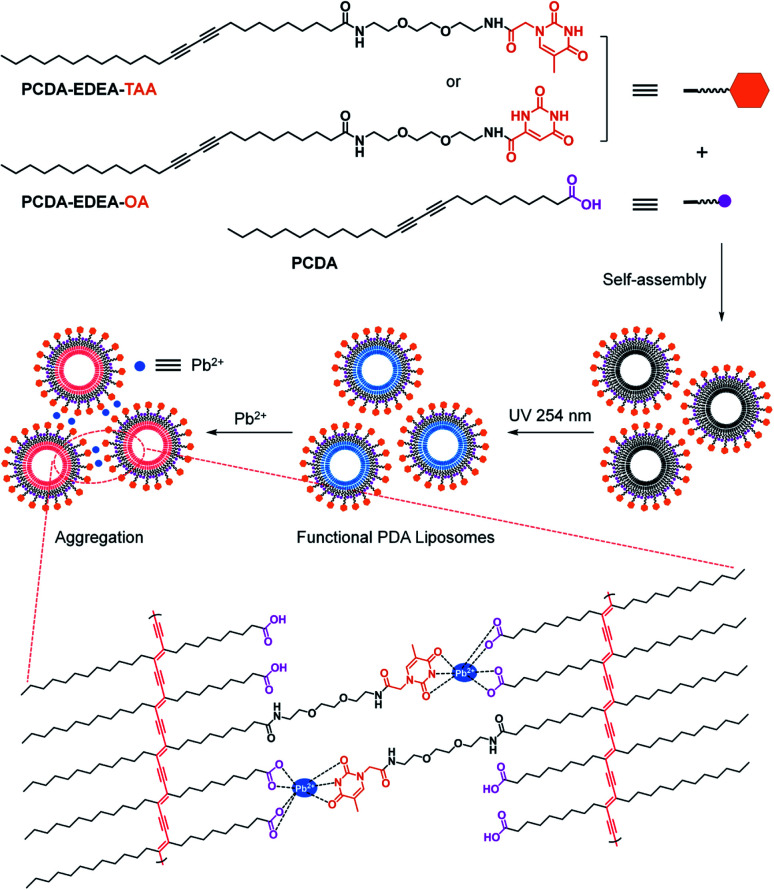
Development of novel sensors for the detection of lead ions (Pb) has attracted increasing interest due to their inherent toxic effects on human health and the environment. In this study, we describe two new polydiacetylene (PDA)-based liposome sensors for the colorimetric and fluorometric recognition of Pb in aqueous solution. In the sensor system, a thymine-1-acetic acid (TAA) or orotic acid (OA) group was reasonably introduced into the diacetylene monomer to work as a strong binding site for Pb. The TAA- or OA-functionalized monomer and 10,12-pentacosadiynoic acid (PCDA) were incorporated into PDA liposomes in aqueous solution. After UV light-induced polymerization, deep blue colored liposome solutions were obtained. Upon the addition of a series of transition metal cations into the liposome solutions, only Pb could induce a color change from blue to red observable by the naked eye and a large fluorescence enhancement. The results clearly showed that the PDA-EDEA-TAA and PDA-EDEA-OA liposomes could act as highly selective and sensitive probes to detect Pb in aqueous solution. The detection limits of PDA-EDEA-TAA and PDA-EDEA-OA systems are 38 nM and 25 nM, respectively. The excellent selectivity of PDA liposomes could be attributed to the stronger complexation behavior of Pb with TAA (or OA) and the carboxylic acid at the lipid-solution interface which could perturb the PDA conjugated backbone. In addition, the proposed sensors were successfully applied to detect trace amounts of Pb in real water samples with excellent recovery, indicating that the developed method had a good accuracy and precision for the analysis of trace Pb in practical samples.
由于铅离子(Pb)对人类健康和环境具有潜在毒性影响,开发用于检测铅离子的新型传感器已引起越来越多的关注。在本研究中,我们描述了两种基于聚二乙炔(PDA)的新型脂质体传感器,用于比色法和荧光法识别水溶液中的铅。在传感器系统中,将胸腺嘧啶 - 1 - 乙酸(TAA)或乳清酸(OA)基团合理引入二乙炔单体中,作为铅的强结合位点。将TAA或OA功能化的单体与10,12 - 二十五碳二炔酸(PCDA)在水溶液中掺入PDA脂质体中。紫外光诱导聚合后,得到深蓝色的脂质体溶液。向脂质体溶液中加入一系列过渡金属阳离子后,只有铅能引起肉眼可见的从蓝色到红色的颜色变化以及大幅的荧光增强。结果清楚地表明,PDA - EDEA - TAA和PDA - EDEA - OA脂质体可作为高选择性和灵敏的探针来检测水溶液中的铅。PDA - EDEA - TAA和PDA - EDEA - OA系统的检测限分别为38 nM和25 nM。PDA脂质体优异的选择性可归因于铅与TAA(或OA)更强的络合行为以及脂质 - 溶液界面处的羧酸,这可能会扰乱PDA共轭主链。此外,所提出的传感器成功应用于实际水样中痕量铅的检测,回收率良好,表明所开发的方法对实际样品中痕量铅的分析具有良好的准确度和精密度。