Global Change Ecology Research Group, University of the Sunshine Coast, Sippy Downs, Queensland, Australia.
Institute of Ecology and Evolution, University of Edinburgh, Edinburgh, UK.
Mol Ecol. 2022 Nov;31(21):5455-5467. doi: 10.1111/mec.16676. Epub 2022 Sep 12.
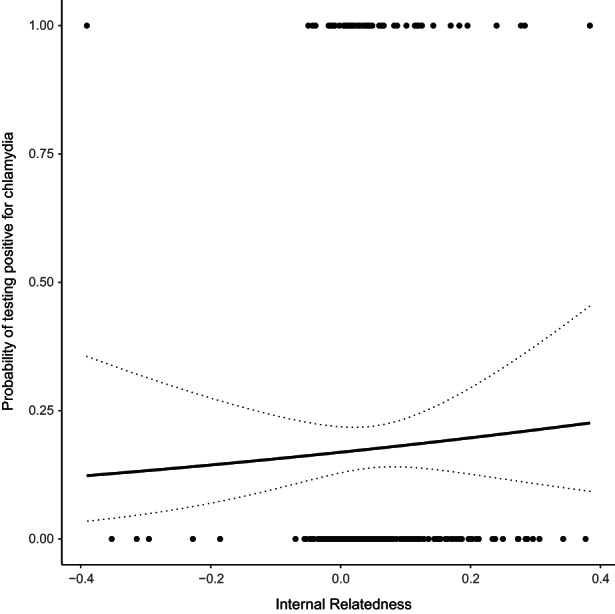
The koala, one of the most iconic Australian wildlife species, is facing several concomitant threats that are driving population declines. Some threats are well known and have clear methods of prevention (e.g., habitat loss can be reduced with stronger land-clearing control), whereas others are less easily addressed. One of the major current threats to koalas is chlamydial disease, which can have major impacts on individual survival and reproduction rates and can translate into population declines. Effective management strategies for the disease in the wild are currently lacking, and, to date, we know little about the determinants of individual susceptibility to disease. Here, we investigated the genetic basis of variation in susceptibility to chlamydia using one of the most intensively studied wild koala populations. We combined data from veterinary examinations, chlamydia testing, genetic sampling and movement monitoring. Out of our sample of 342 wild koalas, 60 were found to have chlamydia. Using genotype information on 5007 SNPs to investigate the role of genetic variation in determining disease status, we found no evidence of inbreeding depression, but a heritability of 0.11 (95% CI: 0.06-0.23) for the probability that koalas had chlamydia. Heritability of susceptibility to chlamydia could be relevant for future disease management, as it suggests adaptive potential for the population.
树袋熊,澳大利亚最具代表性的野生动物之一,正面临着几种同时存在的威胁,这些威胁正在导致其数量下降。有些威胁是众所周知的,并有明确的预防方法(例如,通过加强土地清理控制可以减少栖息地的丧失),而其他威胁则较难解决。目前,树袋熊面临的主要威胁之一是衣原体疾病,它会对个体的生存和繁殖率产生重大影响,并可能导致种群数量下降。目前,野外对这种疾病缺乏有效的管理策略,而且到目前为止,我们对个体易感性的决定因素知之甚少。在这里,我们使用研究最深入的野生树袋熊种群之一,研究了对衣原体易感性的遗传基础。我们结合了兽医检查、衣原体检测、遗传采样和移动监测的数据。在我们的 342 只野生树袋熊样本中,有 60 只被发现携带衣原体。利用 5007 个 SNP 的基因型信息来研究遗传变异在确定疾病状态中的作用,我们没有发现近亲繁殖衰退的证据,但发现树袋熊携带衣原体的概率具有 0.11(95%CI:0.06-0.23)的遗传力。对衣原体易感性的遗传力可能与未来的疾病管理有关,因为它表明了该种群的适应潜力。