Department of Applied Life Science, Sustainable Agriculture Research Institute (SARI), Jeju National University, Jeju‑do 63243, Republic of Korea.
Department of Neurosurgery, Korea University Guro Hospital, Korea University Medicine, Korea University College of Medicine, Guro‑gu, Seoul 08308, Republic of Korea.
Int J Oncol. 2022 Oct;61(4). doi: 10.3892/ijo.2022.5412. Epub 2022 Aug 31.
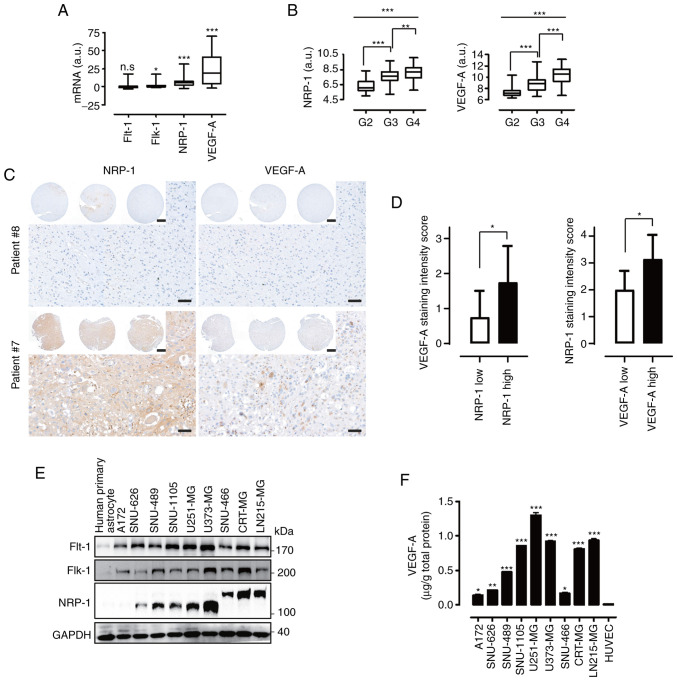
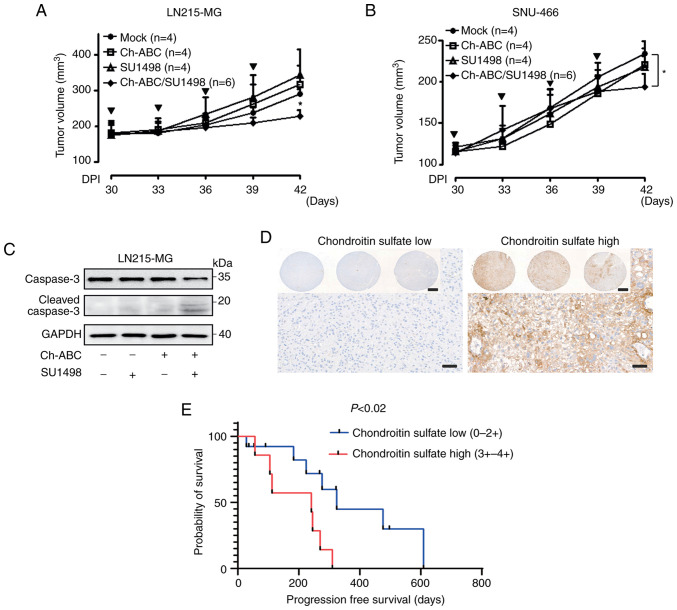
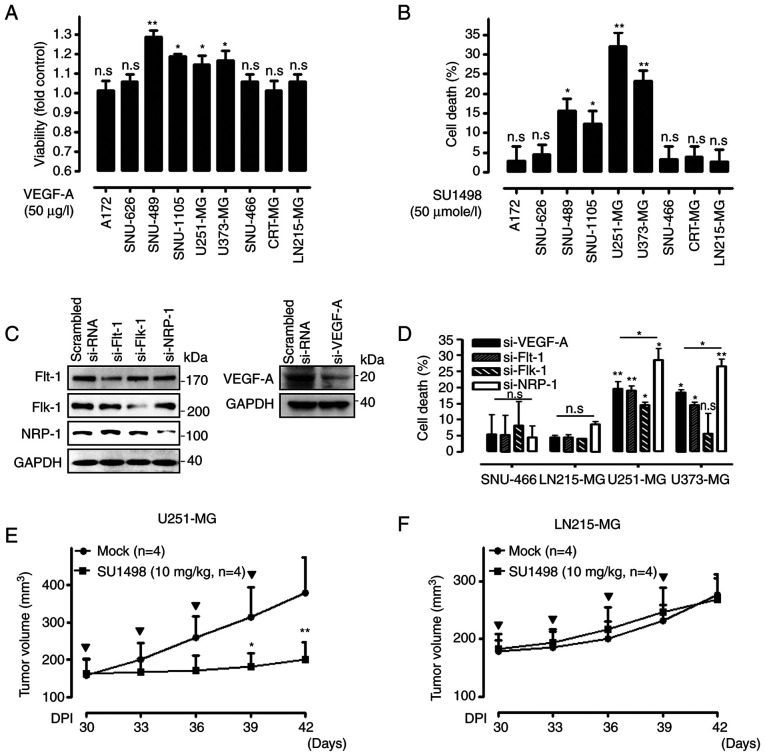
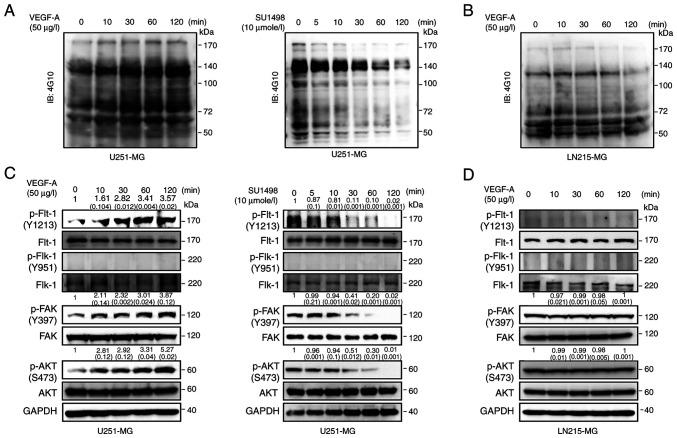
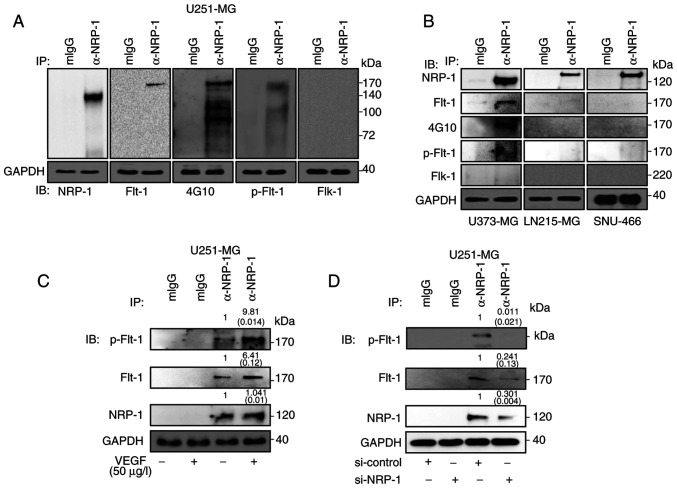
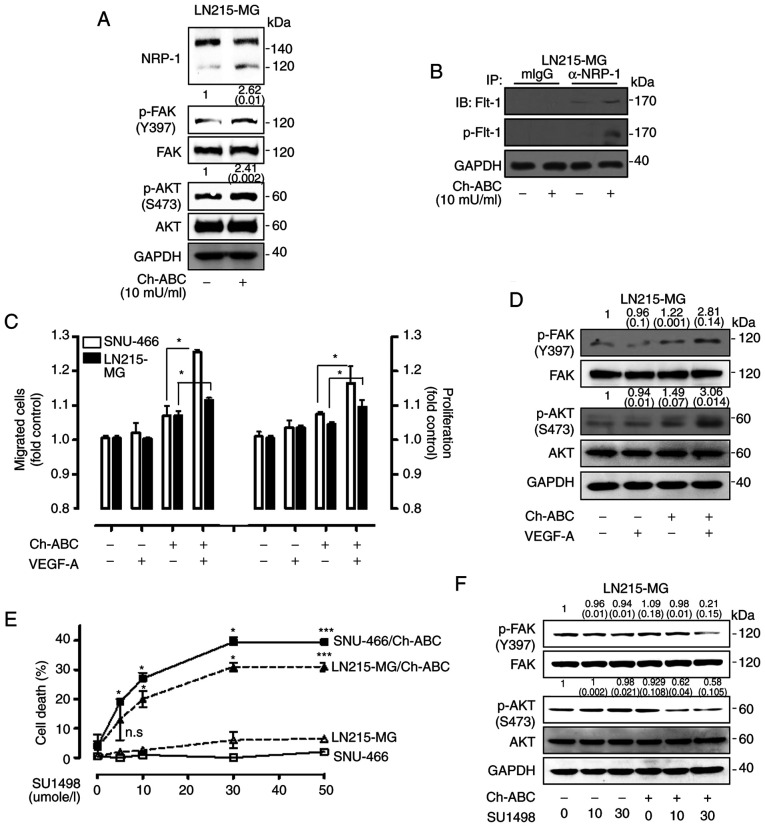
Despite the high expression of neuropilin‑1 (NRP‑1) in human glioblastoma (GB), the understanding of its function as a co‑receptor of vascular endothelial growth factor receptors (VEGFRs) in angiogenesis is currently limited. Therefore, the aim of the present study was to elucidate the non‑classical function of NRP‑1 expression in human GB. Expression patterns of NRP‑1 and VEGF‑A were determined by sandwich ELISA, western blot analysis, or immunohistochemistry. Differential dependency of GB cells following ablation of VEGF‑A signaling was validated and . Cellular mechanism responsible for distinct response to VEGF‑A signaling was evaluated by western blotting and immunoprecipitation analysis. Prognostic implications were assessed using IHC analysis. GB cells exhibited differing sensitivity to silencing of vascular endothelial growth factor (VEGF)‑A signaling, which resulted in a distinct expression pattern of wild‑type or chondroitin‑sulfated NRP‑1. VEGF‑A‑sensitive GB exhibited the physical interaction between wild‑type NRP‑1 and FMS related receptor tyrosine kinase 1 (Flt‑1) whereas VEGF‑A‑resistant GB exhibited chondroitin‑sulfated NRP‑1 without interaction with Flt‑1. Eliminating the chondroitin sulfate modification in NRP‑1 led to re‑sensitization to VEGF‑A signaling, and chondroitin sulfate modification was found to be associated with an adverse prognosis in patients with GB. The present study identified the distinct functions of NRP‑1 in VEGF‑A signaling in accordance with its unique expression type and interaction with Flt‑1. The present research is expected to provide a strong basis for targeting VEGF‑A signaling in patients with GB, with variable responses.
尽管神经纤毛蛋白 1(NRP-1)在人胶质母细胞瘤(GB)中高表达,但其作为血管内皮生长因子受体(VEGFR)共受体在血管生成中的功能理解目前有限。因此,本研究旨在阐明 NRP-1 表达在人 GB 中的非经典功能。通过夹心 ELISA、western blot 分析或免疫组织化学测定 NRP-1 和 VEGF-A 的表达模式。验证了 VEGF-A 信号阻断后 GB 细胞的差异依赖性,并进行了 。通过 western blot 和免疫沉淀分析评估了导致对 VEGF-A 信号产生不同反应的细胞机制。使用 IHC 分析评估了预后意义。GB 细胞对血管内皮生长因子(VEGF)-A 信号沉默的敏感性不同,导致野生型或软骨素硫酸化 NRP-1 的表达模式不同。VEGF-A 敏感的 GB 表现出野生型 NRP-1 与 FMS 相关受体酪氨酸激酶 1(Flt-1)之间的物理相互作用,而 VEGF-A 耐药的 GB 表现出没有与 Flt-1 相互作用的软骨素硫酸化 NRP-1。消除 NRP-1 中的软骨素硫酸盐修饰可导致对 VEGF-A 信号重新敏感,并且发现软骨素硫酸盐修饰与 GB 患者的不良预后相关。本研究根据 NRP-1 的独特表达类型及其与 Flt-1 的相互作用,鉴定了其在 VEGF-A 信号中的不同功能。本研究有望为靶向具有不同反应的 GB 患者的 VEGF-A 信号提供坚实的基础。