• 文献检索
  • 文档翻译
  • 深度研究
  • 学术资讯
  • Suppr Zotero 插件Zotero 插件
  • 邀请有礼
  • 套餐&价格
  • 历史记录
应用&插件
Suppr Zotero 插件Zotero 插件浏览器插件Mac 客户端Windows 客户端微信小程序
定价
高级版会员购买积分包购买API积分包
服务
文献检索文档翻译深度研究API 文档MCP 服务
关于我们
关于 Suppr公司介绍联系我们用户协议隐私条款
关注我们

Suppr 超能文献

核心技术专利:CN118964589B侵权必究
粤ICP备2023148730 号-1Suppr @ 2026

文献检索

告别复杂PubMed语法,用中文像聊天一样搜索,搜遍4000万医学文献。AI智能推荐,让科研检索更轻松。

立即免费搜索

文件翻译

保留排版,准确专业,支持PDF/Word/PPT等文件格式,支持 12+语言互译。

免费翻译文档

深度研究

AI帮你快速写综述,25分钟生成高质量综述,智能提取关键信息,辅助科研写作。

立即免费体验

2020 年 5 月至 6 月在巴西圣埃斯皮里图,一项基于人群的连续研究:SARS-CoV-2 感染率及相关因素。

SARS-CoV-2 infection prevalence and associated factors: a serial population-based study in Espírito Santo, Brazil, May to June 2020.

机构信息

Secretaria de Estado da Saúde do Espírito Santo, Subsecretaria de Estado de Vigilância em Saúde, Vitória, ES, Brasil.

Universidade Federal do Espírito Santo, Departamento de Medicina Social, Vitória, ES, Brasil.

出版信息

Epidemiol Serv Saude. 2022 Aug 29;31(2):e2022112. doi: 10.1590/S1679-49742022000200023. eCollection 2022.

DOI:10.1590/S1679-49742022000200023
PMID:36043577
原文链接:https://pmc.ncbi.nlm.nih.gov/articles/PMC9887971/
Abstract

OBJECTIVE

To analyze SARS-CoV-2 seroprevalence and association of sociodemographic and clinical aspects in the state of Espírito Santo, Brazil.

METHODS

This was a serial cross-sectional study carried out in four phases, using households as the unit of analysis, from May to June 2020. Eleven municipalities were surveyed, with a sample of 4,500 households in each phase.

RESULTS

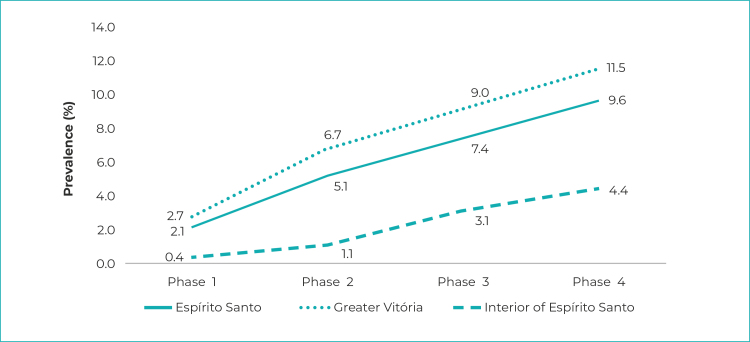
Prevalence ranged from 2.1% (95%CI 1.7;2.5) on May 10 (first phase) to 9.6% (95%CI 8.8;10.4) on June 21 (fourth phase). In the Greater Vitória Metropolitan Region, the prevalence were 2.7% (95%CI 2.2;3.3) in the first phase, and 11.5% (95%CI 10.5;12.6) in the fourth phase; in the interior region of the state, prevalence ranged from 0.4% (95%CI 0.1;0.9) to 4.4% (95%CI 3.2;5.5) between the two phases.

CONCLUSION

The increase in SARS-CoV-2 seroprevalence found in the fourth phase highlighted the high transmission of the virus, information that can support management of the pandemic.

摘要

目的

分析巴西圣埃斯皮里图州 SARS-CoV-2 的血清流行率及与社会人口学和临床方面的关联。

方法

这是一项于 2020 年 5 月至 6 月期间分四个阶段进行的连续横断面研究,以家庭为分析单位。调查了 11 个城市,每个阶段的样本量为 4500 户。

结果

5 月 10 日(第一阶段)的流行率为 2.1%(95%CI 1.7;2.5),6 月 21 日(第四阶段)为 9.6%(95%CI 8.8;10.4)。在大维多利亚大都市区,第一阶段的流行率为 2.7%(95%CI 2.2;3.3),第四阶段为 11.5%(95%CI 10.5;12.6);在该州内陆地区,两阶段的流行率范围为 0.4%(95%CI 0.1;0.9)至 4.4%(95%CI 3.2;5.5)。

结论

第四阶段 SARS-CoV-2 血清阳性率的增加强调了病毒的高传播性,这一信息可以为大流行的管理提供支持。
https://cdn.ncbi.nlm.nih.gov/pmc/blobs/afbb/9887971/93b8b200e665/2237-9622-ress-31-02-e2022112-gf6.jpg
https://cdn.ncbi.nlm.nih.gov/pmc/blobs/afbb/9887971/69914fb63461/2237-9622-ress-31-02-e2022112-gf4.jpg
https://cdn.ncbi.nlm.nih.gov/pmc/blobs/afbb/9887971/b2b7804505b3/2237-9622-ress-31-02-e2022112-gf5.jpg
https://cdn.ncbi.nlm.nih.gov/pmc/blobs/afbb/9887971/93b8b200e665/2237-9622-ress-31-02-e2022112-gf6.jpg
https://cdn.ncbi.nlm.nih.gov/pmc/blobs/afbb/9887971/69914fb63461/2237-9622-ress-31-02-e2022112-gf4.jpg
https://cdn.ncbi.nlm.nih.gov/pmc/blobs/afbb/9887971/b2b7804505b3/2237-9622-ress-31-02-e2022112-gf5.jpg
https://cdn.ncbi.nlm.nih.gov/pmc/blobs/afbb/9887971/93b8b200e665/2237-9622-ress-31-02-e2022112-gf6.jpg

相似文献

1
SARS-CoV-2 infection prevalence and associated factors: a serial population-based study in Espírito Santo, Brazil, May to June 2020.2020 年 5 月至 6 月在巴西圣埃斯皮里图,一项基于人群的连续研究:SARS-CoV-2 感染率及相关因素。
Epidemiol Serv Saude. 2022 Aug 29;31(2):e2022112. doi: 10.1590/S1679-49742022000200023. eCollection 2022.
2
Living conditions, seroprevalence and symptoms of COVID-19 in slums in the Metropolitan Region of Vitória (Espírito Santo).贫民窟的生活条件、COVID-19 血清流行率和症状在维多利亚都会区(圣埃斯皮里图州)。
Rev Bras Epidemiol. 2021 Oct 29;24:e210048. doi: 10.1590/1980-549720210048. eCollection 2021.
3
Serological prevalence of SARS-CoV-2 infection among prison system workers in the state of Espírito Santo, Brazil, 2020.2020 年巴西圣埃斯皮里图州监狱系统工作人员中 SARS-CoV-2 感染的血清流行率。
Epidemiol Serv Saude. 2022 Feb 28;31(1):e2021495. doi: 10.1590/S1679-49742022000100008. eCollection 2022.
4
SARS-CoV-2 antibody prevalence in Brazil: results from two successive nationwide serological household surveys.巴西的 SARS-CoV-2 抗体流行率:两项连续全国血清学家庭调查结果。
Lancet Glob Health. 2020 Nov;8(11):e1390-e1398. doi: 10.1016/S2214-109X(20)30387-9. Epub 2020 Sep 23.
5
Assessment of initial SARS-CoV-2 seroprevalence in the most affected districts in the municipality of São Paulo, Brazil.巴西圣保罗市受影响最严重地区 SARS-CoV-2 初始血清流行率评估。
Braz J Infect Dis. 2021 Jul-Aug;25(4):101604. doi: 10.1016/j.bjid.2021.101604. Epub 2021 Aug 10.
6
[Prevalence of SARS-CoV-2 antibodies in the State of Mato Grosso, Brazil: a population-based survey].[巴西马托格罗索州严重急性呼吸综合征冠状病毒2抗体的流行情况:一项基于人群的调查]
Cad Saude Publica. 2022 Jun 8;38(5):e00093021. doi: 10.1590/0102-311XPT093021. eCollection 2022.
7
COVID-19 in children, adolescents and young adults: a cross-sectional study in Espírito Santo, Brazil, 2020.2020 年巴西圣埃斯皮里图州儿童、青少年和青年人群 COVID-19 :横断面研究。
Epidemiol Serv Saude. 2021 Sep 22;30(4):e20201029. doi: 10.1590/S1679-49742021000400001. eCollection 2021.
8
Seroprevalence trends of anti-SARS-CoV-2 antibodies in the adult population of the São Paulo Municipality, Brazil: Results from seven serosurveys from June 2020 to April 2022. The SoroEpi MSP Study.巴西圣保罗市成年人中抗 SARS-CoV-2 抗体的血清流行率趋势:2020 年 6 月至 2022 年 4 月进行的七项血清学调查结果。SoroEpi MSP 研究。
PLoS One. 2024 Aug 26;19(8):e0309441. doi: 10.1371/journal.pone.0309441. eCollection 2024.
9
Seroprevalence of SARS-CoV-2 antibodies in the poorest region of Brazil: results from a population-based study.巴西最贫困地区的 SARS-CoV-2 抗体血清流行率:一项基于人群的研究结果。
Epidemiol Infect. 2021 May 18;149:e130. doi: 10.1017/S0950268821001163.
10
Seroprevalence of anti-SARS-CoV-2 antibodies and factors associated with infection among adolescent men who have sex with men and transgender women in Salvador, Brazil.巴西萨尔瓦多男男性行为者和跨性别女性青少年中抗 SARS-CoV-2 抗体的血清流行率及与感染相关的因素。
BMC Public Health. 2023 Jan 9;23(1):61. doi: 10.1186/s12889-022-14969-x.

本文引用的文献

1
Factors associated with increased risk of death from covid-19: a survival analysis based on confirmed cases.与 COVID-19 死亡风险增加相关的因素:基于确诊病例的生存分析。
Rev Bras Epidemiol. 2021 Jan 6;23:e200106. doi: 10.1590/1980-549720200106. eCollection 2021.
2
Population-based seroprevalence of SARS-CoV-2 and the herd immunity threshold in Maranhão.基于人群的 SARS-CoV-2 血清流行率和马拉尼昂州的群体免疫阈值。
Rev Saude Publica. 2020 Dec 14;54:131. doi: 10.11606/s1518-8787.2020054003278. eCollection 2020.
3
Prevalence of antibodies against SARS-CoV-2 according to socioeconomic and ethnic status in a nationwide Brazilian survey.
在一项巴西全国性调查中,根据社会经济和种族状况统计的抗SARS-CoV-2抗体流行率。
Rev Panam Salud Publica. 2020 Oct 29;44:e135. doi: 10.26633/RPSP.2020.135. eCollection 2020.
4
Population-based surveys of antibodies against SARS-CoV-2 in Southern Brazil.巴西南部针对 SARS-CoV-2 抗体的基于人群的调查。
Nat Med. 2020 Aug;26(8):1196-1199. doi: 10.1038/s41591-020-0992-3. Epub 2020 Jul 8.
5
Sequential serological surveys in the early stages of the coronavirus disease epidemic: limitations and perspectives.冠状病毒病疫情早期的连续血清学调查:局限性和展望。
Rev Soc Bras Med Trop. 2020;53:e20200351. doi: 10.1590/0037-8682-0351-2020. Epub 2020 Jul 3.
6
Black-White Risk Differentials in COVID-19 (SARS-COV2) Transmission, Mortality and Case Fatality in the United States: Translational Epidemiologic Perspective and Challenges.美国 COVID-19(SARS-COV2)传播、死亡率和病死率的黑-白风险差异:转化流行病学视角和挑战。
Int J Environ Res Public Health. 2020 Jun 17;17(12):4322. doi: 10.3390/ijerph17124322.
7
Trends in the prevalence of COVID-19 infection in Rio Grande do Sul, Brazil: repeated serological surveys.巴西南里奥格兰德州新冠病毒感染流行趋势:重复血清学调查
Cien Saude Colet. 2020 Jun;25(suppl 1):2395-2401. doi: 10.1590/1413-81232020256.1.09632020. Epub 2020 Apr 14.
8
Social Vulnerability and Racial Inequality in COVID-19 Deaths in Chicago.《芝加哥 COVID-19 死亡中的社会脆弱性与种族不平等》。
Health Educ Behav. 2020 Aug;47(4):509-513. doi: 10.1177/1090198120929677. Epub 2020 May 21.
9
COVID-19 in Brazil: "So what?".巴西的新冠疫情:“那又怎样?”
Lancet. 2020 May 9;395(10235):1461. doi: 10.1016/S0140-6736(20)31095-3.
10
COVID-19 in Brazil: advantages of a socialized unified health system and preparation to contain cases.巴西的 COVID-19:社会化统一卫生体系的优势和对病例的防控准备。
Rev Soc Bras Med Trop. 2020 Apr 17;53:e20200167. doi: 10.1590/0037-8682-0167-2020. eCollection 2020.