European Center for Geodynamics and Seismology, Walferdange, Grand Duchy of Luxembourg.
Department of Earth Sciences, Royal Museum for Central Africa, Tervuren, Belgium.
Nature. 2022 Sep;609(7925):83-88. doi: 10.1038/s41586-022-05047-8. Epub 2022 Aug 31.
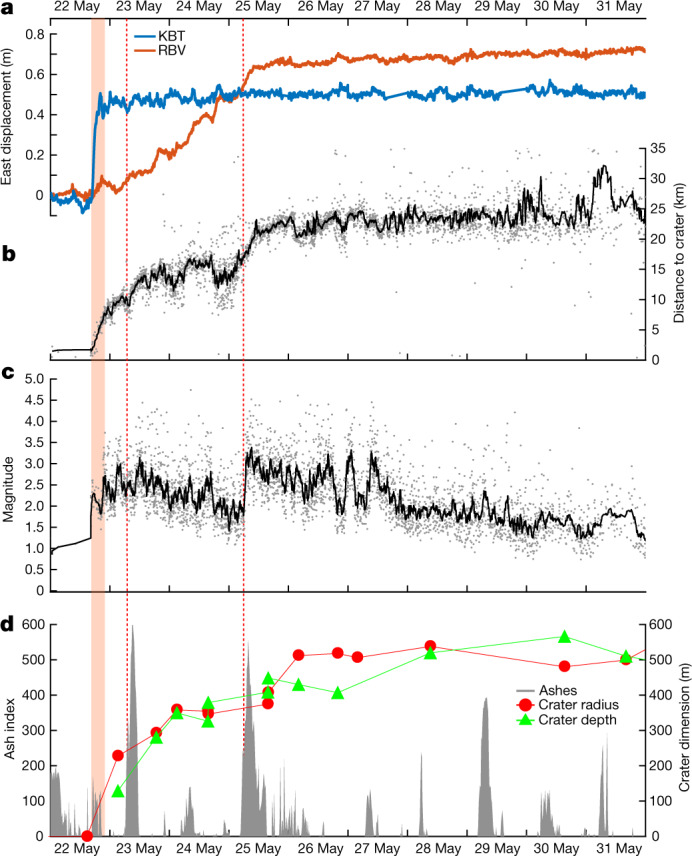
Classical mechanisms of volcanic eruptions mostly involve pressure buildup and magma ascent towards the surface. Such processes produce geophysical and geochemical signals that may be detected and interpreted as eruption precursors. On 22 May 2021, Mount Nyiragongo (Democratic Republic of the Congo), an open-vent volcano with a persistent lava lake perched within its summit crater, shook up this interpretation by producing an approximately six-hour-long flank eruption without apparent precursors, followed-rather than preceded-by lateral magma motion into the crust. Here we show that this reversed sequence was most likely initiated by a rupture of the edifice, producing deadly lava flows and triggering a voluminous 25-km-long dyke intrusion. The dyke propagated southwards at very shallow depth (less than 500 m) underneath the cities of Goma (Democratic Republic of the Congo) and Gisenyi (Rwanda), as well as Lake Kivu. This volcanic crisis raises new questions about the mechanisms controlling such eruptions and the possibility of facing substantially more hazardous events, such as effusions within densely urbanized areas, phreato-magmatism or a limnic eruption from the gas-rich Lake Kivu. It also more generally highlights the challenges faced with open-vent volcanoes for monitoring, early detection and risk management when a significant volume of magma is stored close to the surface.
火山喷发的经典机制主要涉及压力积聚和岩浆上升到地表。这些过程会产生可能被检测到并解释为喷发前兆的地球物理和地球化学信号。2021 年 5 月 22 日,尼拉贡戈火山(刚果民主共和国)发生了一次大约持续六小时的侧翼喷发,没有明显的前兆,而是在侧向岩浆进入地壳之后,颠覆了这种解释。这座火山顶部的火山口内有一个永久性熔岩湖,是一个开放式火山口。此前,人们普遍认为这种喷发机制是压力积聚和岩浆上升到地表导致的。而尼拉贡戈火山的这次喷发则表明,这种相反的喷发序列很可能是由山体崩塌引发的,产生了致命的熔岩流,并引发了大量 25 公里长的岩脉侵入。岩脉在非常浅的深度(小于 500 米)下向南传播,穿过戈马市(刚果民主共和国)和吉塞尼市(卢旺达)以及基伍湖下方。这场火山危机引发了关于控制这种喷发机制的新问题,以及可能面临更危险事件的可能性,例如在人口密集的地区喷发、火山碎屑岩浆活动或富含气体的基伍湖爆发。它还更普遍地强调了在大量岩浆储存在靠近地表的情况下,对开放式火山口进行监测、早期探测和风险管理所面临的挑战。