Ancestry and Health Genomics Laboratory, Charles Perkins Centre, School of Medical Sciences, Faculty of Medicine and Health, University of Sydney, Camperdown, New South Wales, Australia.
Genomics and Epigenetic Theme, Garvan Institute of Medical Research, Darlinghurst, New South Wales, Australia.
Nature. 2022 Sep;609(7927):552-559. doi: 10.1038/s41586-022-05154-6. Epub 2022 Aug 31.
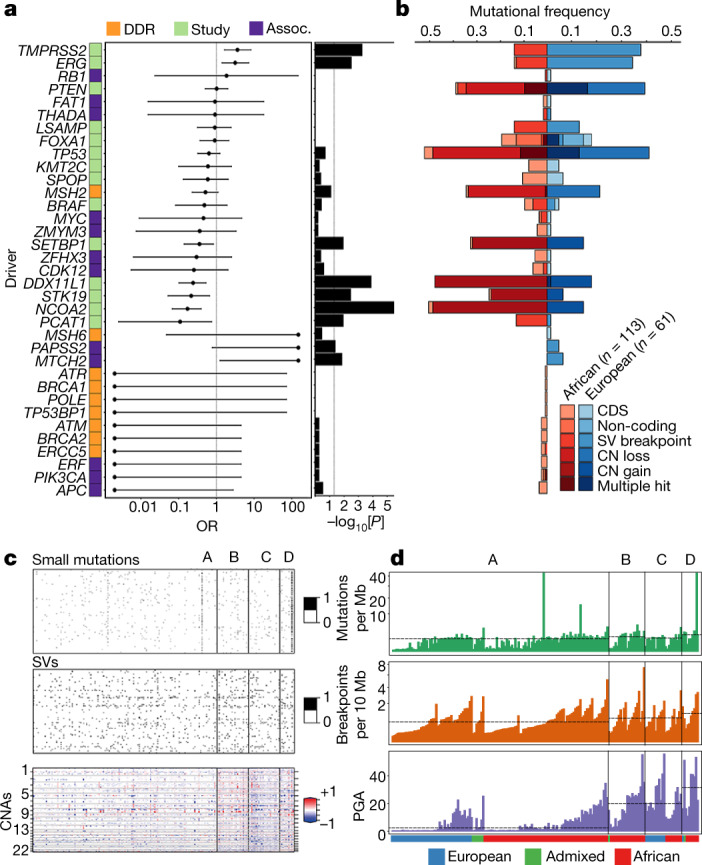
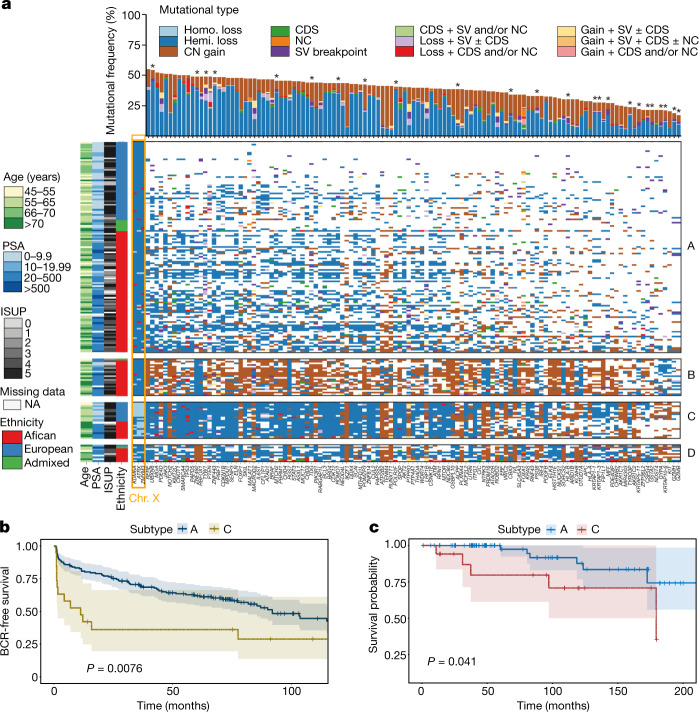
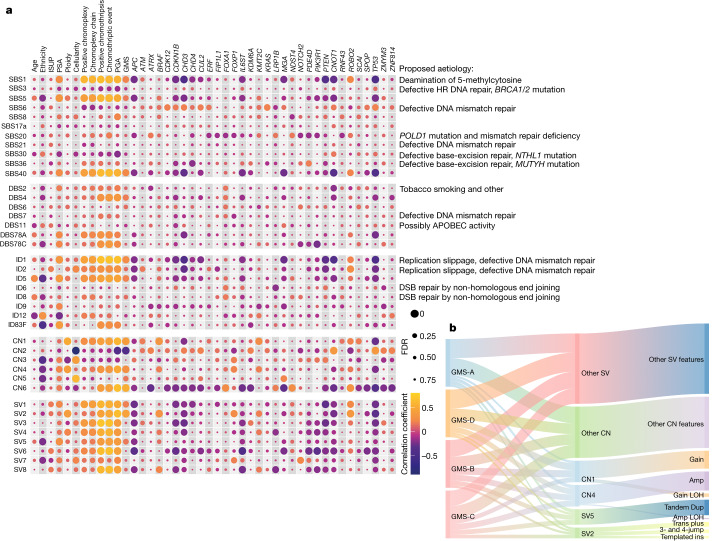
Prostate cancer is characterized by considerable geo-ethnic disparity. African ancestry is a significant risk factor, with mortality rates across sub-Saharan Africa of 2.7-fold higher than global averages. The contributing genetic and non-genetic factors, and associated mutational processes, are unknown. Here, through whole-genome sequencing of treatment-naive prostate cancer samples from 183 ancestrally (African versus European) and globally distinct patients, we generate a large cancer genomics resource for sub-Saharan Africa, identifying around 2 million somatic variants. Significant African-ancestry-specific findings include an elevated tumour mutational burden, increased percentage of genome alteration, a greater number of predicted damaging mutations and a higher total of mutational signatures, and the driver genes NCOA2, STK19, DDX11L1, PCAT1 and SETBP1. Examining all somatic mutational types, we describe a molecular taxonomy for prostate cancer differentiated by ancestry and defined as global mutational subtypes (GMS). By further including Chinese Asian data, we confirm that GMS-B (copy-number gain) and GMS-D (mutationally noisy) are specific to African populations, GMS-A (mutationally quiet) is universal (all ethnicities) and the African-European-restricted subtype GMS-C (copy-number losses) predicts poor clinical outcomes. In addition to the clinical benefit of including individuals of African ancestry, our GMS subtypes reveal different evolutionary trajectories and mutational processes suggesting that both common genetic and environmental factors contribute to the disparity between ethnicities. Analogous to gene-environment interaction-defined here as a different effect of an environmental surrounding in people with different ancestries or vice versa-we anticipate that GMS subtypes act as a proxy for intrinsic and extrinsic mutational processes in cancers, promoting global inclusion in landmark studies.
前列腺癌具有显著的地理民族差异。非洲血统是一个重要的风险因素,撒哈拉以南非洲的死亡率比全球平均水平高出两倍。其遗传和非遗传因素以及相关的突变过程尚不清楚。在这里,通过对 183 名来自不同祖先(非洲与欧洲)和全球不同地区的未经治疗的前列腺癌样本进行全基因组测序,我们为撒哈拉以南非洲地区生成了一个大型癌症基因组资源,鉴定出约 200 万个体细胞变异。具有显著非洲血统特异性的发现包括肿瘤突变负担增加、基因组改变百分比增加、预测有害突变数量增加以及总突变特征数量增加,以及驱动基因 NCOA2、STK19、DDX11L1、PCAT1 和 SETBP1。检查所有体细胞突变类型,我们描述了一个基于祖源和定义为全球突变亚型(GMS)的前列腺癌分子分类法。通过进一步纳入中国亚洲数据,我们证实 GMS-B(拷贝数增益)和 GMS-D(突变嘈杂)是非洲人群特有的,GMS-A(突变安静)是普遍存在的(所有种族),而非洲-欧洲特有的 GMS-C(拷贝数缺失)则预示着不良的临床结局。除了包括非洲血统个体的临床益处外,我们的 GMS 亚型揭示了不同的进化轨迹和突变过程,表明常见的遗传和环境因素都促成了不同种族之间的差异。类似于这里定义的基因-环境相互作用,即不同的环境对不同祖源的人或反之产生不同的影响,我们预计 GMS 亚型将作为癌症内在和外在突变过程的代表,促进在具有里程碑意义的研究中纳入全球人群。