Crumbaker Megan, Chan Eva K F, Gong Tingting, Corcoran Niall, Jaratlerdsiri Weerachai, Lyons Ruth J, Haynes Anne-Maree, Kulidjian Anna A, Kalsbeek Anton M F, Petersen Desiree C, Stricker Phillip D, Jamieson Christina A M, Croucher Peter I, Hovens Christopher M, Joshua Anthony M, Hayes Vanessa M
Garvan Institute of Medical Research, Darlinghurst NSW 2010, Australia.
St. Vincent's Clinical School, University of New South Wales, Sydney, Randwick NSW 2031, Australia.
Cancers (Basel). 2020 May 7;12(5):1178. doi: 10.3390/cancers12051178.
While critical insights have been gained from evaluating the genomic landscape of metastatic prostate cancer, utilizing this information to inform personalized treatment is in its infancy. We performed a retrospective pilot study to assess the current impact of precision medicine for locally advanced and metastatic prostate adenocarcinoma and evaluate how genomic data could be harnessed to individualize treatment.
Deep whole genome-sequencing was performed on 16 tumour-blood pairs from 13 prostate cancer patients; whole genome optical mapping was performed in a subset of 9 patients to further identify large structural variants. Tumour samples were derived from prostate, lymph nodes, bone and brain.
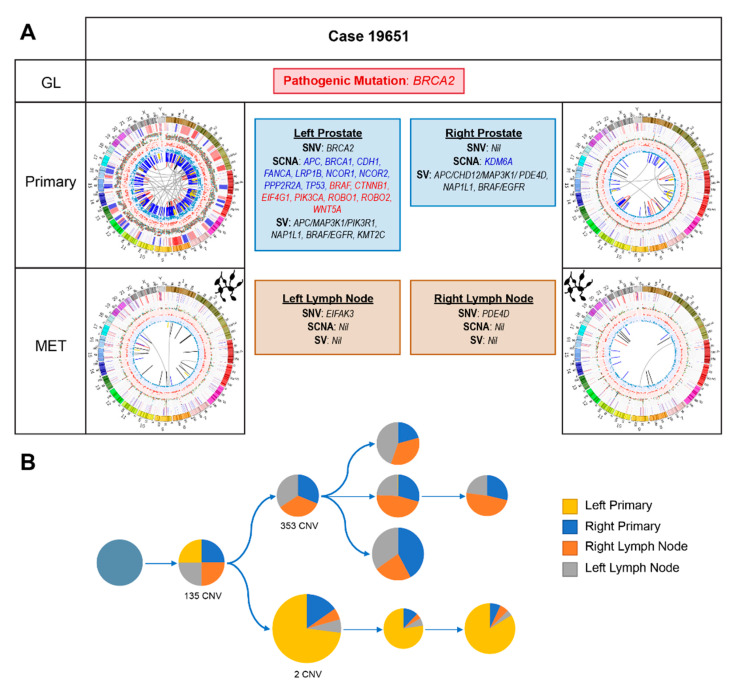
Most samples had acquired genomic alterations in multiple therapeutically relevant pathways, including DNA damage response (11/13 cases), PI3K (7/13), MAPK (10/13) and Wnt (9/13). Five patients had somatic copy number losses in genes that may indicate sensitivity to immunotherapy ( and one patient had germline and somatic alterations.
Most cases, whether primary or metastatic, harboured therapeutically relevant alterations, including those associated with PARP inhibitor sensitivity, immunotherapy sensitivity and resistance to androgen pathway targeting agents. The observed intra-patient heterogeneity and presence of genomic alterations in multiple growth pathways in individual cases suggests that a precision medicine model in prostate cancer needs to simultaneously incorporate multiple pathway-targeting agents. Our whole genome approach allowed for structural variant assessment in addition to the ability to rapidly reassess an individual's molecular landscape as knowledge of relevant biomarkers evolve. This retrospective oncological assessment highlights the genomic complexity of prostate cancer and the potential impact of assessing genomic data for an individual at any stage of the disease.
尽管通过评估转移性前列腺癌的基因组格局已获得了重要见解,但利用这些信息指导个性化治疗仍处于起步阶段。我们进行了一项回顾性试点研究,以评估精准医学对局部晚期和转移性前列腺腺癌的当前影响,并评估如何利用基因组数据实现个体化治疗。
对13例前列腺癌患者的16对肿瘤-血液样本进行了深度全基因组测序;对9例患者的子集进行了全基因组光学图谱分析,以进一步识别大的结构变异。肿瘤样本来自前列腺、淋巴结、骨骼和大脑。
大多数样本在多个与治疗相关的途径中获得了基因组改变,包括DNA损伤反应(11/13例)、PI3K(7/13)、MAPK(10/13)和Wnt(9/13)。5例患者在可能表明对免疫治疗敏感的基因中存在体细胞拷贝数缺失,1例患者存在种系和体细胞改变。
大多数病例,无论是原发性还是转移性,都存在与治疗相关的改变,包括那些与PARP抑制剂敏感性、免疫治疗敏感性以及对雄激素途径靶向药物耐药相关的改变。在个体病例中观察到的患者内异质性以及多个生长途径中基因组改变的存在表明,前列腺癌的精准医学模型需要同时纳入多种途径靶向药物。我们的全基因组方法除了能够随着相关生物标志物知识的发展快速重新评估个体的分子格局外,还允许进行结构变异评估。这项回顾性肿瘤学评估突出了前列腺癌的基因组复杂性以及在疾病的任何阶段评估个体基因组数据的潜在影响。