Department of Neurosurgery, Changzhou Second People's Hospital Affiliated to Nanjing Medical University, No.29, Xinglong Lane, Changzhou, 213004, Jiangsu, China.
BMC Neurol. 2022 Aug 31;22(1):326. doi: 10.1186/s12883-022-02847-3.
To determine the association between dynamic neutrophil-to-lymphocyte ratio (NLR) during hospitalization and mortality 1 month after ischemia reperfusion in patients undergoing endovascular treatment (EVT) with successful revascularization for acute large vessel occlusion stroke.
This retrospective study included patients who had undergone successful EVT. Information was collected regarding patients' clinical characteristics, imaging data, and mortality at 1 month. Univariate and multivariate logistic regression models were applied to assess the association between NLR and mortality. We used a generalized additive model and a generalized additive mixed model to compare trends in NLR over time between survivors and nonsurvivors.
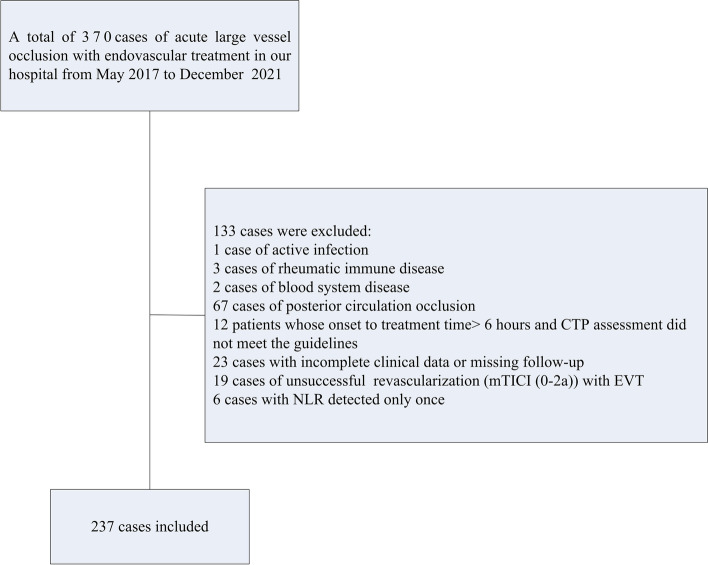
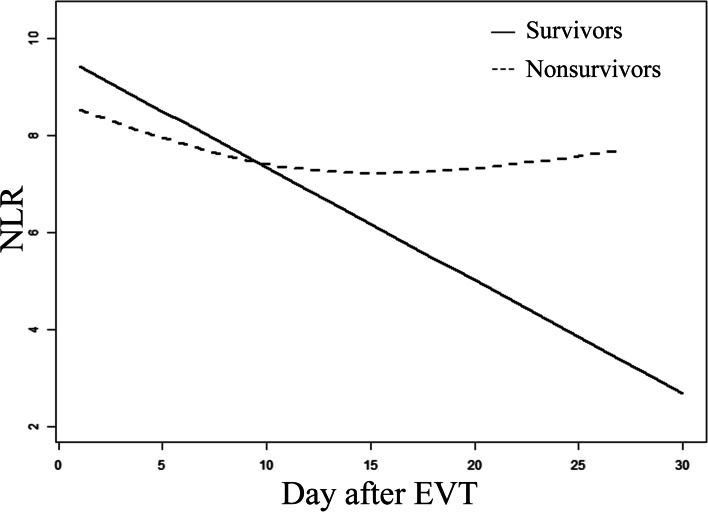
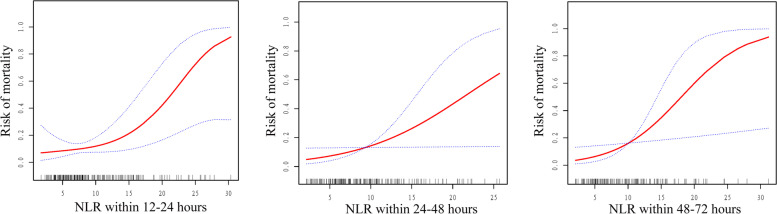
A total of 237 patients were included. During the 1-month follow-up, 42 of these patients (17.7%) died. The multivariate analysis demonstrated that NLR obtained within 12 to 24 hours (odds ratio [OR] = 1.18; 95% confidence interval [CI]: 1.04, 1.33; P = 0.008), 24 to 48 hours (OR = 1.16; 95% CI: 1.01, 1.35; P = 0.044), and 48 to 72 hours (OR = 1.23; 95% CI: 1.03, 1.47; P = 0.021) after EVT were independently associated with mortality at 1 month. In addition, there was a trend for NLR to decrease gradually over time for both survivors and nonsurvivors; however, NLR in survivors decreased by an average of 0.29 daily than in nonsurvivors.
Increased NLR in the early period after EVT was associated with an increased risk of mortality, and a continued trend toward higher NLR over time was also linked with a higher mortality risk.
为了确定接受血管内治疗(EVT)成功再通的急性大血管闭塞性卒中患者住院期间动态中性粒细胞与淋巴细胞比值(NLR)与缺血再灌注后 1 个月死亡率之间的关系。
本回顾性研究纳入了接受成功 EVT 的患者。收集了患者的临床特征、影像学数据和 1 个月时的死亡率。采用单变量和多变量逻辑回归模型评估 NLR 与死亡率之间的关系。我们使用广义加性模型和广义加性混合模型来比较幸存者和非幸存者之间 NLR 随时间的变化趋势。
共纳入 237 例患者,在 1 个月的随访期间,其中 42 例(17.7%)患者死亡。多变量分析表明,EVT 后 12 至 24 小时(优势比 [OR] = 1.18;95%置信区间 [CI]:1.04,1.33;P = 0.008)、24 至 48 小时(OR = 1.16;95% CI:1.01,1.35;P = 0.044)和 48 至 72 小时(OR = 1.23;95% CI:1.03,1.47;P = 0.021)的 NLR 与 1 个月时的死亡率独立相关。此外,无论是幸存者还是非幸存者,NLR 随时间逐渐下降的趋势均存在,但幸存者的 NLR 平均每天下降 0.29,而非幸存者的 NLR 则无明显变化。
EVT 后早期 NLR 升高与死亡率升高相关,且随着时间的推移 NLR 持续升高也与死亡率升高相关。