Department of Epidemiology, School of Public Health, Southern Medical University, Guangzhou, 510515, Guangdong, China.
Department of Neurosurgery, Nanfang Hospital, Southern Medical University, Guangzhou, 510515, Guangdong, China.
BMC Med. 2022 Sep 1;20(1):271. doi: 10.1186/s12916-022-02478-y.
To examine the association between regular use of proton pump inhibitors and the risk of incident dementia, including dementia subtypes, and whether the association differs between APOE genotypes.
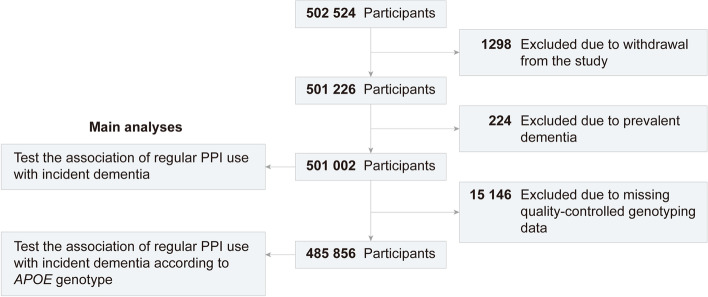
Based on a prospective analysis of data from the UK Biobank, 501,002 individuals (female, 54.4%) aged between 40 and 70 years, who had no prevalent dementia at baseline, were enrolled between 2006 and 2010 and followed up to 2018. We compared all-cause dementia, Alzheimer's disease (AD), and vascular dementia (VaD) incidence rates between proton pump inhibitor users and non-users by the Cox proportional hazard model.
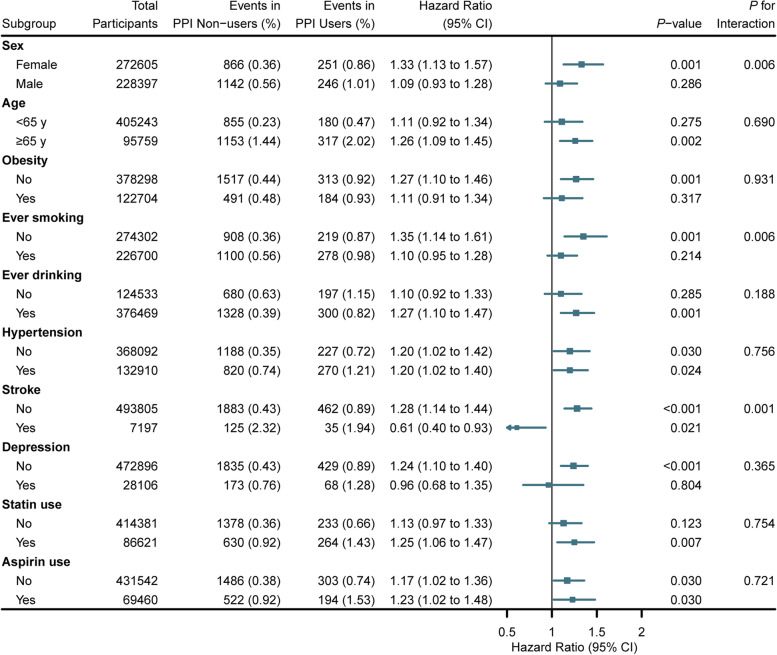
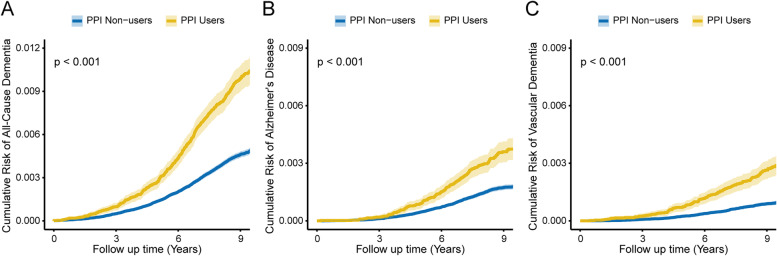
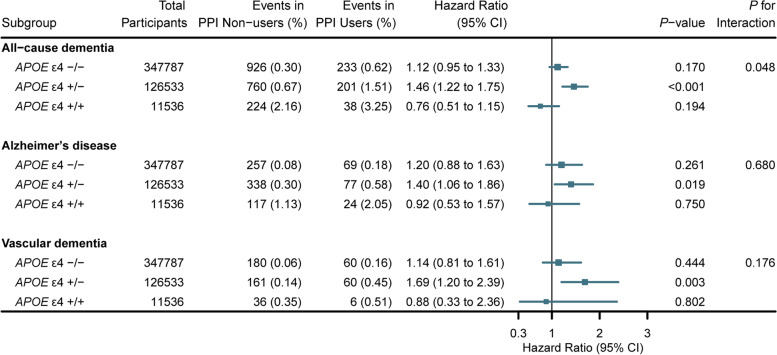
During 4,438,839 person-years of follow-up (median length of follow-up, 9.0 years), there were 2505 incident cases of all-cause dementia, including 932 cases of AD and 524 cases of VaD. The incident rate of all-cause dementia among proton pump inhibitor users was 1.06 events per 1000 person-years, compared with 0.51 events per 1000 person-years among non-users. After adjustment for multiple confounders and indications, the hazard ratios (HRs) of the proton pump inhibitor users were 1.20 (95% CI, 1.07-1.35) for incident all-cause dementia, 1.23 (95% CI, 1.02-1.49) for incident AD, and 1.32 (95% CI, 1.05-1.67) for incident VaD. In addition, the association between proton pump inhibitor use and all-cause dementia differed by APOE genotype (P for interaction = 0.048). Among APOE ε4 heterozygotes, the fully adjusted HR of proton pump inhibitor use was 1.46 (95% CI, 1.22-1.75) and 1.68 (95% CI, 1.36-2.07), especially for individuals aged 65 years and older.
The finding of this large population-based cohort study indicates that the use of proton pump inhibitors is associated with an increased risk of incident dementia, particularly among APOE ε4 heterozygotes.
本研究旨在探讨质子泵抑制剂(PPI)的常规使用与新发痴呆症(包括痴呆亚型)风险之间的关联,以及这种关联是否因 APOE 基因型而有所不同。
本研究基于对英国生物银行(UK Biobank)前瞻性数据分析,共纳入 501002 名年龄在 40 至 70 岁之间、基线时无痴呆症的个体(女性占 54.4%),这些个体于 2006 年至 2010 年间入组,并随访至 2018 年。我们采用 Cox 比例风险模型比较了 PPI 使用者和非使用者之间的全因痴呆、阿尔茨海默病(AD)和血管性痴呆(VaD)的发生率。
在 4438839 人年的随访期间(中位随访时间 9.0 年),共有 2505 例全因痴呆症病例,包括 932 例 AD 和 524 例 VaD。PPI 使用者的全因痴呆症发生率为 1.06 例/1000 人年,而非使用者的发生率为 0.51 例/1000 人年。在校正了多种混杂因素和适应证后,PPI 使用者的全因痴呆症的风险比(HR)为 1.20(95%CI,1.07-1.35),AD 的 HR 为 1.23(95%CI,1.02-1.49),VaD 的 HR 为 1.32(95%CI,1.05-1.67)。此外,质子泵抑制剂使用与全因痴呆症之间的关联因 APOE 基因型而异(交互作用 P 值=0.048)。在 APOE ε4 杂合子中,质子泵抑制剂使用的全调整 HR 为 1.46(95%CI,1.22-1.75)和 1.68(95%CI,1.36-2.07),尤其是在年龄为 65 岁及以上的个体中。
这项基于大型人群队列研究的结果表明,质子泵抑制剂的使用与新发痴呆症风险增加相关,尤其是在 APOE ε4 杂合子中。