National Clinical Research Center for Kidney Disease, State Key Laboratory of Organ Failure Research, Guangdong Provincial Institute of Nephrology, Guangdong Provincial Key Laboratory of Renal Failure Research, Division of Nephrology, Nanfang Hospital, Southern Medical University, Guangzhou, 510515, China.
Alzheimers Res Ther. 2023 Sep 9;15(1):152. doi: 10.1186/s13195-023-01295-6.
The relationship of glucosamine use with incident dementia in the older population remains uncertain. We aimed to evaluate the longitudinal association between habitual glucosamine supplement and the risk of cause-specific dementia and examine the possible effect modifiers on this association.
The study included 214,945 participants over the age of 60 who had available information on glucosamine use and did not have dementia at baseline in the UK Biobank. The APOE genotypes were determined by a combination variant of rs429358 and rs7412. The primary outcome was incident vascular dementia, incident Alzheimer's disease, and incident frontotemporal dementia, respectively.
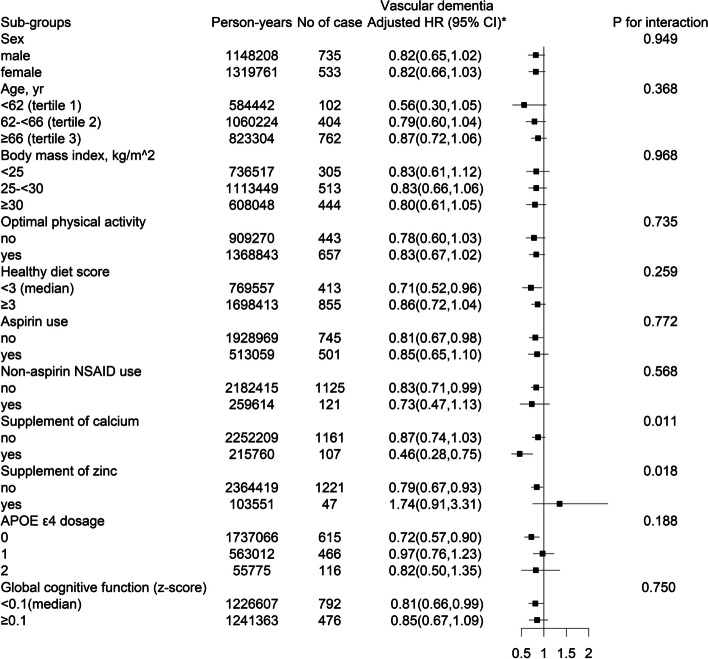
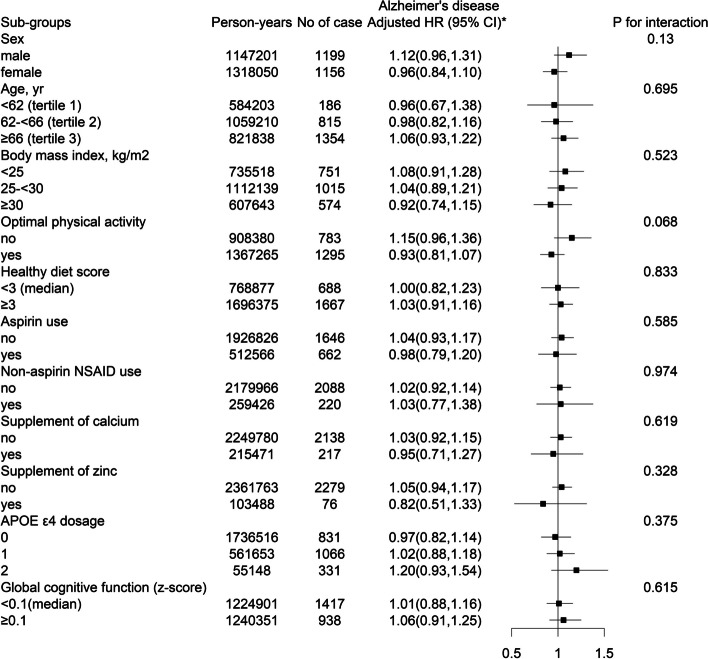
Over a median follow-up duration of 12 years, 1039, 1774, and 122 participants developed vascular dementia, Alzheimer's disease, and frontotemporal dementia, respectively. Overall, habitual glucosamine use was significantly associated with a lower risk of incident vascular dementia (adjusted HR, 0.82; 95%CI, 0.70-0.96), but not significantly associated with incident Alzheimer's disease (adjusted HR, 1.02; 95%CI, 0.92-1.14) and incident frontotemporal dementia (adjusted HR, 0.95; 95%CI, 0.63-1.43). Moreover, the inverse association between habitual glucosamine use and incident vascular dementia was more pronounced in participants with concomitant supplement of calcium (P-interaction = 0.011), and those without concomitant supplement of zinc (P-interaction = 0.018). However, APOE ε4 dosage and baseline cognitive function did not significantly modify the relationships of glucosamine use with incident vascular dementia or Alzheimer's disease (All P-interactions > 0.05).
Regardless of APOE genotypes and baseline cognitive function, habitual glucosamine use was significantly inversely associated with incident vascular dementia in the older population.
在老年人群中,使用氨基葡萄糖与痴呆症发病的关系尚不确定。本研究旨在评估习惯性氨基葡萄糖补充与特定病因痴呆症发病风险的纵向关联,并探讨该关联的可能修饰因素。
本研究纳入了英国生物银行 214945 名年龄在 60 岁以上、基线时无痴呆且有氨基葡萄糖使用信息的参与者。APOE 基因型由 rs429358 和 rs7412 的组合变体确定。主要结局是血管性痴呆、阿尔茨海默病和额颞叶痴呆的发病情况。
在中位随访 12 年期间,分别有 1039 例、1774 例和 122 例参与者发生血管性痴呆、阿尔茨海默病和额颞叶痴呆。总体而言,习惯性氨基葡萄糖使用与血管性痴呆发病风险降低显著相关(校正 HR,0.82;95%CI,0.70-0.96),但与阿尔茨海默病(校正 HR,1.02;95%CI,0.92-1.14)和额颞叶痴呆(校正 HR,0.95;95%CI,0.63-1.43)的发病风险无显著相关性。此外,在同时补充钙的参与者(交互 P 值=0.011)和未同时补充锌的参与者(交互 P 值=0.018)中,习惯性氨基葡萄糖使用与血管性痴呆发病风险之间的负相关更为明显。然而,APOE ε4 剂量和基线认知功能并未显著改变氨基葡萄糖使用与血管性痴呆或阿尔茨海默病发病风险的关系(所有交互 P 值均>0.05)。
无论 APOE 基因型和基线认知功能如何,习惯性氨基葡萄糖使用与老年人群中血管性痴呆的发病风险呈显著负相关。