Tarantino Paolo, Morganti Stefania, Curigliano Giuseppe
Division of New Drugs and Early Drug Development, European Institute of Oncology IRCCS, 20141 Milan, Italy.
Department of Oncology and Hematology, University of Milan, 20122 Milan, Italy.
Explor Target Antitumor Ther. 2021;2(2):139-155. doi: 10.37349/etat.2021.00037. Epub 2021 Apr 30.
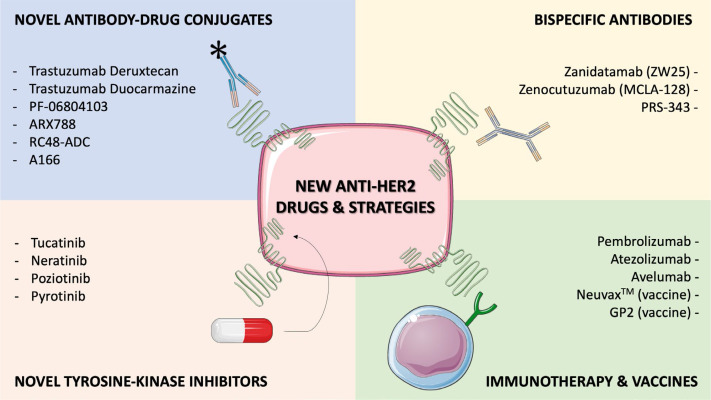
About 15-20% of all breast cancers (BCs) are defined human epidermal growth factor receptor 2 (HER2)-positive, based on the overexpression of HER2 protein and/or amplification of gene. Such alterations lead to a more aggressive behavior of the disease, but also predict response to treatments targeting HER2. Indeed, several anti-HER2 compounds have been developed and approved in the last two decades, significantly improving our ability to cure patients in the early setting, and greatly extending their survival in the advanced setting. However, recent evolutions in this field promise to improve outcomes even further, through advancements in established HER2-targeting strategies, as well as the exploration of novel strategies. In particular, the engineering of new antibody-drug conjugates, with higher drug-to-antibody ratios (DARs) and cleavable linkers, has already led to the development of a highly effective drug, namely trastuzumab deruxtecan, recently approved by the Food and Drug Administration (FDA) and European Medicines Agency (EMA) for the treatment of advanced HER2-positive (HER2) BC, and currently in study in the early setting. Moreover, the novel tyrosine kinase inhibitor tucatinib was recently approved by FDA and EMA, showing to improve survival of HER2 advanced BC patients, particularly in those with brain metastasis. Immunotherapy is also being investigated in the HER2 subtype, through immune-checkpoint inhibition, cancer vaccines and adoptive-cell therapies. Overall, the enlarging arsenal of promising anti-HER2 compounds is expected to deliver significant improvements in the prognosis of both early and advanced HER2 BC in the years to come. Moreover, some of such agents are showing encouraging activity in the much wider population of HER2-low advanced BC patients, challenging current BC classifications. If confirmed, this new paradigm would potentially expand the population deriving benefit from HER2-targeted treatments to up to 70% of all advanced BC patients, leading to a revolution in current treatment algorithms, and possibly to a redefinition of HER2 classification.
基于人表皮生长因子受体2(HER2)蛋白的过表达和/或基因扩增,所有乳腺癌(BC)中约15% - 20%被定义为HER2阳性。此类改变导致疾病具有更侵袭性的行为,但也预示着对靶向HER2治疗的反应。事实上,在过去二十年中已研发并批准了几种抗HER2化合物,显著提高了我们治愈早期患者的能力,并大大延长了晚期患者的生存期。然而,该领域的最新进展有望通过既定HER2靶向策略的进步以及新策略的探索进一步改善治疗结果。特别是,新型抗体 - 药物偶联物的设计,具有更高的药物与抗体比率(DARs)和可裂解连接子,已促成一种高效药物的开发,即曲妥珠单抗德卢替康,最近已获美国食品药品监督管理局(FDA)和欧洲药品管理局(EMA)批准用于治疗晚期HER2阳性(HER2)BC,目前正处于早期研究阶段。此外,新型酪氨酸激酶抑制剂图卡替尼最近获FDA和EMA批准,显示可改善HER2晚期BC患者的生存期,尤其是脑转移患者。免疫疗法也正在HER2亚型中进行研究,通过免疫检查点抑制、癌症疫苗和过继性细胞疗法。总体而言,有望用于抗HER2的化合物不断增加,预计在未来几年将显著改善早期和晚期HER2 BC的预后。此外,其中一些药物在HER2低表达晚期BC患者这一更为广泛的群体中显示出令人鼓舞的活性,对当前BC分类提出了挑战。如果得到证实,这一新模式可能会使受益于HER2靶向治疗的人群扩大至所有晚期BC患者的70%,引发当前治疗方案的变革,并可能重新定义HER2分类。