Department of Oncology and Hemato-Oncology (DIPO), University of Milan, Milan; Division of Early Drug Development for Innovative Therapies, European Institute of Oncology, IRCCS, Milan, Italy. Electronic address: https://twitter.com/GabrAnton.
Department of Oncology and Hemato-Oncology (DIPO), University of Milan, Milan; Division of Early Drug Development for Innovative Therapies, European Institute of Oncology, IRCCS, Milan, Italy. Electronic address: https://twitter.com/CCortiMD.
ESMO Open. 2023 Aug;8(4):101608. doi: 10.1016/j.esmoop.2023.101608. Epub 2023 Jul 17.
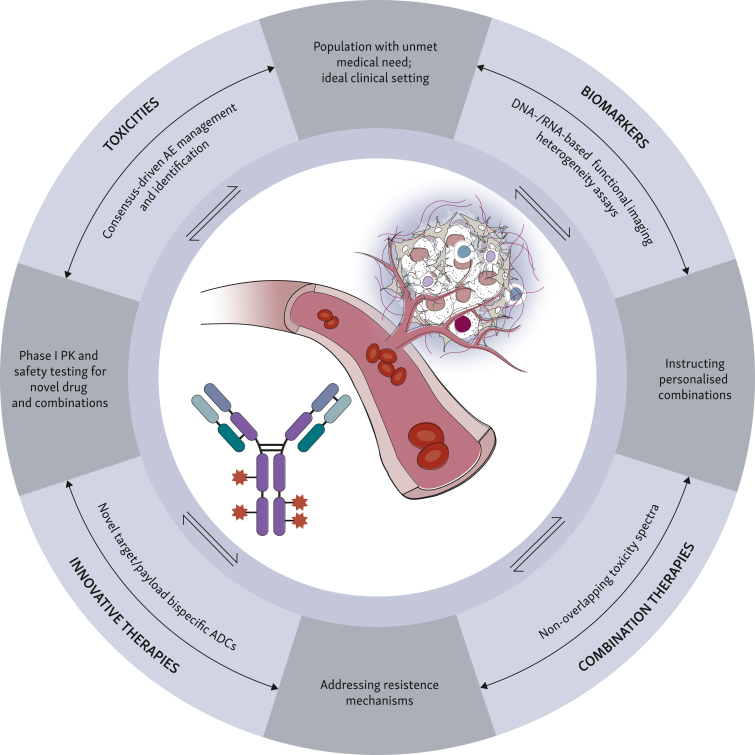
The current treatment of patients with human epidermal growth factor receptor 2 (HER2)-positive advanced breast cancer (ABC) has been greatly impacted in the past decade by the introduction of antibody-drug conjugates (ADCs), which represent a relatively novel therapeutic class with the peculiar ability to deliver otherwise overtly toxic chemotherapeutics to tumor sites by exploiting the specificities of monoclonal antibodies. Indeed, drug engineering refinements in ADC design, such as through the introduction of cleavable linkers and hydrophobic payloads, resulted in improved patient outcomes in recent years. Two different ADCs, namely trastuzumab emtansine (T-DM1) and trastuzumab deruxtecan (T-DXd), have already entered clinical practice for the treatment of HER2-positive ABC. In this scenario, T-DXd has shown to portend better survival outcomes compared to T-DM1, while leaving a large unsought area of unmet medical need upon T-DXd failure. Treatment decision and benefit of cancer drugs following T-DXd still represent an area of clinical controversy, where a preclinical investigation and clinical development should be prioritized. As the pace of innovation is currently accelerating, and with novel ADC formulations advancing in early-phase clinical trials, the whole BC field is changing at an unprecedented rate, with potential broadenings of therapeutic indications. In this review, we present the clinical landscape of HER2-positive advanced BC and discuss our vision on how to tackle T-DXd resistance, providing a perspective on the priority areas of the cancer research in this setting.
在过去的十年中,抗体药物偶联物 (ADC) 的引入极大地改变了人表皮生长因子受体 2 (HER2)-阳性晚期乳腺癌 (ABC) 患者的治疗方法,ADC 是一种相对较新的治疗类别,具有通过利用单克隆抗体的特异性将其他明显有毒的化疗药物递送到肿瘤部位的独特能力。事实上,ADC 设计中的药物工程改进,例如引入可切割的接头和疏水性有效载荷,近年来导致患者的结果得到了改善。两种不同的 ADC,即曲妥珠单抗-美坦新(T-DM1)和曲妥珠单抗-德曲妥珠单抗(T-DXd),已经进入临床实践,用于治疗 HER2-阳性 ABC。在此情况下,与 T-DM1 相比,T-DXd 显示出更好的生存结果,而在 T-DXd 失败后仍留下了大量未满足的医疗需求。在 T-DXd 之后的癌症药物治疗决策和获益仍然是一个临床争议领域,其中应优先进行临床前研究和临床开发。由于目前创新步伐正在加快,并且新型 ADC 制剂正在早期临床试验中推进,整个 BC 领域正在以前所未有的速度发生变化,治疗适应证可能会扩大。在这篇综述中,我们介绍了 HER2-阳性晚期 BC 的临床现状,并讨论了我们如何应对 T-DXd 耐药性的看法,为该领域的癌症研究提供了优先领域的视角。